
If you mainly slice ham
You want to cut soft, cooked ham into slices of an adjustable thickness, so check which blade comes with the model. For the AS 3915, Severin specifies a blade for slicing cold meats and an adjustable slice thickness.


For slicing cooked ham in a small kitchen, the blade is the key thing to consider: choose a model that comes with a blade suited to soft ham and lets you adjust the slice thickness. A foldable model can be handy if storage space is your priority. Also compare how much room the machine takes up in use and check exactly which parts are included with the model.
You want to cut soft, cooked ham into slices of an adjustable thickness, so check which blade comes with the model. For the AS 3915, Severin specifies a blade for slicing cold meats and an adjustable slice thickness.
You want to put the machine away after use, so compare a foldable model with the space a fixed model takes up on your worktop. Emerio describes the MS-125000.1 as foldable, while ritterwerk lists the width and depth of the E 16.
You want easy access to the parts when cleaning, so check for finger protection and safe shut-off. Emerio specifies removable blades and a food pusher with thumb protection; Severin's manual says to unplug the machine before cleaning.
First check whether the included blade is suitable for your ham, then make sure the machine fits on your worktop and in your storage space. An adjustable slice thickness will only do what you need if the blade is also right for the job.
| What to consider | What to check | Who is this important for? |
|---|---|---|
| A blade suited to ham | Check the exact model, the type of blade included and the slice thickness adjustment range. | If you mainly slice soft, cooked ham, you’ll want to know exactly which blade is included and whether you can adjust the slice thickness; around 31% of consumers say suitability for ham is their top priority. |
| Worktop and storage space | Measure the space available for use and storage, allowing room for the carriage and food pusher to move. | If you want to put the machine away after use, you’ll still need a stable, clear space while slicing; around 25% of consumers put space requirements at the top of their list. |
| Cleaning and safe use | Check which parts can be removed according to the manual and how to clean the machine with the power disconnected. | If you want easy access to the parts after slicing and to handle the moving blade safely, easy maintenance is important; around 25% of consumers list cleaning and safe use as their top priority. |
| Slicing ham and bread | Compare the included blades and, before buying, check whether a separate blade fits the exact model. | If you want to slice both ham and bread, check whether one model can do both jobs or whether you need different blades; around 19% of consumers put versatility and the blades required at the top of their list. |
According to ritterwerk, the standard Ritter E 16 has a serrated blade. If you want a separate smooth ham blade, check that its size, shape and fitting are compatible with the specific model.
Compare the items included and the full model number, not just the brand name.
A compatible ham blade may be an extra part to buy and store.
Even a foldable machine needs to stand securely during use, with enough room for the carriage to move.
Measure both the storage space and the clear worktop area, then compare them with the dimensions and controls of the model you’ve chosen.
The Dutch government states that there is no fixed statutory guarantee period in the Netherlands and that the seller must provide a solution if a product is faulty.
Before taking out extra cover, check what additional rights it actually gives you.
The AS 3915 is worth considering if cooked ham is your main priority. Severin specifies an included blade for slicing cold meats and a steplessly adjustable slice thickness of 0–15 mm.
The MS-125000.1 is a foldable option to compare if you want to put the machine away after use.
The E 16 is a fixed, metal model to consider if you can make room on your worktop and want to slice more than one type of food.
The SKS110 is a food slicer worth comparing if bread is just as important as ham.
These models are worth considering if you want to slice cooked ham to an adjustable thickness and need to make storage work in a small kitchen.
 No image available
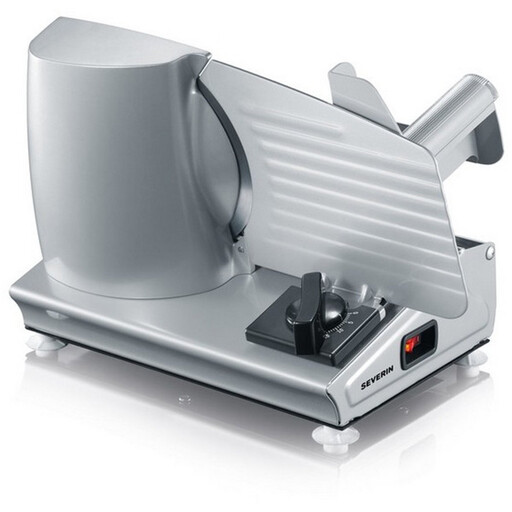
An option to compare if you mainly want to slice cooked ham to an adjustable thickness.
The product information lists a smooth blade, an adjustment range of 0–15 mm, finger protection and a tilting carriage.
 No image available
A foldable model to compare if you want to put the machine away after use.
The product name lists a Ø 17 cm serrated blade, an adjustment range of 0–15 mm and 100 W. The product information also mentions a removable carriage with a food holder. Check that the included blade is suitable for soft ham.
First check which blade comes with the exact model. ritterwerk describes a smooth ham and sausage blade as suitable for soft ham, but not for bread; Severin specifies an included blade for slicing cold meats with the AS 3915.
Follow the manual for the specific model and unplug the machine before cleaning. The Severin AS 3915 manual warns that the appliance must not be immersed in liquid; ritterwerk lists a removable carriage for the E 16.
Follow the label and use-by date for the specific ham. The Netherlands Nutrition Centre advises keeping opened cold meats in the coldest part of the fridge at 4 °C and generally using them within 3–5 days. Older people, pregnant women, very young children and people with weakened immune systems are advised not to keep opened cold meats for longer than 2–3 days. This is general advice for cold meats, not a fixed shelf life for every type of home-sliced ham.
CE marking is mandatory for electric slicers sold on the Dutch market as electrical consumer products, as the NVWA states. This does not mean that a specific product on offer has been assessed; check the marking on the product.
You don’t need an extended guarantee to have statutory rights to a product that works as it should. According to the Dutch government, there is no fixed statutory guarantee period in the Netherlands, and the seller must provide a solution if there is a problem. If you’re considering paid-for extra cover, compare the rights it actually adds.