
Desk user looking for localised warmth
You mainly sit in one spot and may not want to heat the whole lounge. Milieu Centraal describes an infrared panel as a way to heat a specific workspace.


Choose a convector heater if you want to warm the air around several seats and have a safe, clear place to position it. For warmth focused solely on your regular workspace, a directional infrared panel may be a better fit, as Milieu Centraal explains. When comparing convector heaters, look at the fan settings, thermostat and expected usage time: a higher stated wattage does not automatically mean higher actual energy consumption.
You mainly sit in one spot and may not want to heat the whole lounge. Milieu Centraal describes an infrared panel as a way to heat a specific workspace.
You may also want to warm the air around other seats, but you’ll need to consider walkways, paper, textiles and other people. The Dutch Fire Service offers advice on connecting electric heaters; the manual for your chosen model is still essential when deciding where to place it.
You’re looking for supplementary heating that won’t disturb you while you work or talk. Eurom, Tristar and De'Longhi models differ in features such as their fan design, so check the setting you actually intend to use.
When to choose it: if you want to warm more than one seat or the surrounding air, and have a safe place to position it.
The trade-off: a convector heater warms the air rather than just the person at the desk. That means heating an entire room electrically for long periods calls for a different approach from providing localised warmth.
When to choose it: if you’re the main person who needs warmth at one regular workspace for short periods.
The trade-off: the direct radiant heat is intended for the spot where you’re sitting; outside the panel’s range, you won’t feel that direct warmth. Milieu Centraal also points out that whether it’s suitable for heating a room for long periods depends on the insulation.
When to consider it: if the whole lounge is too cold for long periods or several people need warmth at the same time.
The trade-off: whether changes are possible depends on the room and the arrangements with the building manager. According to Milieu Centraal, a portable electric heater is generally not a sensible replacement for efficient whole-room heating.
| What matters when buying | What to look for | Who will value this? |
|---|---|---|
| Warmth where you need it | Decide whether you need to warm the air in the room or mainly the person at the desk. Only rely on a stated room coverage range under the model’s specified operating conditions. | If I’m mainly at my desk, I want warmth by my chair without heating the whole lounge. That’s why around 29% of consumers prioritise warmth at their own workspace. |
| Safe positioning | Read the manual for the exact model and check the clearance required around the air outlet and the heater. | With other people and belongings around, I want to position the heater securely and away from paper and textiles. Around 29% of consumers who prioritise safe use in a shared space feel the same way. |
| A quiet working environment | Check whether the model has a fan and whether it can be switched off in the setting you want to use. | I don’t want a fan to disturb me while I work or talk. Around 24% of consumers give top priority to quiet operation. |
| Energy use while operating | Note the wattage of the setting you’ve chosen and the number of hours the heating element is actually on; the thermostat can affect how long it runs. | If the heater is on for long periods, I want to be able to estimate its energy use based on wattage and usage time. Around 18% of consumers focus mainly on running costs. |
According to Milieu Centraal, a portable electric heater is generally not a sensible replacement for efficient whole-room heating. How long you use it and its actual wattage while operating both affect your energy consumption.
First, work out whether you want to heat one workspace or the whole lounge. Use the wattage and the time the element is on to estimate your energy use.
Tip-over or overheat protection doesn’t replace the instructions on where to position the heater. The manual for the Eurom Safe-T-Convect 2400 specifies a clearance of at least 1 metre between the air outlet and flammable materials.
Read the manual for the exact model before choosing a spot by your desk.
The Eurom Safe-T-Convect 2400 has a fan for its turbo setting. A statement about the normal setting doesn’t automatically tell you how noisy the fan setting is.
Check whether the fan on your chosen model can be switched off separately, and which setting you’ll use while working or talking.
These examples illustrate differences between product ranges and models; a brand mention doesn’t indicate whether a specific model is available.
Its range includes the freestanding Safe-T-Convect 2400 and the Alutherm 1000 Wifi, which Eurom says can be freestanding or wall-mounted.
The freestanding KA-5911 is a convector heater for occasional supplementary heating in a well-insulated room.
Its portable convector heaters include the Instant Led SG2000LED, with an electronic thermostat, and the Instant Max Mec CO2200MECMAX, with a mechanical thermostat.
The Dutch product range includes the HSX2320F convector heater, which has a fan system and room thermostat.
This Joybuy pick is a convector heater for warming the surrounding area. Check that the stated room coverage, available space for positioning and connection instructions suit your lounge.
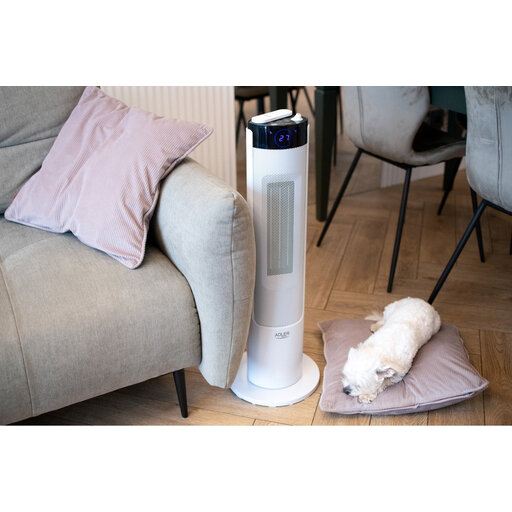 No image available
The product information says it can heat a room of up to 25 m²; check that this suits the space and conditions in which you plan to use the heater.
The stated heat settings are 1400 W and 2200 W. The product information also lists a thermostat, timer and 80° horizontal oscillation.
Keep at least 1 metre between the air outlet and flammable materials, and don’t cover the heater, as stated in the product information. When buying, also check that the heater carries the mandatory CE marking. The NVWA explains that CE marking is a declaration made by the manufacturer and, on its own, isn’t proof of independent testing.
Only if the manual for the exact model and the available space allow it. Keep air vents clear and don’t put paper or textiles against the heater. The manual for the Eurom Safe-T-Convect 2400 specifies a clearance of at least 1 metre between the air outlet and flammable materials; this isn’t a general clearance rule for all models.
The Dutch Fire Service advises plugging high-power appliances such as electric heaters directly into a wall socket wherever possible. Also check the connection instructions for your chosen model; a wound-up cable reel can overheat. This safety advice doesn’t, in itself, establish a general legal ban.
Multiply the selected output in kW by the number of hours the heating element is actually on to estimate energy use in kWh. If it heats continuously at 1500 W for one hour, it uses 1,5 kWh; a thermostat may switch the element off at intervals. To estimate the cost, multiply the kWh by your current electricity tariff.
Electrical consumer products placed on the market in the Netherlands must carry the CE marking. According to the NVWA, this is the manufacturer’s declaration that the product meets the relevant European requirements; it doesn’t mean that every appliance has been independently tested.
No. According to the Dutch Government, there’s no fixed statutory guarantee period in the Netherlands: you’re entitled to a product that works properly, and the retailer is your point of contact if there’s a problem. A manufacturer’s guarantee is additional.