
Home worker with a cold office
You want to warm the air in the room while you work and are looking for an appliance that suits the space and the length of time you’ll use it. Milieu Centraal describes convection heating as heating the air in a room.


A convector heater is a good choice if you want to warm the air in a small home office and can position or install the appliance safely in line with the instructions. If you usually sit in one place and mainly want to warm yourself for a short time, consider an infrared panel too: it provides targeted radiant heat, while a convector heater warms the air in the room.
You want to warm the air in the room while you work and are looking for an appliance that suits the space and the length of time you’ll use it. Milieu Centraal describes convection heating as heating the air in a room.
You want warmth without constant fan noise. So check the difference between natural convection and an activated turbo setting; Eurom and Tristar describe models where the turbo function uses a fan.
Check whether a freestanding model can be positioned safely, or whether a suitable wall-mounted model or targeted heating would make better use of the available space. Follow the installation and positioning instructions for the model you choose.
| What to consider | What should you look for? | Who is this important for? |
|---|---|---|
| Heating the room | Compare the stated power and room coverage of the exact model with the size of your room. If you only need to warm your seat, consider an infrared panel too. | If you mainly want to warm the air in your home office while you work, make sure the heater is a good fit for the space; around 33% of consumers put room air first. |
| Quiet operation while you work | Check whether the model has a fan and whether you can switch it off independently. Only compare noise ratings if it’s clear which operating mode they refer to. | If you need to concentrate or take calls, you’ll want to avoid fan noise; around 27% of consumers prioritise quiet operation over faster air circulation. |
| Running costs | To estimate costs, multiply the power in kW by the hours of use and your electricity tariff per kWh. This assumes the heater runs continuously at its rated power; thermostat cycles may change actual consumption. | If you mainly want extra heat during certain working hours, you’ll want to weigh electricity use against how long you use the heater; around 20% of consumers put running costs first. |
| Safe positioning | Read the clearance and installation instructions for the exact model. The fire service advises plugging electric heaters directly into a wall socket, not an extension lead or cable reel. | If there’s paper, curtains or cables near your desk, you’ll need to find a suitable spot first; around 20% of consumers make safe positioning their top priority. |
A convector heater warms the air in the room, while targeted supplementary heating serves a different purpose. Electric heating isn’t automatically the cheapest option for heating an entire room over a long period.
First decide which area needs to be warm and for how long. If you usually sit in one place, consider an infrared panel too and estimate the running costs using your own tariff.
The turbo settings described for Eurom and Tristar models use a fan to move the air. That’s different from natural convection without a fan.
Check whether you can switch off the turbo setting while you work or make calls, and which setting you’ll use instead.
A heater may be close to flammable items around a desk. The manual for the Eurom Safe-T-Convect 2400 specifies a minimum distance of 1 metre from combustible materials at the air outlet; this distance does not automatically apply to other models.
Measure the available space and follow the instructions for the exact model. Ideally, plug an electric heater directly into a suitable wall socket, as advised by the Netherlands Fire Service.
The range includes freestanding convector heaters and the Alutherm 1000 Wifi, which Eurom says can be used freestanding or wall-mounted.
The KA-5912 is a portable convector heater with rotary controls, designed for occasional supplementary heating.
Mill describes the portable CO1200WIFI3 as offering app control and recommends it for rooms smaller than 18 m².
According to De'Longhi, the HSX2320F is a portable convector heater with a room thermostat and fan system.
The Heateco CN 03 MIS F range includes freestanding convector heaters with mechanical thermostats and different power options.
This selection focuses on a freestanding convector heater for supplementary heating in a home office. Before buying, check that the model and its positioning instructions are suitable for your desk.
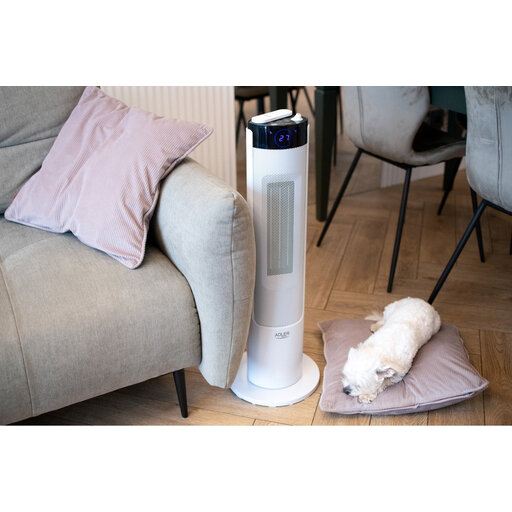 Image unavailable
The product name describes a convector heater for anyone looking to warm the air around their workspace. Check the product information for details of the controls, heat settings, safety features and clearance requirements for this exact model.
Also check the required CE marking and applicable safety requirements for the specific model. A product listing alone does not prove that all requirements have been met.
If you usually sit in one place, an infrared panel aimed at you is a useful alternative: it provides radiant heat where you’re sitting, while a convector heater warms the air in the room. Outside the area reached by the radiant heat, you won’t feel its direct warmth.
The Netherlands Fire Service advises plugging high-power appliances such as electric heaters directly into a wall socket rather than an extension lead or cable reel. Follow the electrical connection instructions for the model you choose too.
Follow the manual for the exact model. The manual for the Eurom Safe-T-Convect 2400 says to switch off the appliance, unplug it and let it cool completely before cleaning. Keep the air inlet and outlet clear, and don’t cover the appliance.
Estimate running costs using the power consumption, your expected hours of use and your own electricity tariff; thermostat cycles may affect actual consumption. According to ACM ConsuWijzer, online consumer purchases in the Netherlands generally come with a 14-day cooling-off period from delivery. You’re also entitled to a legal guarantee if the product doesn’t perform as you could reasonably expect under normal use; a manufacturer’s warranty does not replace these statutory rights.
Electrical consumer products that must carry the CE marking have to meet the applicable requirements in their specific form; the Netherlands Food and Consumer Product Safety Authority explains when this marking is mandatory. Household electric space heaters covered by Regulation (EU) 2024/1103 must also meet the applicable ecodesign requirements, including provisions that have applied since 1 July 2025. A CE marking or an older product page alone does not confirm that a particular model meets all current requirements.