First, choose an oven that will fit your cake tin, then check whether it will fit on your worktop with the recommended clearance around it. A compact model can save worktop space, while a larger one may accommodate more types of bakeware. Capacity in litres alone won’t tell you whether your tin will fit. Use the temperature and baking time in your recipe as a guide, and check that the cake is cooked through.
Who is this guide for?
Bakers with a small worktop
You want to bake a cake without the oven taking up all your available preparation space. Measure the oven’s external dimensions and allow for the clearance specified in the manual. Manufacturers’ dimensions and installation instructions can help you check whether it will fit.
Bakers with a favourite cake tin
You want to keep using your existing tin, especially if it’s a rectangular one. The usable interior space and shelf positions will tell you more than the stated capacity in litres. Good Food’s lemon drizzle recipe uses a tin measuring approximately 14 × 24 cm.
Bakers who cook a range of dishes
As well as space for a cake, you’re looking for settings and accessories for other dishes. Compare what a specific model offers with what you’ll actually use, and weigh that against the space the oven will take up.
What should you look for?
First measure your worktop and cake tin, then check for a convection function, and finally see which oven settings suit your recipe. The percentages below show how different buying priorities are weighted in this particular baking and space scenario.
| What to consider |
What should you check? |
Who will find this especially important? |
| Worktop space and positioning |
Measure the width, depth and height, then compare them with the external dimensions and positioning instructions for the exact model. |
If I have limited worktop space, I want to know how much room the oven needs, including clearance. Around 29% of consumers put safe positioning first. |
| Whether your cake tin will fit |
Measure the length, width and height of your tin, then compare them with the usable interior space and shelf positions. |
If I want to keep using my existing rectangular tin, I’d rather check the internal dimensions than rely on the capacity in litres alone. Around 29% of consumers mainly choose an oven based on whether their own tin will fit. |
| Control over the baking process |
Check whether the exact model has convection, which setting your recipe calls for, and how to check that the cake is cooked through. |
If I want to follow the recipe using the right oven setting, I look for convection and check that the cake is cooked through. Around 24% of consumers prioritise control over the baking process. |
| Other dishes and aftercare |
Check which accessories and settings are actually included, and distinguish any extra warranty from your statutory rights. |
If I want to use the oven for other dishes too, I compare the extra features with the space it needs. Around 18% of consumers prioritise versatility and aftercare. |
Good Food’s recipe calls for 180 °C in a conventional oven and 160 °C with a fan; these settings apply to that recipe. Rutger Bakt points out that ovens can bake differently. Check whether the cake is cooked through rather than relying on the timer alone.
Common buying mistakes
-
Choosing based on capacity in litres alone
The capacity in litres won’t tell you whether a rectangular cake tin will fit on the shelf. Rommelsbacher’s stated limit of 25 cm for the BG 1055/E applies to round tins and doesn’t confirm that a rectangular tin will fit.
Measure your tin and compare its dimensions with the usable interior space and shelf position of the exact model.
-
Assuming ‘mini oven’ means ‘convection oven’
Not every mini oven has convection. According to Tristar, the OV-3620SU doesn’t have a convection function, so it isn’t the same as the OV-3627.
Check for a convection setting against the full model number, not just the product category or title.
-
Squeezing the oven into the exact space you’ve measured
The external dimensions don’t tell you how much space you’ll need for positioning: heat needs to escape, and the required clearance varies by model.
Before buying, read the positioning instructions in the manual for the exact model, then measure again.
-
Confusing an extra warranty with your statutory rights
In the Netherlands, the seller remains responsible for putting things right if a product is faulty. A manufacturer’s warranty is an extra and doesn’t replace that responsibility.
Before paying for extra cover, compare it with the rights you already have. The Dutch government explains that there is no fixed statutory warranty period.
Brands to compare
Rommelsbacher
The BG 1055/E is a compact mini oven with circulating-air settings, according to the manufacturer.
- Rommelsbacher lists a capacity of 18 litres, external dimensions of 44 × 33,5 × 28,5 cm and compatibility with round tins up to 25 cm in diameter.
- The measurement for round tins doesn’t confirm that a rectangular cake tin will fit. These are model specifications, not the results of an independent baking test.
Princess
According to Princess, the 112741 is a 20-litre convection oven for anyone considering a compact option that’s a little larger.
- Princess lists a baking tray, grill rack, handle and crumb tray.
- Check the usable interior space: capacity alone won’t tell you whether your baking tin will fit.
Tristar
According to Tristar, the OV-3627 is a 27-litre convection oven.
- Tristar lists six heating settings, a baking tray and a grill rack for the OV-3627.
- Check the full model number: according to Tristar, the OV-3620SU doesn’t have a convection function.
Inventum
According to Inventum, the OV307B is a 30-litre convection oven with top and bottom heat.
- Inventum lists six programmes and includes a baking tray, rack, crumb tray and rotisserie spit.
- A larger capacity doesn’t remove the need to measure your available worktop space and cake tin.
Severin
According to Severin, the TO 2068 is a convection oven with a capacity of approximately 20 litres.
- Severin lists fan-assisted cooking, an interior light and external dimensions of 29,5 × 44 × 39 cm (height × width × depth).
- Compare the dimensions with your worktop and check that your cake tin fits at a suitable shelf height.
Ovens at Joybuy
This selection includes mini and freestanding ovens for different baking and cooking needs. For each exact model, check that its convection function, space for your cake tin and positioning requirements suit your needs.
 No image available
Wiggo WMO-E456(W) mini oven
An option if you’d like to use other oven functions as well as baking cakes. Check the external dimensions and positioning requirements to make sure it will fit on your limited worktop space.
The product name lists 2000 W, 45 L and white.
View at Joybuy
 No image available
Rommelsbacher BGS 1400 mini oven
A compact model to consider. Check the interior space for your cake tin and the recommended clearance around the oven.
View at Joybuy
 No image available
Rommelsbacher BG 950 mini oven
A small oven to consider if you have limited worktop space. Before choosing it for this recipe, check whether this exact model has a convection function.
View at Joybuy
 No image available
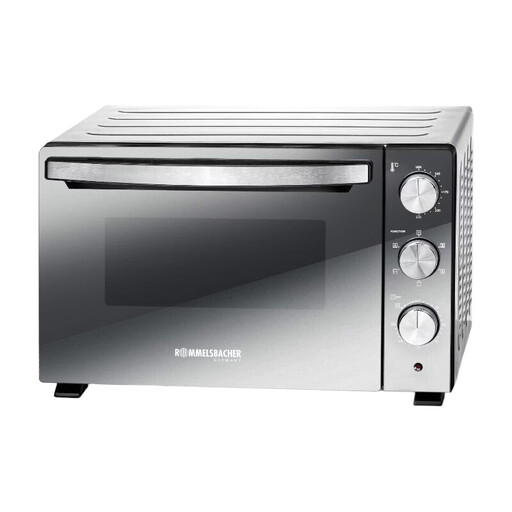
Rommelsbacher BGS 1500 baking and grilling oven
A larger option to consider if you’d like to use the oven for other dishes too. First, measure to make sure it will fit on your worktop.
Stated external dimensions: 50,5 × 40,3 × 33 cm. Also allow for the clearance specified in the manual.
View at Joybuy
 No image available
Wiggo WMO-E4562H(B) mini oven with hob
An option if you’d like a hob on the appliance as well as an oven. Measure the required worktop space carefully.
The product name lists 45 litres and 3534 W.
View at Joybuy
Frequently asked questions
Can I use the temperature from a recipe for top and bottom heat when using a fan oven?
Not without checking which oven setting the recipe calls for. Good Food’s lemon drizzle recipe specifies 180 °C for a conventional oven and 160 °C with a fan. Rutger Bakt points out that ovens can bake differently, so check whether the cake is cooked through rather than relying on the baking time alone.
Where should I put the cake tin in the oven?
Place a suitable tin on the rack and choose a shelf position that puts the cake roughly in the middle of the oven, with room to rise. Follow the model’s manual and use oven gloves when handling hot parts.
Can I put the oven underneath a kitchen cupboard?
Follow the positioning instructions for the exact model to allow the required clearance. Don’t rely on the external dimensions alone: heat from electrical appliances needs to escape.
Who can help if the oven doesn’t work properly during normal use?
In the Netherlands, the seller must provide a solution if a product is faulty. The Dutch government states that there is no fixed statutory warranty period; any manufacturer’s warranty is in addition to this.
Where can I take my old oven?
In the Netherlands, when you buy a similar new appliance for personal use, the old-for-new scheme applies: the seller must take back the old appliance free of charge. The Dutch government also explains the options for online purchases.


