
Timeline mixer
You want to keep an eye on several tracks and control windows while editing. Your screen layout and the horizontal workspace available are key considerations.


For community radio mixing, choose a 34-inch ultrawide if you want to see a long timeline and several windows side by side and have enough desk space. A 27-inch screen takes up less room, while two screens let you keep windows separate. Adobe describes this layout for Audition, but a larger or extra screen won’t make large audio files open more quickly. Also check that the video connection, any USB-C power delivery and the adjustment options suit your computer and workspace.
You want to keep an eye on several tracks and control windows while editing. Your screen layout and the horizontal workspace available are key considerations.
You connect a laptop and peripherals, and want to check in advance that the display, USB hub and any power delivery will work through your chosen connection.
You’re looking for readable controls and an adjustable setup, without a wide screen taking up too much of your available space.
A good fit if: you want to see a long editing timeline alongside other windows and have enough desk space.
The trade-off: a wide screen takes up more horizontal space than a 27-inch screen and won’t make audio files load faster.
A good fit if: a smaller workspace matters more to you than having the widest possible timeline. The ASUS PA278CV is an example of a 27-inch screen with a resolution of 2560 × 1440 pixels.
The trade-off: you’ll have fewer horizontal pixels than with the ultrawides mentioned above; the ASUS model cited is from a US product page.
A good fit if: for example, you want the main Audition interface on one screen and floating windows on the other. Adobe describes this layout.
The trade-off: your computer must be able to run two screens, and you’ll need room for both.
The key question is whether you mainly need more timeline space, a suitable connection, a more compact workspace or help with slow-loading files.
| What to consider | What should you look for? | Who should consider this? |
|---|---|---|
| Viewing the timeline and mixer | Compare the resolution and aspect ratio, consider your own software layout and measure the available desk width. | If I want to see the tracks and mixer at the same time while mixing, space for the timeline and windows is my priority. Around 36% of consumers prioritise seeing the timeline clearly. |
| Connecting a laptop and peripherals | Check the video output, cable and supported resolution. If you want to use a single cable, also check that USB-C video and the required charging power are supported. | If I want to use my laptop and peripherals through the screen, I first check that the display and power connections are compatible. Around 29% of consumers give connectivity top priority. |
| Desk space and readability | Measure the screen and stand against the space available; check the height adjustment, reflections and readability from your usual viewing position. | With limited desk space, I want to position the screen comfortably and read text clearly without losing too much workspace. Around 21% of consumers prioritise workspace and readability. |
| Large source files | Work out whether you have too little visible workspace or whether files are slow to open or process. For the latter, check your computer, storage and audio settings separately. | If large audio files take a long time to open, I want to know whether a new monitor will solve the problem before I choose one. Around 14% of consumers prioritise handling large files. |
A monitor changes the workspace you can see, but it won’t automatically make audio files open or process more quickly.
First, work out whether you can’t see enough windows or whether files are slow to open. If it’s the latter, look into your computer, storage and audio settings separately.
Video and power features vary between monitors and computers. The presence of USB-C alone doesn’t guarantee compatibility.
Compare the specifications of both devices and check that the connection you choose supports the resolution you want and any required power delivery.
A wide workspace is only useful if the screen fits on your desk and can be positioned for comfortable viewing.
Measure the screen and stand, and check the height adjustment and reflections before choosing a wide or more compact model.
According to the Dutch government, the Netherlands has no fixed statutory warranty period. If a product is faulty, your point of contact is the seller.
Check exactly what an additional manufacturer’s warranty covers; it applies alongside your statutory rights.
LG describes the 34U650A-B as a 34-inch 21:9 IPS screen with a resolution of 3440 × 1440 pixels.
Dell describes the U3425WE as a 34.1-inch screen with a resolution of 3440 × 1440 pixels and Thunderbolt hub features.
Philips describes the 34B2U3600C/00 as a 34-inch screen with a resolution of 3440 × 1440 pixels.
According to the ASUS specifications cited, the PA278CV has a 27-inch screen with a resolution of 2560 × 1440 pixels.
These Joybuy picks range from 27-inch screens to ultrawide monitors for working with timelines and windows. Check that each model’s connections and dimensions suit your computer and desk.
 No image available
An option for a more compact screen setup; check that the resolution suits your computer and preferred software layout.
Specifications: 3840 × 2160 pixels, 60 Hz, 4 ms, HDMI and DisplayPort; height-adjustable stand.
 No image available
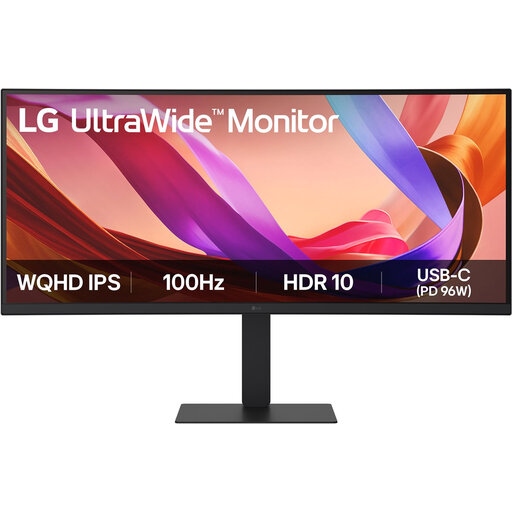
An ultrawide option if you want to view a long timeline and other windows side by side; make sure you have enough desk width.
LG describes this model as a 34-inch 21:9 IPS screen with a resolution of 3440 × 1440 pixels, and lists a 100 Hz refresh rate and USB-C.
 No image available
A 49-inch curved screen for anyone considering an especially wide workspace; measure the space available first.
The product name lists a 32:9 aspect ratio, VA panel and 1500R curvature. The description says your desk or VESA mount must support at least 15 kg and recommends two-person installation.
 No image available
A large ultrawide option for working with timelines and several windows; check that your computer supports the connection and resolution you plan to use.
The product name lists a 40-inch IPS screen, 5120 × 2160 pixels, 100 Hz and USB-C with 65 W power delivery.
 No image available
A wide screen for anyone looking for plenty of workspace on a single monitor; check that it will fit on your desk before you buy.
The product name lists a resolution of 5120 × 1440 pixels and an LCD screen.
No. A wider screen gives you more visible workspace, but won’t make audio files open faster. Adobe describes settings for peak files in Audition; if files are slow, also check your computer and storage.
Yes. Adobe describes an Audition layout with the application on one screen and floating windows on the other. Check that your computer supports two screens and has the connections you need.
Make sure text and controls are easy to read, avoid reflections and adjust your workspace to suit you. Arboportaal also recommends varying your activities and taking microbreaks; these are usage tips, not claims about product performance.
According to the European Commission, computer monitors are covered by energy labelling for electronic displays, with a scale from A to G. The Dutch government states that the Netherlands has no fixed statutory warranty period; if a product is faulty, your point of contact is the seller. A manufacturer’s warranty is additional.
According to Arboportaal, employees who work at a screen for more than two hours a day are covered by requirements relating to the screen and the workspace setup, among other things. There are circumstances in which employers can depart from these requirements, provided health and safety remain protected; this does not automatically make them a purchase requirement for private volunteers.