
Vandaag of morgen in huis

Kwaliteit gegarandeerd

Welkomstaanbiedingen ontgrendelen: GRATIS bezorging | Tot 80% korting | Gratis 30 dagen JoyPlus-proefperiode
Download de app
A computer desk needs to do more than look good. It should fit the available space, remain stable and provide enough room for your equipment. Yet many buyers focus mainly on colour or price. As a result, a desk can turn out to be too small after assembly, wobble on an uneven floor or lack space for cables and accessories.
With this guide, you can compare the key features of a computer desk, from a compact desk for the bedroom to a large desk for a home office.
A desk that is 80 cm wide may seem practical, but the usable space becomes smaller once you add a monitor, keyboard, laptop stand and documents. So, as well as the width, check the depth. For basic use, a depth of 50 cm may be sufficient. If you work with multiple screens, a desk that is 70 to 80 cm deep is often a better choice.
Also measure the space around the desk. Allow for skirting boards, sockets, an office chair and enough room to open a drawer or cupboard.
A desk with drawers or storage is not automatically practical. Look at the layout: are the drawers on the side where you can open them? Do they restrict your legroom? An L-shaped desk can provide plenty of workspace, but it will only fit properly if the corner is wide and deep enough.
Terms such as ‘sturdy’ or ‘durable’ say little on their own. Check the materials used, the construction and the stated load capacity. A metal frame can provide additional support, but the assembly and the connection between the frame and desktop remain important. Adjustable feet are useful when your floor is not completely level, but they do not replace correct assembly.
The standard height of the models discussed is around 75 to 76 cm. This is a common desk height, but the right choice depends on your office chair and height. Your forearms should be roughly horizontal when typing. So check whether the chair can be adjusted high enough and whether there is sufficient legroom beneath the desktop.
A home-office desk needs at least enough space for your computer, monitor and accessories. A large desk measuring 160 x 80 cm offers more room for a monitor, printer and writing work. For a student room or bedroom desk, 80 x 50 cm may be more convenient.
The product information for several models specifies a combination of chipboard and steel. The LANTINE corner desk is also described as using E1 chipboard. E1 refers to a formaldehyde emission class for wood-based panel materials; always check the latest product specifications and the information supplied with the product before buying.
Pay attention to the difference between static load capacity and everyday use. A model with a stated static capacity of 50 kg is suitable for the specified load when correctly assembled and loaded evenly. The LANTINE desk measuring 160 x 80 cm states a capacity of 400 kg. This is a product specification provided by the seller and is not a reason to overload the desk or place weight unevenly.
Clear instructions, numbered parts and included tools can make assembly easier. After assembly, check all the screws and adjust the feet before placing any equipment on the desk. With a corner desk, it is especially important to check that both sides are properly supported.
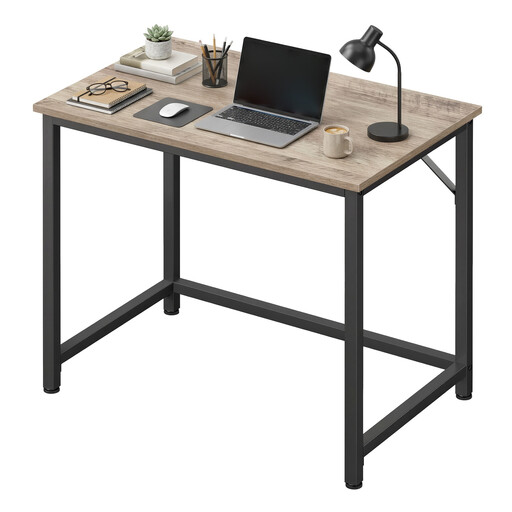
Why it suits this profile: Measuring 80 x 50 cm, it takes up relatively little space and is suitable for a bedroom, student room or compact workspace.
The fixed dimensions make it easy to measure the space in advance. The product information states that it has adjustable feet, allowing you to compensate for minor differences in the floor.
Chipboard with a steel frame, a stated static load capacity of 50 kg and assembly instructions with clearly marked parts.
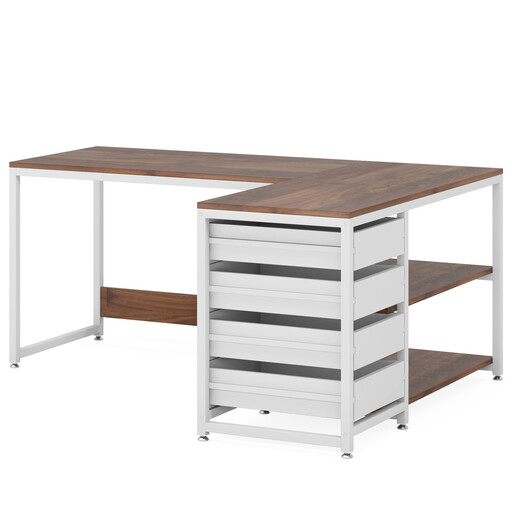
Why it suits this profile: This reversible L-shaped desk combines workspace with four drawers and two open shelves. It is well suited to people working from home who want to organise documents, accessories and equipment.
The reversible layout prevents the storage space from automatically being on the wrong side. Check in advance which L-shaped configuration you need.
Dimensions of 150 x 110 x 75 cm, four drawers, two shelves and adjustable feet according to the product description.
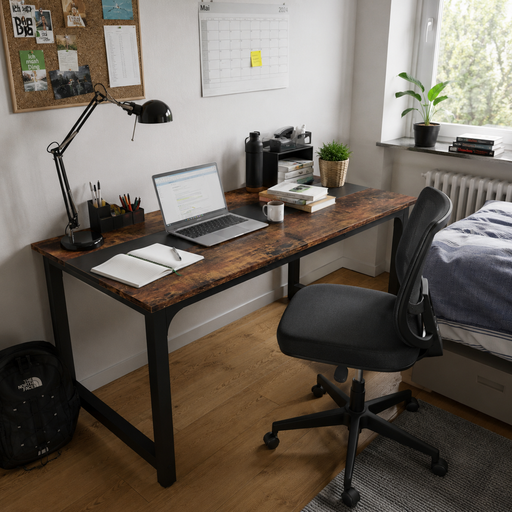
Why it suits this profile: The 160 x 80 cm desktop is designed for multiple devices, writing, studying or a spacious home-working set-up.
The extra depth and length reduce the risk of an overcrowded desktop. However, first check that the room can accommodate these dimensions while leaving enough space to move around.
Steel frame, additional steel supports, adjustable foot pads and stated dimensions of 160 x 80 x 75 cm.
We have put together a complete, up-to-date list of products that fully meet these strict selection criteria and the applicable European safety regulations.
For a laptop and basic accessories, 80 x 50 cm may be sufficient. If you use multiple screens or a printer, it is best to choose a deeper or longer desktop, such as 160 x 80 cm. Always measure the available space before ordering.
Place the desk on a level surface, tighten all the connections evenly and use adjustable feet to correct minor height differences. After a few days of use, check again that the screws are still tight.
Its lifespan depends on the material, load, moisture, assembly and everyday use. Keep within the stated load capacity, avoid prolonged point loading and protect the desktop from moisture. The seller’s product information and warranty terms provide further details for each model.
