
Vandaag of morgen in huis

Kwaliteit gegarandeerd

Welkomstaanbiedingen ontgrendelen: GRATIS bezorging | Tot 80% korting | Gratis 30 dagen JoyPlus-proefperiode
Download de app
Whether you're hitting the road in an RV, going camping for the weekend, or making long hauls as a truck driver, a reliable cooler is essential. But the search for the right compressor cooler can feel like navigating a maze of technical specifications and marketing promises. Many models look similar, but the differences in performance and user-friendliness are significant.
Before you invest, it's important to recognise a few common pitfalls that often lead to buyer's remorse.
To avoid these pitfalls, it's smart to focus on a few concrete, verifiable specifications. These will determine if a 12V electric cooler is truly right for your needs.
The most important choice is the technology. A compressor cooler works on the same principle as your home refrigerator. A compressor circulates a refrigerant, allowing the unit to cool actively and powerfully, regardless of the ambient temperature. This type can reach temperatures as low as -20°C, allowing you to use it as a portable fridge and freezer.
Thermoelectric models are often cheaper but can only cool to a certain number of degrees below the ambient temperature. On a hot summer day in Southern Europe, this means your drinks will be lukewarm at best. For serious cooling and freezing, a compressor is the only reliable option.
A good car refrigerator must be flexible. Look for models that run on both 12V/24V (via the cigarette lighter in your car, RV, or truck) and 230V (at home or at a campsite). A 12V/230V cooler gives you the freedom to use it anywhere.
Even more important is battery protection. A quality model will have an adjustable system with three levels (often labelled H, M, and L). This allows you to set the voltage at which the cooler automatically shuts off, preventing it from draining your vehicle's starter battery.
Think carefully about the capacity you need. For a solo trip, 20-25 litres is often sufficient. For a family or a longer journey, 40 litres or more is a more logical choice. Don't just look at the total capacity in litres, but also at the internal layout.
Some models, like an Alpicool cooler, offer two separate compartments (dual zone). This allows you to use one section as a refrigerator and the other as a freezer. It's ideal for keeping ice cream frozen while your drinks stay chilled. Convenient extras like a cooler with wheels or a retractable handle make moving a heavy, full unit much easier.
Based on these objective criteria, we have selected several models that suit different user profiles.

Why This Fits Their Persona: Its compact 22-litre size is perfect for the boot of a passenger car. Ideal for day trips, weekend getaways, or if you're travelling solo and don't need to cool huge supplies.
This model is equipped with 3-stage battery protection. This helps you avoid the dead battery trap, as the cooler shuts itself off before the voltage drops too low.
The dual power supply (12/24V DC & 100-240V AC) makes it versatile for use in the car and at the campsite. The compressor can cool down to -18°C.
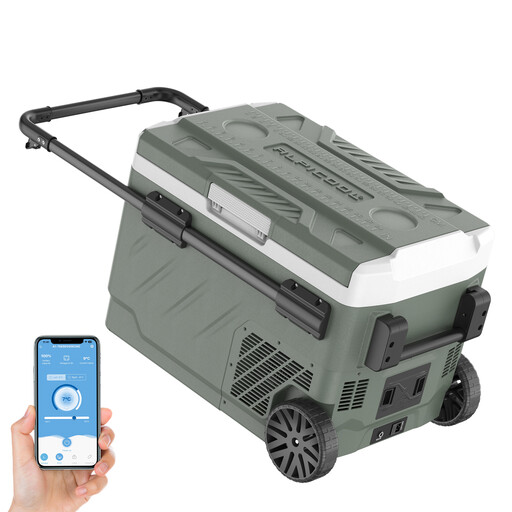
Why This Fits Their Persona: With 40 litres, dual-zone functionality, and app control, this is a fully-featured cooler for an RV or boat. The robust wheels and retractable handle make it easy to move around the campsite, despite its size.
The dual-zone layout tackles the pitfall of unusable space. You can use the compartments efficiently for cooling and freezing, which offers more flexibility than one large, awkward space.
Control via an app is a major plus; you can adjust the temperature without opening the cooler. The specified noise level of <45dB provides clarity on its sound output.

Why This Fits Their Persona: With nearly 50 litres of capacity, there's enough room for drinks, snacks, and meals for the whole family. The dual storage space helps to separate odours and keep everything organised during a long road trip.
The specified noise level of just 40 dB addresses the noise pitfall. According to the manufacturer, this is quiet enough not to be disruptive. The shockproof construction ensures it continues to operate stably, even on bumpy roads.
Its large capacity and dual-zone layout are the biggest advantages. Additionally, Bluetooth connectivity allows you to control the cooler remotely, which is convenient when it's in the back of the car.
We have compiled a complete, up-to-date list of products that fully meet these strict selection criteria and local regulations.
This depends heavily on the battery's capacity (in Ah), the set temperature, the ambient temperature, and the cooler's efficiency. An average camping fridge consumes between 45 and 60 Watts. Most models are equipped with a battery protection system that shuts off the cooler before your car's starter battery is depleted, ensuring you can always start your vehicle.
Modern compressor coolers are surprisingly quiet. Most manufacturers specify a noise level of around 40-45 decibels (dB). This is comparable to the sound of a modern home refrigerator or a quiet library. It is always advisable to check the specific dB rating if you plan to sleep in the same space as the cooler.
Yes, that is one of their major advantages. Most compressor models can reach temperatures of -18°C to -20°C, allowing them to function as a fully-fledged freezer. Models with a dual zone even offer the ability to use one compartment for freezing and the other for cooling, making them extremely versatile.
