
Vandaag of morgen in huis

Kwaliteit gegarandeerd

Welkomstaanbiedingen ontgrendelen: GRATIS bezorging | Tot 80% korting | Gratis 30 dagen JoyPlus-proefperiode
Download de app
A lukewarm drink on a hot day or food that doesn't survive the journey. For anyone who travels frequently, camps, or spends time on the water, these are familiar frustrations. A traditional cooler with ice packs often isn't enough. A compressor cooler is the solution. This type of electric cooler works just like your home refrigerator, delivering powerful, reliable cooling regardless of the outside temperature.
However, the market is vast. What capacity do you need? Should it be able to freeze? And what about power connections? As a Joybuy Product Recommendation Officer, I'll guide you through the specifications to help you find a model that perfectly suits your needs.
Before making a choice, it's wise to consider a few practical points. This will help you select a model that meets not only your current needs but also your future ones.
A cooler's capacity is expressed in liters. A compact model of around 20 liters is often sufficient for a weekend trip for two. Planning a longer journey or traveling with the whole family? Then a capacity of 40 liters or more is a logical choice. Don't just look at the number of liters, but also consider the internal layout. Some models are designed to hold bottles upright, while others offer more space for food items.
A good portable refrigerator offers flexibility. Most models are coolers that run on 230V and 12V. This means you can use it in your car, RV, or truck via the 12V/24V connection, and also at the campsite or at home with a standard wall outlet (230V).
Also, pay attention to battery protection. This feature prevents the cooler from draining your vehicle's battery. You can usually choose from three modes (low, medium, high), allowing you to find the right balance between cooling performance and battery preservation.
A major advantage of a compressor cooler is its ability to freeze. Many models can reach temperatures as low as -20°C. A cooler with a freezing function is ideal for bringing along ice or frozen goods.
Some advanced models feature a dual zone. This allows you to set two compartments to different temperatures independently. For example, you can use one section as a refrigerator for drinks and the other as a freezer for meat or ice cream.
Based on specifications and features, we've highlighted some popular choices for you.
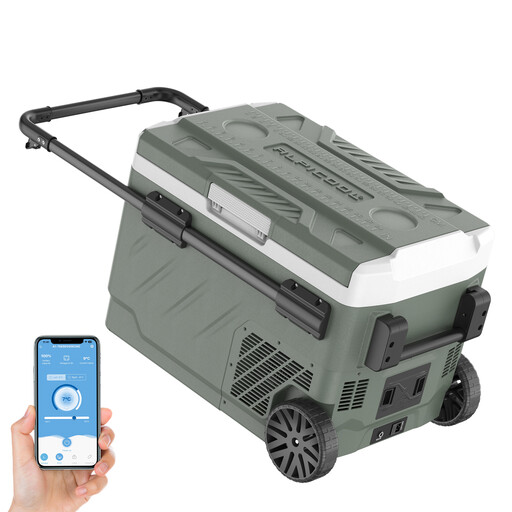
Why it stands out: The Alpicool 40L combines a generous capacity with modern features. Its dual zone with separate temperature controls offers outstanding flexibility. You can operate the cooler via the LED panel or with an app on your smartphone. The retractable handle and sturdy wheels make it easy to move, even when fully loaded.
Key features:
Who is it for? For families and campers looking for a versatile camping refrigerator with the flexibility of two temperature zones. Ideal for longer road trips where you need to both cool and freeze items.

Why it stands out: With a capacity of nearly 50 liters, the EUHOMY is a powerhouse for those who need to pack a lot. According to the manufacturer, its shock-resistant design ensures stable operation on bumpy roads or on a boat. The two storage compartments help to keep odors separate.
Key features:
Who is it for? This RV refrigerator is an excellent choice for RV and boat owners, truck drivers, or larger groups needing maximum storage space for long journeys.

Why it stands out: The BINGI 22L proves that powerful cooling performance doesn't have to take up much space. This compact model fits easily in a car trunk or a small camper van. Despite its size, it functions as a full-fledged refrigerator and freezer, with a temperature range down to -18°C.
Key features:
Who is it for? Perfect for solo travelers, couples, or as a secondary car cooler for day trips and weekend getaways. Its compact footprint makes it ideal for situations where space is limited.
These models are a great starting point, but there are more options available to suit specific needs. For a broader overview of coolers that you can connect to both 12V and a wall outlet, check out our 240V coolers category.
A compressor cooler uses a refrigeration system similar to a household refrigerator. It can cool and freeze powerfully, regardless of the ambient temperature. A thermoelectric cooler, on the other hand, cools to a certain number of degrees (e.g., 20°C) below the ambient temperature. So, if it's 30°C outside, it won't get colder than 10°C and cannot freeze.
Power consumption varies by model and settings but averages around 45-60 watts. A key advantage is that the compressor only runs when needed to maintain the set temperature. In ECO mode, consumption is even lower. Thanks to the battery protection feature, you don't have to worry about a dead car battery.
Yes, that's possible. To run a 12V cooler on solar power, you'll need a solar panel combined with a portable power station or a battery with a charge controller. You then connect the cooler itself to the 12V output of the power station or battery. The required solar panels and power stations are typically not included.
