
Vandaag of morgen in huis

Kwaliteit gegarandeerd

Welkomstaanbiedingen ontgrendelen: GRATIS bezorging | Tot 80% korting | Gratis 30 dagen JoyPlus-proefperiode
Download de app
A long drive on a hot day, and you're dreaming of an ice-cold drink. You reach into your cooler, only to find a lukewarm can. Sound familiar? A quality compressor cooler can be the difference between refreshment and disappointment. But the market is flooded with models that promise more than they deliver.
As a Product Recommendation Officer at Joybuy, I often see where things go wrong. Before you invest in a portable refrigerator, it's crucial to understand two common pitfalls that can cost you unnecessary money and frustration.
This guide will help you avoid these problems and recognise the right specifications, ensuring you choose a car refrigerator that truly works for your situation.
Marketing terms can be tempting, but the specifications tell the real story. Focus on these three points to find a model that gets the job done.
The technology determines the performance. A compressor cooler works just like your home refrigerator: a refrigerant is compressed to dissipate heat.
cooler with a freezer function.A thermoelectric cooler uses a Peltier element. This is simpler and cheaper, but its cooling performance is directly dependent on the ambient temperature. For serious use on the road, while camping, or in a truck, a compressor is the only reliable choice.
A good camping refrigerator is versatile. Look for models that run on both 12V/24V (via your vehicle's cigarette lighter socket) and 220V (at home or the campsite). This makes it a 12v and 220v cooler that you can use anywhere.
Even more important is the battery protection. A quality model will have an adjustable 3-level system (often labelled H/M/L - High/Medium/Low). This system monitors your car battery's voltage and automatically shuts off the cooler before the battery is too drained to start the engine. This is an indispensable feature for any car cooler.
The required capacity depends on your travel style. For a day trip, 10-20 litres is often sufficient. For a week of family camping, you'll quickly be looking at 40 litres or more.
Not everyone has the same needs. Here are some options tailored to specific user profiles.

Why This Fits Their Persona: Ideal for short trips, day outings, or as extra cooling space in the car. Its compact footprint makes it easy to place, yet it offers enough room for drinks and snacks for two people.
This is a full-fledged compressor cooler, not a weak thermoelectric version. It features 3-stage battery protection, so you don't have to worry about a dead battery.
True freezing capability down to -20°C in a compact package. Convenient app control and a magnetic lid for better insulation.

Why This Fits Their Persona: For camper and boat owners or families on long journeys. The large capacity and robust construction are perfect for those who depend on reliable cooling for meals and drinks.
The dual-zone functionality solves the compromise between cooling and freezing. The sturdy wheels and retractable handle address the practical annoyances of large, heavy coolers.
A very spacious 49-litre capacity with two independently controlled zones. Includes handy extras like a cutting board, cup holders, and internal LED lighting.
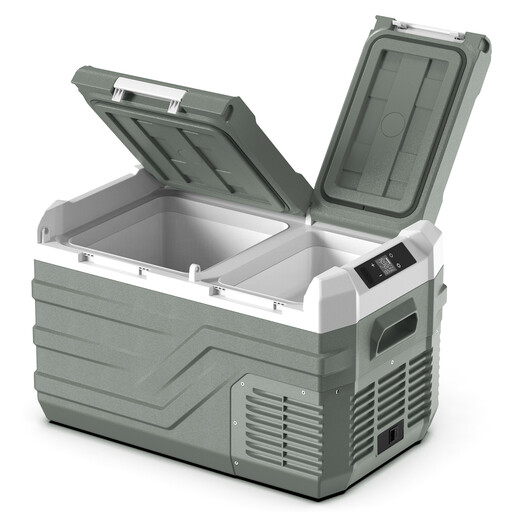
Why This Fits Their Persona: Designed for the tight space of a cabin. It offers the luxury of both a fridge and a freezer for long hauls, without taking up much room. Reliability is key here.
The 3-stage battery protection is crucial for professionals who rely on their vehicle. The dual-zone compressor delivers reliable performance, even when the cabin heats up in the sun.
Unique design with two lids that open in different directions for easy access. Offers dual-zone cooling and freezing in a relatively compact housing.
We have compiled a complete, up-to-date list of products that meet these strict selection criteria and current regulations.
This depends on the battery's capacity, the set temperature, the ambient temperature, and the cooler's insulation. However, a 12v refrigerator with good battery protection is designed to shut itself off before it drains your car's starter battery. In ECO mode and at a moderate outside temperature, a cooler can often run all night without issues.
The main difference is the cooling technology. A compressor cooler works like a real refrigerator and can freeze, regardless of how hot it is outside. A cheaper electric cooler (thermoelectric) can only cool to a certain number of degrees below the ambient temperature and cannot freeze. For reliable cooling, a compressor is superior.
Modern compressor coolers are surprisingly quiet. Most manufacturers specify a noise level of around 40-45 decibels (dB). This is comparable to the sound in a library or the soft hum of your home refrigerator. It is generally not disruptive, even if you are sleeping in the same space, such as in a camper or truck.
