
Writer with long typing sessions
You spend long periods writing drafts and revisions, and want to see which hand and wrist position feels comfortable. A keyboard is no substitute for taking breaks from screen-based work.


For long writing sessions at home, a compact keyboard is worth considering if you want to bring your mouse closer. A curved or split design may suit you better if you want to try a different hand position. The Occupational Safety and Health Administration (OSHA) advises placing your keyboard directly in front of you, with relaxed shoulders and your elbows close to your body. None of these designs is, by itself, a proven solution for existing symptoms.
You spend long periods writing drafts and revisions, and want to see which hand and wrist position feels comfortable. A keyboard is no substitute for taking breaks from screen-based work.
You often switch between typing and using the mouse while researching, and want to be able to position the mouse closer to the keyboard.
You write on different devices, such as a laptop and another computer, so you need to consider the keyboard layout, connection and connectivity.
A good fit if: you often reach for the mouse while writing and don’t need a dedicated numeric keypad. BakkerElkhuizen explains that a compact keyboard without a numeric keypad can free up space to position the mouse closer.
The trade-off: you won’t get the separate hand positions offered by a split model. Also check whether you need a numeric keypad.
A good fit if: you want to try a shaped hand position without placing two separate keyboard halves on your desk. Logitech describes the ERGO K860 as a curved, split keyboard.
The trade-off: its fixed shape offers less independent adjustment than two separate halves. Consider the keyboard layout and the space available for your mouse, too.
A good fit if: you want to adjust the distance and angle of your hands independently, and have enough desk space to do so.
The trade-off: check the exact keyboard layout and connection. Palm rests may be sold separately for some versions.
| What to consider | What should you look for? | Who should prioritise this? |
|---|---|---|
| Hand and wrist position | Try out the key positions and assess the height, wrist angle and mouse position at your own desk. | For long writing sessions, I want to find a hand position that suits my set-up. Around 40% of consumers prioritise hand and wrist position. |
| Mouse reach and desk space | Measure the space for both your keyboard and mouse, and work out how often you use a numeric keypad. | If I often switch between typing and using the mouse, I want to keep it within comfortable reach without giving up unnecessary desk space. Around 30% of consumers prioritise mouse reach and space. |
| Connection and layout | Check the exact version, keyboard layout, connection required and whether you’ll need an adapter. | When I write on multiple devices, I want to know whether the connection and keyboard layout suit my equipment and habits. Around 20% of consumers prioritise compatibility. |
| Break reminder | Check whether you want an indicator and whether the version you choose requires software to use it. | During long tasks, a visible reminder can help you remember to take breaks from work. Around 10% of consumers prioritise break reminders. |
A manufacturer’s claim about a design or its effectiveness does not prove that the keyboard prevents or relieves symptoms.
Choose a keyboard that suits you and your workspace, and take breaks from screen-based work. The 2018 Cochrane review of ergonomic interventions for office workers describes the evidence for preventing neck and upper-limb symptoms as unclear.
A fixed numeric keypad can take up space that you might otherwise use to bring your mouse closer.
Before you buy, lay out where the keyboard and mouse will go on your desk, and consider how often you enter numbers.
A different layout may need more desk space. If you later find you need a numeric keypad, you may have to buy one separately.
A product range may include different wired or wireless versions and keyboard layouts.
Before buying, check the full variant name, key legends and connection for the version on offer.
The models discussed have different shapes: the curved, split ERGO K860 and the compact, wave-shaped Wave Keys.
The S-board 840 and UltraBoard 950 Wireless are compact models to consider if you want to keep your mouse close to the keyboard.
Type Mini is a compact range with wired and wireless versions; according to the manufacturer, Type Midi adds a numeric keypad.
Compact Break combines a compact keyboard with a break indicator.
Freestyle2 is an option with two movable halves, for anyone who wants to set the distance between them.
This selection includes compact keyboards and wireless models for use with multiple devices. Above all, check that the keyboard layout and connection suit your computer and desk.
 Image unavailable
Worth considering if you switch between multiple devices while writing.
Rechargeable; connects via Bluetooth and dongle; switches between up to three connected devices.
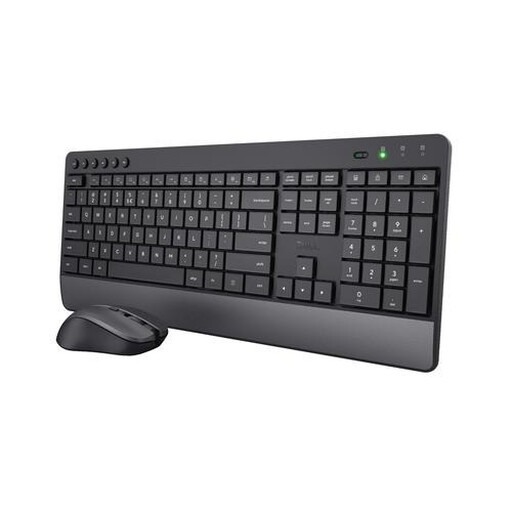 Image unavailable
Worth considering if you’re looking for a keyboard with a mouse and integrated palm rest for working from home.
The set includes a mouse; the keyboard has quiet keys, an integrated palm rest and a wireless USB receiver. The stated layout is US/QWERTY.
 Image unavailable
Worth considering if you want a numeric keypad and switch between devices.
Full-size keyboard with a numeric keypad and rechargeable battery with USB-C charging. The description states that it connects to up to four devices via USB receiver and Bluetooth. The stated layout is US/QWERTY.
 Image unavailable
Worth considering if you’re looking for a compact keyboard with a wired connection.
60% form factor with a detachable USB-C cable. The stated layout is US International QWERTY.
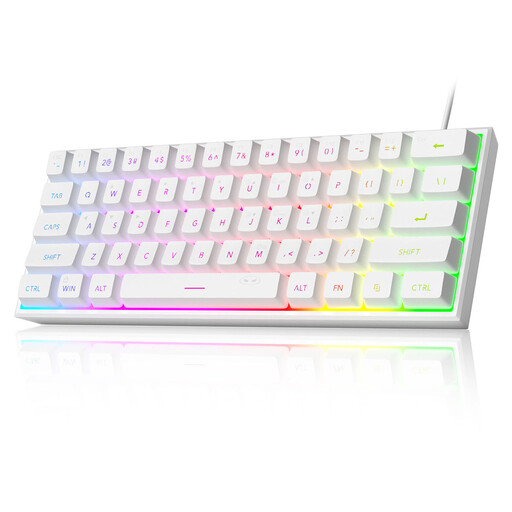 Image unavailable
Worth considering if you want a compact, wired keyboard without a numeric keypad.
60% layout with 61 keys and a USB connection. The stated layout is US QWERTY.
Place the keyboard directly in front of you and consider its height alongside the position of your mouse. OSHA advises keeping your shoulders relaxed, your elbows close to your body and your wrists in line with your forearms. This is workplace guidance, not a Dutch product requirement.
Don’t assume it will. The 2018 Cochrane review of ergonomic interventions for office workers describes the evidence for preventing neck and upper-limb symptoms as unclear; a design claim is no guarantee of recovery.
Check the connection and the exact version. The manufacturer states that the UltraBoard 950 Wireless has Bluetooth and can pair with up to five devices; these features do not automatically apply to other models or versions.
According to Arboportaal, employers also have a duty of care when employees work from home. If an employee works at a screen for more than 2 hours a day, the screen and keyboard must not be attached to each other; for laptop use, it must be possible to use a separate screen or keyboard. Screen-based work should be alternated at set intervals with other work or a break. These rules for employees do not necessarily apply to someone writing at home in a personal capacity.
For an ordinary online consumer purchase, you generally have a statutory cancellation period of up to 14 days after delivery, with some exceptions. You also have a statutory guarantee: if a product is faulty under normal use, the seller is responsible for providing an appropriate solution. According to ACM ConsuWijzer, keyboards in the Netherlands do not automatically come with a fixed two-year guarantee.