Who is this relevant to?

Writer with limited desk space

You want to keep room for your screen and mouse. Check the overall dimensions and whether the model has a separate number pad. For example, BakkerElkhuizen describes the UltraBoard 950 V2 as having an integrated numeric keypad.

Writer who wants to adjust their hand position

You want to adjust the position of each hand and can set aside desk space to do so. Note the difference between fixed keyboard shapes and individually positionable halves, as found on the R-Go Split Break and Kinesis Freestyle2.

Writer who wants to type confidently straight away

You prioritise a familiar layout and a suitable connection, even if that rules out a very different design. Check the exact key layout and connection of the model you want to buy.

What should you look for when choosing?

Compact and straight

Suited to: limited desk width and keeping your mouse close to your typing position.

Worth noting: without a separate number pad, you won’t have dedicated number keys; check the layout of the model you choose.

Fixed curved design with palm rest

Suited to: anyone who wants a wave-shaped keyboard and palm rest, but doesn’t want to position separate halves.

Worth noting: compact doesn’t automatically mean it will fit your desk; measure the exact model.

Two adjustable halves

Suited to: anyone who wants to choose the distance or angle between the keyboard halves and has room to do so.

Worth noting: spreading the halves apart takes up space and may take some getting used to; the cables and tilt accessories required vary by model.

Fixed split, full-size

Suited to: anyone who values a fixed split design and number pad more than the smallest possible setup.

Worth noting: the halves can’t be positioned separately; check whether there will still be room for your mouse beside the keyboard.

Consideration What to check before buying Who should pay particular attention?
Room for a keyboard and mouse Compare the width and depth of the whole setup with the clear space on your desk. Also check whether there’s a separate number pad. If I want to keep my mouse close while writing, I need to know how much space the complete setup will take up. Around 36% of consumers put this first.
Position of my hands Decide whether a fixed shape will do or whether you want to move the halves; check whether any tilt requires accessories. If I want to choose the distance and angle between my hands, I’ll also need enough room to position the halves. Around 29% of consumers prioritise this adjustability.
Familiar key layout Check the layout and punctuation key positions on the exact model, not just the product range. If I want to type through long writing sessions without having to adjust, a suitable layout matters more to me than separate halves. Around 21% of consumers prioritise familiar typing.
Connection to my device Check the available USB ports, wireless connection and compatibility of the exact model with your device. If I want to connect the keyboard to my writing device without finding that the port or connection is unsuitable, I’ll check this in advance. Around 14% of consumers make connectivity their main consideration.

Common buying pitfalls

  • Assuming ‘compact’ means it will definitely fit

    A palm rest, mouse and spread-out keyboard halves can take up more room together than the keys alone.

    Measure the available width and depth. If needed, mark out the full setup, including your mouse, on the desk.

  • Mistaking an ergonomic design for a proven treatment

    A Cochrane review of office workers describes the evidence for the preventive effects of many ergonomic interventions as uncertain. A particular design doesn’t prove that it will have a health benefit for you.

    Choose a model that suits your needs and how you’ll use it, vary your activities and seek an appropriate assessment if symptoms persist.

  • Confusing models and accessories

    Key layout, connection and included accessories can vary between models. For example, with the Kinesis Freestyle2, the available tilt depends on the accessories.

    Before buying, check the full model name, layout, box contents and connection required.

    An accessory needed for the tilt you want may have to be bought separately.

Brands to consider

BakkerElkhuizen

The UltraBoard 950 V2 is a compact wired model; the separate UltraBoard 950 Wireless is a wireless option.

  • According to BakkerElkhuizen, the V2 has USB-C, a USB-A adapter and an integrated numeric keypad instead of a separate number pad.
  • Don’t confuse the wired V2 with the Wireless model. Also check the connection and key layout of the version you choose. The manufacturer’s claims about posture don’t guarantee fewer aches and pains.

R-Go Tools

The Split Break is designed for anyone who wants to position the keyboard halves separately, while still being able to join them when needed.

  • R-Go Tools describes a magnet that joins the halves and a break indicator that works with R-Go Break software.
  • The wired US-QWERTY model described isn’t necessarily the same as wireless or differently laid-out versions. Medical claims on the sales page aren’t a proven outcome for every user.

Logitech

Wave Keys has a fixed wave shape and palm rest; the ERGO K860 is a fixed split, full-size keyboard with a number pad.

  • Logitech lists Bluetooth and Logi Bolt for Wave Keys, and adjustable palm lift for the ERGO K860.
  • The ERGO K860 doesn’t have separately positionable halves. Compare the overall dimensions and layout of the exact model; manufacturer claims about posture don’t prove a health benefit for you.

Kinesis

The Freestyle2 is designed for users who want to spread the two halves apart and, optionally, tilt them.

  • Kinesis lists connection cables of 9″ or 20″; how far apart the halves can be positioned depends on the cable you choose. According to Kinesis, tilt accessories offer angles of 5, 10 and 15 degrees.
  • Connection, cable and European key layout vary by model; check that the tilt and layout you want are available with the version you choose.

Joybuy products

These product picks are suited to compact typing at a small workstation. Check that the layout and connection of each model are right for your writing device.

AULA WIN60HE 60% wired gaming keyboard

AULA WIN60HE 60% wired gaming keyboard

According to the product description, the 60% layout is designed to free up desk space.

The product name mentions Hall effect switches and a compact wired design.

Check that the layout and controls suit the way you write.

Joybuy

Razer Huntsman Mini with Purple Switch, US QWERTY layout

Razer Huntsman Mini (Purple Switch), US QWERTY

The compact 60% layout is designed for setups where space is limited.

The product name mentions Purple Switch and a US QWERTY layout.

Check that the US layout suits your typing habits.

Joybuy
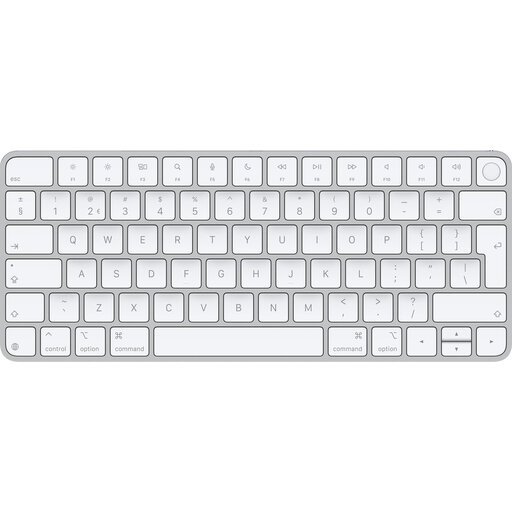
Apple Magic Keyboard with Touch ID, Dutch model

Apple Magic Keyboard with Touch ID, Dutch model

The tenkeyless layout and stated width of 27,89 cm make it worth checking the overall size against your desk.

The product information lists Bluetooth and a rechargeable battery.

According to the product name, this model is designed for Mac models with Apple Silicon.

Joybuy

Voxis B033 foldable Bluetooth keyboard with touchpad

Voxis B033 foldable Bluetooth keyboard with touchpad

This foldable model may suit a flexible workspace; the stated dimensions are 15,2 × 9,7 cm when folded and 30,5 × 9,8 cm when unfolded.

The product information lists 63 keys, Bluetooth and an integrated touchpad.

Compare the unfolded dimensions with the space you have available while writing.

Joybuy
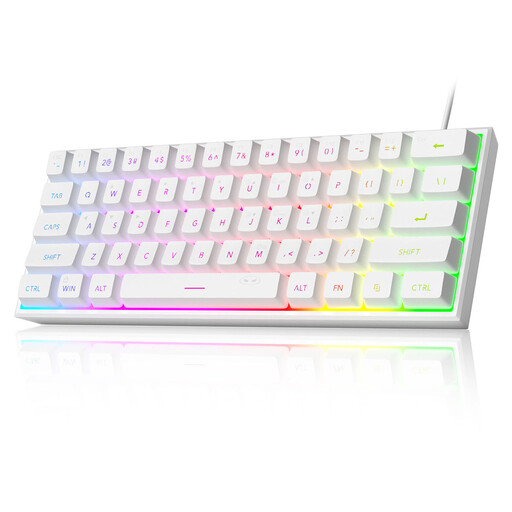
MageGee TS91 60% wired keyboard, US QWERTY

MageGee TS91 60% wired keyboard, US QWERTY

The 60% layout without a number pad is designed for a compact workspace.

The product information lists dimensions of 29,2 × 10,1 cm and a membrane design with a mechanical feel.

The product name specifies a US QWERTY layout; check that it matches the layout you need.

Joybuy

Frequently asked questions

Should I choose a split keyboard for writing at a small desk?

No. If mouse space is your priority, start with a compact model without a separate number pad. If hand position matters more, compare models with movable halves. With either option, measure the space required for the complete setup.

How should I set up my workspace for longer writing sessions?

Position your screen and keyboard to suit your working posture, and break up your screen work with other activities. Arboportaal also recommends looking away regularly and taking microbreaks; a break indicator isn’t a substitute for varying your activities.

What if I’m not happy with the key layout or connection after buying online?

Check the exact model and the returns policy before placing your order. According to ACM ConsuWijzer, consumers generally have a statutory cooling-off period of up to 14 days after delivery for ordinary online purchases. The seller is also responsible for the applicable statutory guarantee if a product is faulty.

Is an ergonomic keyboard a legal requirement?

Not as a general requirement for someone writing a novel in their own time. For employees who use a screen for more than two hours a day, Arboportaal lists workplace requirements, including that the screen and keyboard must not be attached to each other. Those workplace rules don’t necessarily apply to personal use.

What should I check about the product safety of an electronic keyboard in the Netherlands?

Check the product information and the applicable CE marking for the product being offered. The Dutch government lists electronic devices as products that need a CE marking to be sold on the EU market. The marking doesn’t tell you whether a particular keyboard shape will reduce aches and pains.
