
Project group with a laptop
You want to play an edited film with picture and sound, so you first check that your laptop and projector are compatible.


Start with how you’ll play the film: check that your laptop can connect to the projector, then test the entire film file, including the audio. Choose a battery-powered model if you often move between rooms. In a room that’s difficult to darken, the stated brightness may matter more, but also consider the projection distance and power supply.
You want to play an edited film with picture and sound, so you first check that your laptop and projector are compatible.
You take your set-up with you and weigh up battery life, weight and access to mains power.
You can only darken the room to a limited extent, so visibility for your audience matters more than finding the smallest possible projector.
Start by checking the connection for your own film file. Then consider portability, lighting conditions and the components you’ll need for the complete set-up.
| What to consider | What should you check? | Who is this important for? |
|---|---|---|
| Playing your own film | Check the source’s video output, the projector’s input and the audio output; test the entire file in advance. | If I want to show my edit from a laptop, I want to know beforehand that the picture and sound work. Around 33% of consumers prioritise a reliable playback connection. |
| Portability and power | Compare the film’s running time, including the introduction, with the stated battery life, and check whether mains power is available. | If I’m showing a film in different locations, I want to know whether the battery will last for the whole session. Around 27% of consumers prioritise portability and power supply. |
| Visibility at the venue | Measure the available projection distance and consider how dark the room can be, the image size and the stated unit of brightness. | If the room can’t be darkened properly, I want the audience to be able to follow the film. Around 20% of consumers prioritise visibility in their screening space. |
| Components you’ll need | Check what’s in the box, whether any cables or adapters are needed, and which features you require for your playback set-up. | If I only want to buy the features I need, I want to know what else my chosen set-up requires. Around 20% of consumers prioritise essential features and running costs. |
Brightness figures aren’t always directly comparable: manufacturers may quote ANSI lumens, ISO lumens, or white and colour light output. So don’t use the stated figure as a direct measure of picture quality.
A streaming platform and a wired input serve different purposes. A streaming feature doesn’t confirm that your file will play from the laptop you’ve chosen.
Choose your source first and test the complete playback set-up, including audio, before comparing extra features.
You may need a suitable cable or video adapter for the connection you’ve chosen.
XGIMI quotes maximum video playback times for the MoGo 4 and Vibe One Battery Powered in eco mode. Your session may also run longer if you include an introduction or discussion afterwards.
Allow for the whole event and test your preferred picture mode. Also check whether a mains socket is available.
If the battery won’t last long enough, you’ll need to use mains power or an additional power source.
Manufacturers quote figures such as ANSI lumens, ISO lumens, and white and colour light output. These aren’t standardised real-world tests that let you rank picture performance directly.
Make a note of the unit used for each model, and also consider how dark the room can be, the image size and the available projection distance.
A bundle may contain different components from the projector sold on its own, so the projector name alone doesn’t tell you exactly what you’re buying.
Compare the full product variant and check which components are included with the version on offer.
A bundle may include components you don’t need, while a different version may require extra accessories for your set-up.
The MoGo 4 and Vibe One Battery Powered are separate portable models for showing films in different locations.
The GV50 is a compact option if connectivity and flexible positioning are important for your film set-up.
The CO-FH02 is an option for a mains-powered set-up with enough space, when stated brightness is important.
The Capsule 3 Laser is a compact projector for a project group looking to travel light.
The NeoPix 130W could suit a compact home set-up if you don’t need a high level of detail.
These Joybuy products are options for playing a student film from a suitable source. Check the stated connections, power supply and positioning requirements for each model.
 No image available
The stated battery life and connections make this model worth considering if you want to play a film from a suitable source and take your set-up with you.
The product title lists native 1080p, 800 ANSI lumens, HDMI 2.1, USB-C and a battery life of 2 hours.
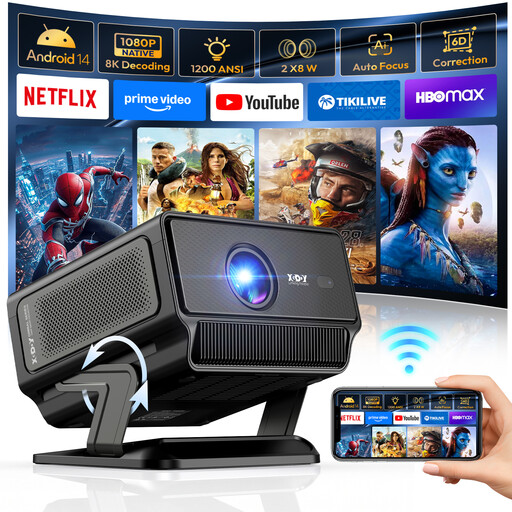 No image available
The HDMI and USB connections, along with the adjustable stand, are worth considering if you’re playing a film from a suitable source and want to adjust the projection angle.
The product title lists native 1080p, 1200 ANSI lumens and HDMI and USB compatibility.
 No image available
This portable battery-powered model could suit screenings at different locations. Test the full session in your preferred picture mode beforehand.
The product title lists Full HD 1080p, 450 ISO lumens, a battery for 2.5 hours and an EA SPORTS FC 26 game code. XGIMI quotes up to 2.5 hours of video in eco mode for the MoGo 4.
 No image available
The listed HDMI input could be useful if you want to play your film from a suitable HDMI source. Also check the distance to the screen.
The product information lists 1080p, HDMI 2.0, 650 lumens and a throw ratio of 0.18:1. It also specifies an image size of 60–100 inches and a projection distance of 26–40 cm.
 No image available
The stated HDMI compatibility makes this model worth considering if you want to play your film from a suitable external source.
The product title lists native 1080p, 900 ANSI lumens and HDMI compatibility. The product information also mentions automatic focus and keystone correction.
That depends on your laptop’s video output and the input on the projector you choose. BenQ lists HDMI and USB-C DisplayPort input for the GV50, while Epson lists HDMI for the CO-FH02. Beforehand, test the playback software and audio with the actual film file too.
First, measure the distance to the wall or screen and check the positioning options for the exact model. BenQ gives the GV50 a throw ratio of 1.2; check at the screening venue whether the available distance and image size will work.
In the Netherlands, online purchases from a business often come with a 14-day cooling-off period. You’re also entitled to a product that works properly, and the seller is your point of contact if there’s a fault. The Dutch government states that there’s no fixed, general statutory two-year guarantee period for every product. An extended warranty you buy separately doesn’t replace your statutory rights.
Products covered by EU rules that require CE marking must comply with those rules. Check the product information and the marking on the exact model. The marking is the manufacturer’s declaration and, on its own, isn’t proof of an independent assessment.
You generally need permission to use other people’s copyright-protected work, such as music or film clips in your project. Whether an exception or licence applies to a particular educational screening depends on the context and the works used. Choosing a projector doesn’t give you the rights to show a film.