What should you look for when choosing?
The right temperature depends on the recipe: Rutger Bakt’s recommendation for pastéis de nata does not automatically apply to other custard tarts.
Freestanding mini oven
Choose this option if: you want to place individual tins on a tray or rack and the internal space is suitable for their dimensions.
Trade-off: according to their manufacturers, the Tristar OV-3620 and Severin TO 2067 reach up to 230 °C. That is lower than the temperature Rutger Bakt recommends for his specific recipe. According to Severin, the TO 2067 does not have a fan function.
Freestanding fan oven
Choose this option if: your tins need more room or you want to bake other things too. According to Inventum, the Inventum OV307B has a 30-litre capacity, a fan function, and top and bottom heat.
Trade-off: according to Inventum, the OV307B reaches up to 230 °C. More capacity does not automatically mean better baking results or lower energy use for a small batch.
Compact air fryer
Choose this option if: a small number of heatproof tins will fit in the basket and your recipe is suitable for the available temperature.
Trade-off: according to Tefal, the Tefal EY1458 has a 3-litre capacity, a maximum temperature of 200 °C and no heating element at the bottom. When testing air fryers, the Consumers' Association assesses whether quiche and cake brown evenly on top and cook through underneath. A baking programme alone does not tell you what results you will get with custard tarts.
| What to consider |
What should you look for? |
Who is this important for? |
| Temperature and baking results |
Compare the maximum temperature and heating setting with your recipe, and check the heat tolerance of your tins too. |
I want to follow the recipe without having to adjust the baking settings; around 36% of consumers prioritise temperature and the expected baking results. |
| Tins and batch size |
Measure your tins and compare them with the usable space on the tray, rack or in the basket. |
I want to use the number of tins I need at the same time; around 29% of consumers prioritise fit and batch size. |
| Worktop space and energy use |
Check the external dimensions and the recommended ventilation clearance. Where possible, compare energy use in kWh for similar baking sessions. |
I have limited space and do not want to use more oven space than my baking requires; around 21% of consumers prioritise space and energy use. |
| Maintenance and safe positioning |
Check the cleaning instructions, removable parts and positioning requirements for the exact model. |
I want to position the appliance safely and clean it easily after baking; around 14% of consumers prioritise maintenance and safe use. |
Products for small baking sessions
Joybuy picks to compare freestanding ovens and air fryers for small baking sessions, with tins, recipe temperatures and available space in mind.
 No image available
Wiggo WMO-E456(W) mini oven, 45 L, 2000 W, white
The stated 45-litre capacity may suit you if you want to bake other things as well as custard tarts; check that the external dimensions will fit on your worktop.
Capacity: 45 L. Power: 2000 W.
View at Joybuy
 No image available
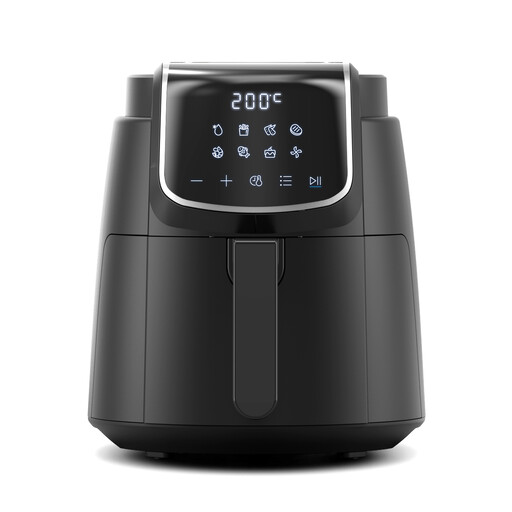
Midea 4L Air Fryer with LED touchscreen
This air fryer may suit small batches if your recipe works at the stated temperature. For his specific pastéis de nata recipe, Rutger Bakt recommends a temperature above 250 °C, ideally around 280 °C.
Capacity: 4 L. Maximum temperature: 200 °C. The product name lists 8 functions, including baking, and 1500 W.
View at Joybuy
 No image available
Severin TO 2074 4-in-1 toaster oven
A freestanding oven to consider if you want to prepare other dishes as well as tarts; check that its maximum temperature and internal space suit your recipe and tins.
The product name lists baking, toasting and grilling functions, and 1200 W.
View at Joybuy
 No image available
Rommelsbacher BGS 1400 mini oven
A mini oven to compare if you want to use individual tins. Check the usable internal space, heating settings and maximum temperature for your recipe.
View at Joybuy
 No image available
Rommelsbacher Mini Oven BG 950
A compact oven to compare for small baking sessions; measure your tins and check that they fit on the usable tray before making your choice.
View at Joybuy
Frequently asked questions
Does your oven need to reach 280 °C for every custard tart?
No, that is not a general requirement. For his own pastéis de nata recipe, Rutger Bakt recommends a temperature above 250 °C, ideally around 280 °C. Follow the recipe you choose and check that your tins can withstand that temperature.
How do you position and maintain a freestanding oven safely?
Follow the instructions for the exact appliance when positioning and cleaning it. The Dutch Fire Service advises allowing heat from appliances such as ovens to escape and, where possible, plugging high-power appliances directly into a socket rather than using an extension reel or multi-socket adaptor.
Is an energy label required for a portable mini oven?
The European Commission says that small, portable ovens are outside the scope of EU energy labelling rules for domestic ovens. So check the type of product first; the absence of such a label does not in itself prove that a portable model is inefficient or being sold unlawfully.
Are you always entitled to just a two-year guarantee on an oven in the Netherlands?
No. According to the Dutch government, statutory guarantee in the Netherlands has no fixed time limit: what you can expect from a product depends on the product and the circumstances. If a product is faulty, contact the seller; a manufacturer's guarantee may also apply.
Can you calculate electricity costs using only the stated wattage?
No, wattage alone does not provide a reliable calculation of energy use for a complete baking session; how long you use the appliance also matters. Where possible, compare energy use in kWh for similar baking sessions. Milieu Centraal also recommends taking the size of the oven into account.


