
Photographer capturing moving reeds
You take photos handheld when the wind moves the reeds and want to work out which shutter speed will capture their movement sharply enough.


Choose a mirrorless camera if you want interchangeable lenses to frame both a wide view and details from the same path. A compact camera with a fixed zoom is a good fit if you’d rather carry one camera and avoid changing lenses. Image stabilisation helps counter camera shake, but it won’t stop moving reeds. To keep them sharp in the wind, you may need a faster shutter speed, which affects your aperture and ISO.
You take photos handheld when the wind moves the reeds and want to work out which shutter speed will capture their movement sharply enough.
You carry your complete kit on a nature walk and weigh up versatility against size and weight.
You can’t always change your position and want to choose between a sweeping view and close-up details from an accessible route.
Start by thinking about how you want to reframe your shot from where you’re standing: with interchangeable lenses or a single fixed zoom lens.
A good fit if: you want to capture both a wide view and details of the reeds from the same path, and are happy to choose a suitable lens.
Bear in mind: the mount, the included lens and the weight of the complete kit. Stabilisation won’t stop moving reeds.
A good fit if: you want to take one camera with you and switch between a wide view and a tighter crop without changing lenses.
Bear in mind: the lens is fixed. Sony specifies a 24–200 mm 35mm-equivalent zoom range for the RX100 VII; consider the angle of view and image quality for your own needs.
A good fit if: you also consider model-specific protection ratings for longer walks. OM SYSTEM lists an IP53 rating and a weight of 418 g for the OM-5 Mark II body, including battery and card.
Bear in mind: add the lens to the weight you’ll be carrying, and don’t take a protection rating as permission to submerge the camera.
When photographing reed landscapes handheld from a path, the main things to weigh up are movement, framing, portability, detail and whether the kit is complete.
| What to consider | What to look for when buying | Who is this important to? |
|---|---|---|
| Sharp reeds when they’re moving | Check the stabilisation offered by your chosen body and lens combination, and whether you can set the shutter speed and ISO. A faster shutter speed lets in less light and may mean using a different aperture or a higher ISO. | When the reeds are moving, I want to be able to adjust the shutter speed accordingly. Around 29% of consumers give top priority to keeping moving reeds sharp. |
| Angle of view from one position | Check the optical zoom range or which interchangeable lens will give you the crop you want. An extra lens gives you more options, but adds to your kit. | I want to be able to frame both the landscape and tighter details from an accessible path. Around 23% of consumers put this angle of view first. |
| Portability and outdoor use | Compare the weight of the complete kit and check the protection rating for the exact camera body and lens. | On a long walk, I want to carry my complete camera kit and know what level of protection it offers. Around 18% of consumers prioritise portability and outdoor use. |
| Detail and post-processing | Consider resolution alongside the lens and sensor, and check for RAW support if you want to edit your images later. More megapixels alone don’t guarantee a better photo. | If I want to preserve fine detail or edit crops, I look beyond the megapixel count. Around 18% of consumers prioritise preserving detail and post-processing. |
| What’s included in the kit | Check whether you’re buying a body or a kit, which lens is included and whether it’s compatible with the mount and gives you the angle of view you want. | I want to know in advance which components I need to take the photos I want. Around 12% of consumers make a complete camera kit their top priority. |
Stabilisation can help counter camera shake, but it can’t prevent the reeds themselves from moving.
Check the conditions for the exact body and lens combination, and see whether you can set the shutter speed and ISO. Canon Netherlands also distinguishes between camera shake and subject movement.
You carry and use a complete combination. Without a suitable lens, you may not be able to get the angle of view you want.
Check whether the offer includes a body or a kit, whether the lens is compatible and how much the complete combination weighs.
A wide zoom range or a high pixel count alone won’t determine which angle of view and image quality are right for where you’re standing.
First decide what crop you need from the path, then consider the lens, sensor and post-processing you want together.
The OM-5 Mark II is a model-specific option to consider if you’re looking for a mirrorless camera body for outdoor use.
The X-T5 is an APS-C mirrorless camera to consider if resolution, RAW and interchangeable lenses matter to you.
The EOS R7 is an APS-C option with an RF mount for anyone looking to build a kit with interchangeable lenses.
The RX100 VII has a fixed zoom lens for anyone who wants to take different crops without changing lenses.
The Z5II is a full-frame mirrorless camera to consider if you’re looking for interchangeable lenses and in-body stabilisation.
This selection includes compact cameras, an action camera and mirrorless camera kits for photography on the go. Check each model to make sure its angle of view, lens and controls suit handheld photography from a path.
 No image available
This point-and-shoot camera is listed as a compact option to take with you; check that its angle of view suits where you’ll be standing.
The product name lists 80 MP and 18× zoom. Check the crop you want before relying on these figures.
 No image available
The product name describes this as a pocket camera for photography and video, making it a compact option to take with you on the go.
The product name lists 4K, 44 MP and 16× zoom. Check that the angle of view and crop you want suit your needs.
 No image available
This mirrorless camera kit has an interchangeable lens, making it an option if you want to use different angles of view from one position.
The product name lists a 16–50 mm zoom lens. Check that it gives you the angle of view you need from the path.
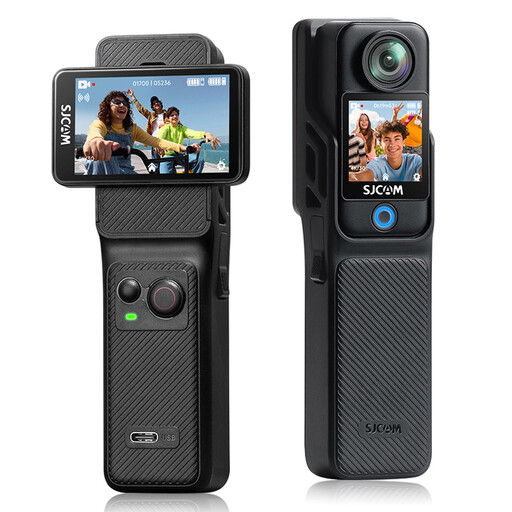 No image available
The product name describes this as a compact action camera for activities including walking and outdoor pursuits.
The product name lists 16 MP photos and a 154° wide-angle lens. Check that the angle of view suits the landscape you want to capture from the path.
 No image available
This mirrorless camera kit is an option if you want to use an interchangeable lens to frame different crops from a fixed position.
The product name lists a 16–50 mm f/3.5–5.6 OSS II lens. Check that its range suits the angle of view you want.
Image stabilisation helps counter camera movement, not the movement of the reeds. If you want to capture moving reeds sharply, consider your shutter speed; a faster exposure may require a different aperture or a higher ISO.
Check whether you’re buying a body or a kit, and whether the included or chosen lens fits the mount and gives you the angle of view you want. According to Canon, the Canon EOS R7 has different compatibility requirements for RF, EF and EF-S lenses; EF-M lenses aren’t compatible.
According to ACM ConsuWijzer, online purchases generally come with a statutory 14-day cooling-off period after delivery, with some exceptions. The statutory guarantee is separate from any manufacturer’s warranty. If a product doesn’t meet what you could reasonably expect under normal use, the seller is responsible for providing an appropriate solution.
Don’t assume access is unrestricted; follow local information and site signs. The Dutch government says that provinces decide what’s permitted in their areas. Natuurmonumenten generally asks visitors to stay on the paths in its nature reserves. Check the rules for the specific place you plan to visit.