
Walker who wants to start shooting straight away
Wants to capture a reed landscape without changing lenses on the spot, and values ease of handling, simple controls and the field of view offered by a single camera.


Choose a compact camera with a built-in zoom lens if you want to frame different shots from one spot without changing lenses. A compact camera with a fixed wide-angle lens is suited to sweeping landscape shots. A mirrorless camera lets you choose from interchangeable lenses, but you’ll need to fit the right one before you set off. Image stabilisation helps counter camera shake, not reeds moving in the wind: shutter speed determines whether you freeze the movement or let it blur.
Wants to capture a reed landscape without changing lenses on the spot, and values ease of handling, simple controls and the field of view offered by a single camera.
Wants to choose a lens before setting off to get the desired framing, and is happy to carry a kit made up of separate components.
Wants to decide whether moving reeds appear sharp or blurred, so pays separate attention to shutter speed, stabilisation and the available light.
A good choice if: you want to frame both a wide scene and more distant reeds from the path, without changing lenses.
The trade-off: you’re limited to the built-in zoom range; also consider image quality in the light you’ll be shooting in.
A good choice if: capturing the wider landscape is your main priority and you’re happy to work with a fixed field of view.
The trade-off: without optical zoom, you can’t bring distant details closer.
A good choice if: you want to choose a lens before you set off that suits the framing you’re after.
The trade-off: an extra lens gives you more choice, but changing lenses on the way can mean extra stops and handling.
The Dutch Consumers’ Association highlights factors such as size, ease of use, zoom range and image quality. First decide how you want to frame your shot from where you’ll be standing, then check how quickly you can set this up on the camera.
| Buying concern | What to look for when buying | Who should prioritise this? |
|---|---|---|
| Quick framing | Compare how quickly you can set the field of view you want and check whether the camera has a built-in zoom lens. | If I want to switch quickly from a wide shot to a tighter one from the path, I don’t want to change lenses. Around 36% of consumers say quick framing is their main buying concern. |
| The right field of view | Decide whether a fixed wide-angle lens will do, or whether you need optical zoom or a different lens; check which lens comes with the kit. | If you want to capture both the whole scene and more distant details from the same spot, pay close attention to the range. Around 28% of consumers say getting the right field of view is their main buying concern. |
| Reeds in motion | Check whether the camera body or lens has stabilisation, and whether you can adjust the shutter speed easily. | If I want to choose between sharp reeds and intentional motion blur, I pay attention to shutter speed and the light on location. Around 18% of consumers say moving reeds and light are their main buying concern. |
| Portability and outdoor use | Compare the weight of the complete kit, including the lens, and check the protection offered by both the body and lens. | If you want to take a camera on a walk, consider the whole kit, not just the camera body. Around 18% of consumers say portability and outdoor use are their main buying concern. |
Stabilisation counteracts camera shake, but it won’t freeze the reeds. Shutter speed is one of the factors that determines how movement is captured.
Choose a faster shutter speed to freeze movement, or a slower one if you want to create intentional blur. Canon Nederland explains the difference in its guide to image stabilisation and photographing movement.
The lens also affects the field of view. What’s included in a kit can determine which other items you’ll need; for example, Nikon says that a charger isn’t included with the Z50II kit mentioned here.
Before buying, check the range of the included lens and everything supplied with that version.
You may need to buy a suitable lens or a missing component separately; what you need depends on the version you choose.
A wider zoom range doesn’t automatically mean you’ll get the best framing for the scene. A subject that’s zoomed in on a long way can also be harder to keep in the frame.
Choose a range based on what you want to photograph from the permitted path.
The RX100 VII is a compact camera with a built-in optical zoom range equivalent to 24–200 mm in 35mm format.
According to Ricoh, the GR IV is a compact camera with a fixed wide-angle lens equivalent to around 28 mm in 35mm format.
The EOS R50 is an APS-C mirrorless camera compatible with RF and RF-S lenses.
Nikon offers the Z50II with various kits, including one with 16–50mm and 50–250mm lenses.
These cameras are suited to anyone looking for a camera for photography, flexible framing or a lens range chosen in advance for a walk.
 No image available
The stated optical zoom may suit you if you want to take different shots from one spot without changing lenses.
The product description lists 80 MP and 18× optical zoom; these are product claims, not independent test results.
 No image available
This pocket camera may suit anyone looking for a compact camera for photography who wants to frame shots using a rotating screen.
The product description mentions a 1-inch CMOS sensor and 3-axis stabilisation for video; this video stabilisation doesn’t tell you anything about image stabilisation for stills. The product title also lists 4K/120fps video.
 No image available
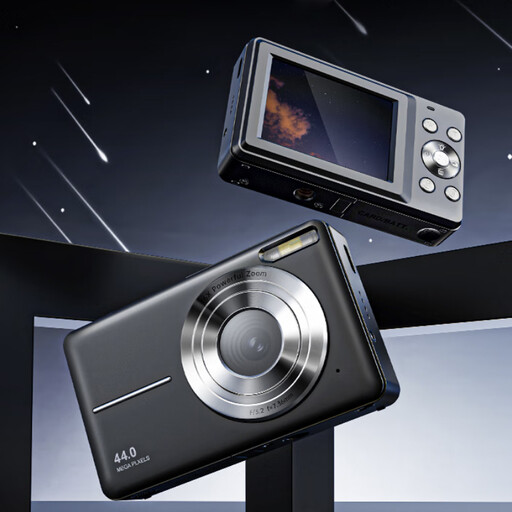
This pocket camera is worth comparing if you’re looking for a camera for both photography and video.
The product title lists 4K, 44 MP and 16× zoom; the product information specifies 16× digital zoom and autofocus. A microSD card isn’t included, according to the product information.
 No image available
The included 16–50mm zoom lens lets you set up the range you want before you set off.
The product description lists a 24.2 MP APS-C sensor and digital Active Mode stabilisation for video. An adapter/charger and SD memory card aren’t included, according to the description.
 No image available
The included 16–50mm lens lets you set up your chosen range on the camera before you set off.
The product description lists a 24.2 MP APS-C sensor and 11 fps; the product title names the 16–50mm f/3.5-5.6 OSS II lens.
Choose a faster shutter speed to freeze the movement, or a slower one for intentional blur. Image stabilisation counteracts camera shake, so assess moving reeds separately.
Not for every shot. Shooting handheld takes less preparation, but in low light a tripod can help if the shutter speed you need is too slow to use handheld. Base your choice on the movement you want to capture, and check the rules at the location.
It depends on the area. The Dutch government says that each province sets the rules for its area. On Staatsbosbeheer sites, follow the local signs and designated paths; check the rules for the specific location before leaving the path.
According to the Dutch government, there’s no fixed statutory warranty period in the Netherlands, but you’re entitled to a product that works as it should. If a product is faulty, the seller must provide a solution; a manufacturer’s warranty is an additional benefit.
Check whether your chosen version includes a lens and whether its range suits the framing you want. Also check which battery, charger and memory card are included; for example, the Z50II kit mentioned by Nikon doesn’t include a charger.