What should you look for when choosing?
Mirrorless camera with interchangeable lens
Choose this option: if you want to capture different compositions and flower details, and can put together a lens with a suitable filter mount.
Trade-off: an extra lens gives you more choice, but also means carrying more equipment and handling more kit at a busy market. Check the lens mount, filter fit and kit contents separately.
Compact camera with fixed zoom lens
Choose this option: if you want to take photos quickly and would rather not change lenses.
Trade-off: the lens isn’t interchangeable. Don’t assume a polarising filter will fit directly just because the camera has a built-in zoom; check the filter mount and close-up capabilities of the exact model.
Keep reflections in your shot
Choose this approach: if the reflection of the flower stall or its surroundings is an intentional part of your composition.
Trade-off: a polarising filter can reduce a reflection you want to keep. When the reflected image is your subject, focus on the reflection.
First decide whether you want to reduce reflections or include them in your shot. Then compare lens options, flower detail and how much equipment you’ll need to carry.
| What to consider |
What should you look for? |
Who should take this into account? |
| Controlling reflections |
Check that a circular polarising filter fits the specific lens. Also consider whether you want to keep some of the reflection. |
If I’m photographing flowers behind glass, I want to decide for myself how much glare remains. Around 33% of consumers give controlling reflections their top priority. |
| Capturing flower details |
Compare the maximum magnification and focusing capabilities of the supplied or chosen lens; don’t assume the kit lens is a macro lens. |
When I want to capture veins and textures in close-up, I look at the lens’s magnification. Around 27% of consumers prioritise flower details. |
| Assessing contrast |
Check whether exposure is easy to adjust and which HDR or exposure bracketing features the exact model offers. |
When bright reflections sit beside dark parts of a stall, I want to be able to adjust the exposure to suit the scene. Around 20% of consumers prioritise handling contrast. |
| Carrying less equipment |
Compare the weight of the complete camera and lens set-up. A fixed zoom saves you changing lenses; a mirrorless camera gives you a choice of lenses. |
If I’m walking between stalls for a long time, I want to take photos quickly without carrying lots of separate items. Around 20% of consumers give portability their top priority. |
Joybuy product picks
Joybuy camera picks for this topic.
 No image available
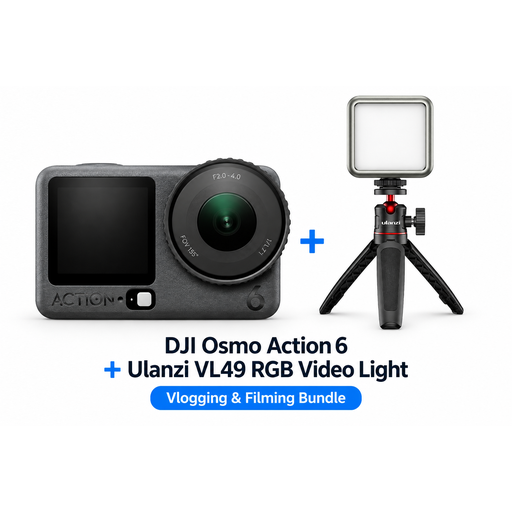
DJI Osmo Action 6 Adventure Combo with Ulanzi VL49 RGB LED Video Light
The product name describes a camera bundle for vlogging and photography with a Ulanzi VL49 RGB LED light.
View at Joybuy
 No image available
DJI Osmo Pocket 3
The product name lists photography and vlogging as intended uses; check separately whether the camera and lens suit the flower details you want to capture.
The product name mentions a 1-inch CMOS sensor, 4K/120fps video, 3-axis stabilisation and a rotating 2-inch touchscreen.
View at Joybuy
 No image available
Sony ZV-E10 with 16–50mm zoom lens, black
The product name lists the Sony ZV-E10 with a 16–50mm zoom lens; check the capabilities of this exact lens for reflections and close-ups.
View at Joybuy
 No image available
Sony Alpha A6100 with 16–50mm f/3.5-5.6 OSS II lens
The product name lists a Sony Alpha A6100 kit with a 16–50mm f/3.5-5.6 OSS II lens. Check the filter fit and close-up capabilities of the exact lens.
View at Joybuy
Frequently asked questions
Do you mainly need a different camera to deal with strong reflections?
Not necessarily. First, consider your shooting angle and check whether a circular polarising filter fits the exact lens. Nikon describes reducing reflections from glass and water; if you want to photograph the reflection itself, reducing it may not be what you want.
How do you focus on a reflection in a window or puddle?
First decide whether you want to focus on the subject behind the surface or on the reflected image. Canon explains that focusing on the original subject before turning towards the reflection can result in the wrong focusing distance.
What extra equipment should you check for a mirrorless camera?
Check which lens is included in the kit and whether a polarising filter, if you plan to use one, will fit it. Also include a memory card, battery and any additional close-up lens in your own cost comparison.
What can you do if a camera bought online develops a fault early on?
According to ACM ConsuWijzer, the seller must offer an appropriate remedy free of charge if a product develops a fault sooner than you could reasonably expect with normal use. Online purchases generally also come with a 14-day cooling-off period after delivery; ACM ConsuWijzer explains the exceptions.
Can you photograph identifiable people at a flower market and publish the photos?
This depends, among other things, on how the photos are used and the context. The Dutch Data Protection Authority notes that the GDPR has an exemption for purely personal or household use. If people are identifiable and the photos are used for other purposes, such as business use or publication on behalf of an organisation, you need to consider the applicable privacy rules and a valid legal basis. This does not give general permission to take or publish every photo at every market.


