
Writer with limited desk space
Writes a lot of feedback and wants to keep the mouse close without having to search for a hidden key function every time they make a correction.


If you mainly type feedback, start with a compact keyboard without a built-in number pad, and check that frequently used keys such as the arrow keys and Delete are easy to reach. Then choose based on your workspace: a wired connection, switching between devices or quiet keys could make all the difference. If you enter numbers regularly, compare a built-in number pad with a separate one that you can put away.
Writes a lot of feedback and wants to keep the mouse close without having to search for a hidden key function every time they make a correction.
Needs a keyboard that suits a shared environment and considers the layout and how much noise it makes at their workstation.
Writes feedback and regularly enters numbers, weighing up a built-in number pad against a separate one that can be put away.
First, measure the space available for your keyboard and mouse. Then compare the layout and connection with the keys and devices you use when marking work.
| What to consider | What should you check? | Who is this important for? |
|---|---|---|
| Desk space | Measure the available width, including space for your mouse. Also compare the position of frequently used keys. | When I type feedback at a small desk, I want enough room for my mouse and notes. Around 33% of consumers prioritise desk space. |
| Typing noise and key feel | Check the key mechanism and model; descriptions such as ‘quiet’ are not based on comparable noise measurements. | When I work close to other people, I pay extra attention to the sound and feel of the keys during longer writing sessions. Around 27% of consumers prioritise quiet typing. |
| Connection and devices | Check that the wired or wireless connection works with your work device and is permitted. | When I switch between a school computer and another device, I want to know whether I can connect to both at my workstation. Around 20% of consumers prioritise device compatibility. |
| Correction and number keys | Check the position of the arrow keys, Delete and function keys, and whether you need a number pad. | When I regularly enter numbers as well as text, I want those keys to be within easy reach without giving up too much desk space. Around 20% of consumers prioritise direct access to correction or number keys. |
A small keyboard may make frequently used keys less accessible, which can matter when correcting feedback.
Before choosing the smallest size, check the exact model’s arrow keys, Delete, function keys and number-entry options.
A product listing that mentions Bluetooth or a receiver connection does not automatically mean you can connect to your work device, or that you are allowed to.
Check compatibility and your school’s rules. If necessary, choose a wired model that suits the available port.
A product description cannot tell you exactly how a keyboard will sound or feel at your workstation.
Compare the dimensions, layout and key mechanism. Don’t treat product descriptions as a guarantee of fewer complaints or a particular noise level.
The Pebble Keys 2 K380s is a compact Bluetooth option for typing text and switching between devices.
The UltraBoard 950 V2 is a compact wired model; the UltraBoard 960 V2 has a built-in number pad.
The KW 9200 MINI is a compact option with several connection methods.
The K3 Max is a compact mechanical keyboard with a 75% layout.
The Compact Break range is a line of compact keyboards with a break indicator.
This Joybuy selection includes compact keyboards for workspaces with limited room. The models differ in layout, switch type and available connections.
 No image available
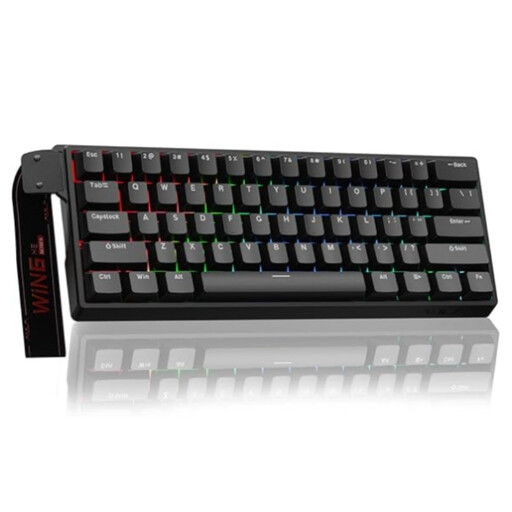
The wired 60% layout may suit you if desk space is limited. Check where the navigation and correction keys are before buying.
The product name lists Hall Effect switches and Rapid Trigger.
 No image available
The 75% layout may appeal if you’re looking for a compact setup. Check that the layout suits your work.
The product name lists a QWERTY US layout and wired, Bluetooth or 2.4 GHz connectivity. The US layout may differ from the Dutch layout you need.
 No image available
The compact layout may suit a desk with limited space. Check that the keys you need are within easy reach.
The product name lists 68 keys and a US layout. Check that the layout suits the way you work.
 No image available
The 75% layout is a compact option. Check that the available keys suit your correction and navigation tasks.
The product name lists 83 keys, QWERTY US and hot-swappable linear switches. The US layout may differ from the Dutch layout you need.
 No image available
Compare the layout with the keys you use to correct and navigate through feedback.
The product name lists Purple Switch and US QWERTY. Check whether this layout suits your work.
According to Arboportaal, the screen and keyboard must not be attached to each other if an employee works at a screen for more than 2 hours a day. When using a laptop, it must therefore be possible to use a separate screen or keyboard. This does not mean you have to choose a particular keyboard model.
First, measure the space for your keyboard and mouse. A compact model without a built-in number pad can free up space, but check that the correction keys remain easy to reach. Arboportaal also advises employees to alternate screen work with other tasks or take a break.
Only if the connection works with both devices and the school allows you to pair them. Digital tools that process student data are subject to GDPR rules. According to the Dutch Data Protection Authority, the school must be able to demonstrate that it has taken appropriate technical and organisational measures.
For distance purchases, you usually have a 14-day cooling-off period, according to the Dutch government. Products sold in the Netherlands are also covered by a statutory guarantee that they must be of satisfactory quality; there is no single fixed statutory guarantee period for all products. The terms depend on the circumstances and the nature of the fault.