What should you look for when choosing?
Start with the space available, then consider whether switching between devices, key feel or entering numbers directly matters most for your lesson planning.
| What to consider |
What should you check? |
Who should give this more weight? |
| Space for your keyboard, mouse and papers |
Measure the available space on your desk and compare it with the dimensions of the exact model. |
If I need room for a mouse and teaching materials, I want to know how much space the keyboard takes up. Around 36% of consumers prioritise workspace above all else. |
| Switching between devices |
Check Bluetooth support, available USB ports or the included receiver, and how you switch between devices. |
If I work on teaching materials on both a computer and a tablet, I don’t want to keep switching keyboards. Around 29% of consumers prioritise switching between devices. |
| Key feel and sound |
Check the key mechanism and, if possible, try the keys for yourself. Consider the set-up of your whole workspace too. |
If I type in a shared space, I want to know how the keyboard feels and sounds. Around 21% of consumers consider the typing experience their main priority. |
| Keyboard layout and number entry |
Check the layout, the position of symbols and navigation keys, and whether an integrated number pad will meet your needs. |
If I enter numbers regularly, I want to know whether the layout suits my work. Around 14% of consumers mainly need a familiar layout or convenient number entry. |
Compact keyboards on Joybuy
These Joybuy products include compact keyboards in wired, wireless and foldable designs. For each model, check the layout, connection and features against your own workspace.
 No image available
Redragon M68 Magnetic Switch mechanical gaming keyboard, 68 keys, US layout
A compact, wired option for freeing up desk space. The product information lists 68 keys, a US layout and a detachable Type-C cable.
View on Joybuy
 No image available
Ajazz AK820 Pro 75% mechanical keyboard, QWERTY US, Flying Fish Switch, grey
This compact model could be a good fit if you need several connection options. The product information lists 82 keys and wired, Bluetooth and 2.4 GHz connections; the layout is QWERTY US.
View on Joybuy
 No image available
Razer Huntsman Mini keyboard (Purple Switch), US QWERTY
A wired 60% model for a compact computer set-up. The product information lists optical Purple switches and a detachable USB-C cable. The description says the keys are clicky, which may be worth bearing in mind in a shared space.
View on Joybuy
 No image available
Voxis B033 foldable Bluetooth keyboard with touchpad
This foldable model is designed for portable use and has an integrated touchpad. The product information lists 63 keys and compatibility with computers, tablets and smartphones. Check that the layout suits your work.
View on Joybuy
 No image available
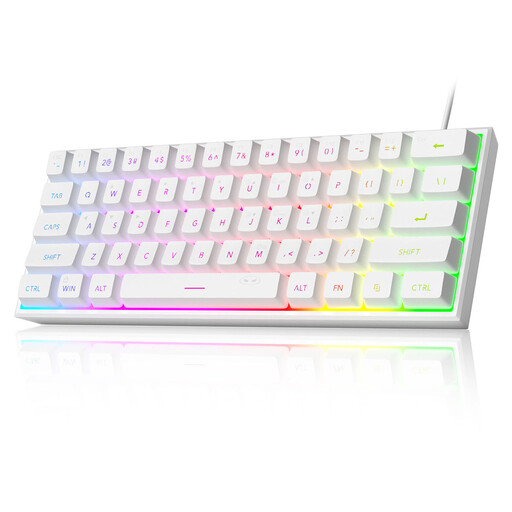
MageGee TS91 60% wired keyboard, 61 keys, QWERTY US, white
This compact wired model could suit a fixed workspace with a USB connection. The product information lists 61 keys, RGB lighting, a QWERTY US layout and dimensions of 29,2 × 10,1 cm.
View on Joybuy
Frequently asked questions
What should I measure before ordering a compact keyboard?
Measure the available space, including room for your mouse and printed teaching materials, and compare it with the dimensions of the exact model. For example, Logitech lists the Pebble Keys 2 K380s as 279,5 mm wide. If you’re choosing a wired model, remember to allow room for the cable too.
How can I use one keyboard with my computer and tablet?
First, check which connections each device supports. The manufacturers describe ways to switch between paired devices for the Logitech Pebble Keys 2 K380s, CHERRY KW 7100 MINI BT and Trust Lyra; the connections available vary by model.
Do I need to charge a compact keyboard?
It depends on the power source for the model. Trust describes the Lyra as rechargeable; check the product information and care instructions for the model you choose.
What if I don’t like the keyboard layout or the keyboard develops a fault?
For a standard online consumer purchase, you generally have a 14-day cooling-off period after delivery, subject to exceptions. If a product does not meet what you can reasonably expect during normal use, the retailer is responsible for the statutory guarantee. ACM ConsuWijzer explains these consumer rights; before buying, also check the layout and model on offer.
Is a separate keyboard required by law for screen-based work?
Not automatically for every user. Arboportaal, part of the Ministry of Social Affairs and Employment, states that for employees who do screen-based work for more than 2 hours a day, the screen and keyboard must not be attached to each other. This requirement does not automatically apply to every reader or every lesson-planning task.


