
Testers who use lots of shortcuts
You want to use the arrow keys, function keys and the right physical keyboard layout during testing, without having to adapt your workflow to your keyboard.


Start with the keys your testing requires: if you often use function keys, arrow keys or key combinations, a compact layout that retains these keys is often more practical than a smaller keyboard that makes you switch between functions. Then measure the space available for both your keyboard and mouse, and check the physical layout, connection and compatibility with your test devices.
You want to use the arrow keys, function keys and the right physical keyboard layout during testing, without having to adapt your workflow to your keyboard.
You want to leave enough room for your mouse, so you compare the keyboard’s dimensions with the space available at your workstation.
You work with multiple computers or operating systems and want to check that the connection and physical keyboard layout suit each test environment.
Start with the keys used in your test cases, then work out how much room the keyboard and mouse will take up together. This helps you avoid giving up important inputs for a smaller size when you don’t need the extra desk space.
| What to consider | What to look for | Who is this important for? |
|---|---|---|
| Space for your keyboard and mouse | Measure the available width and depth, including the space your mouse needs. Compare these measurements with the dimensions of the exact model. | If I work at a small desk, I want enough room to use my mouse alongside my keyboard. An estimated 31% of consumers prioritise desk space when making this choice. |
| Direct access to test keys | Make a list of the keys and combinations in your test cases. Check them against the layout of the exact model. | If my tests often use the arrow keys, function keys or shortcuts, I want to use them without extra steps. An estimated 31% of consumers prioritise direct access to test keys. |
| Compatibility and connection | For each test device, check the operating system, the required USB or Bluetooth connection, and any software needed to customise the keys. | If I switch between computers, the keyboard needs to work with the intended devices and test layouts. An estimated 19% of consumers give compatibility and connection top priority. |
| Comfort during long testing sessions | Consider the actual positioning of your keyboard and mouse, and whether you can vary your work. A smaller case or break reminder does not guarantee a health benefit. | If I test for long periods, I want to set up my workstation comfortably and vary my tasks. An estimated 19% of consumers prioritise comfort when testing for extended periods. |
For desktop app testing, the inputs you need may matter more than saving those last few centimetres of desk space. A smaller layout may mean you need a key combination to access certain keys.
Before deciding, compare the keys in your test cases with the layout of the exact model.
If your testing requires extra key combinations, you’ll need to use a different way to enter those inputs during testing.
A USB cable may be intended to charge a wireless keyboard. This doesn’t prove that the keyboard can also send keystrokes through the cable.
If you want to type using a wired connection, check explicitly that the model supports input over the cable.
According to the Government of the Netherlands, there is no fixed statutory warranty period in the Netherlands. A manufacturer’s warranty is separate from your statutory rights and does not automatically provide the same full protection if a product fails to meet the terms of the agreement.
Compare the terms of any paid extended warranty with the rights you already have.
A paid extended warranty may be an unnecessary expense if it does not provide any additional rights.
The K3 Max is a compact 75% mechanical option for anyone looking for a function row, arrow keys and a choice of connection options.
The MX Keys Mini is a slim, compact wireless alternative for typing at a small workstation.
The Lyra is designed for compact working across multiple devices, while the GXT 864 Cada is a separate wired TKL option.
The Compact Break combines a slim design with a software-controlled break indicator.
This selection includes compact wired and wireless keyboards, including TKL, 75% and 60% layouts. For each model, check whether the keys you need for app testing are directly accessible.
 No image available
A wired TKL option if you want a compact keyboard with a full row of keys.
Wired; TKL layout; QWERTY; compatible with PC and PS5.
 No image available
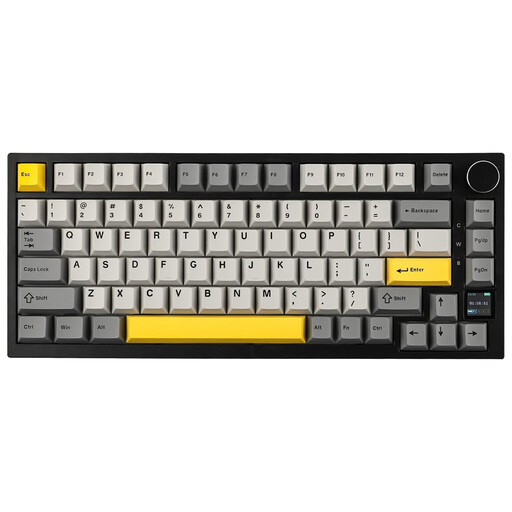
A compact 75% option to consider if you want to retain navigation and function keys.
Mechanical; US QWERTY; wired, Bluetooth and 2.4 GHz; compatible with Windows and Mac.
 No image available
A wired 75% option if you want a compact layout and don’t need a wireless connection.
Mechanical; US QWERTY; wired; 83 keys; red linear switches; compatible with PC, Windows and Mac.
 No image available
A compact model to consider if you want to save desk space; check whether the test keys you need are directly accessible on this layout.
Purple Switch; US QWERTY layout.
 No image available
A very compact wired option if saving as much space as possible is important; check how to access your test keys on the exact layout before buying.
61 keys; wired; US QWERTY; RGB lighting; compatible with PC, Mac, PS4 and Xbox One.
Choose based on the keys you need to access directly during testing. For example, Keychron describes the K3 Max as an 84-key 75% layout; check how to access the arrow and function keys on each model.
Measure the available space and position your keyboard and mouse so you can work comfortably. A narrower keyboard may free up space beside it, but it’s only one part of a well-set-up workstation; remember to vary your tasks too.
Check that your computer supports the connection required by the exact model, such as USB or Bluetooth. For a wired model, consider the cable route; if you choose a rechargeable wireless model, plan when to charge it. Follow the chosen model’s manual when cleaning it.
For online purchases from a business, you usually have a 14-day cooling-off period, according to the Government of the Netherlands. You also have rights if a product does not meet the terms of the agreement; according to the Government of the Netherlands, there is no fixed statutory warranty period in the Netherlands. A manufacturer’s warranty is in addition to your statutory rights.
The Arboportaal states that for employees who work with screens for more than two hours a day, the screen and keyboard must not be attached to each other. In that case, laptop users must be able to use a separate screen or keyboard. This workplace rule applies under specific conditions and does not prescribe a particular keyboard model for private buyers.