
Designer who uses keyboard shortcuts
You often switch between designing and controlling things, and want to reach important navigation or function keys directly. HyperX, Keychron and Logitech G describe the key layouts and features discussed here.


For a small desk, the choice comes down to the keys you need to use directly while designing and playing. A 65% model combines a compact size with dedicated arrow keys; 60% gives you more room for your mouse, while 75% or TKL may be more practical if you use function keys more often. Check the exact model’s dimensions and layout too.
You often switch between designing and controlling things, and want to reach important navigation or function keys directly. HyperX, Keychron and Logitech G describe the key layouts and features discussed here.
You have a narrow desk and want to leave enough room for mouse movement. The Razer Huntsman Mini and HyperX Alloy Origins 65 are examples of smaller layouts.
You use your keyboard for different tasks or devices, so you want to consider its layout, connection options and customisable keys. Keychron and Logitech G describe these options for specific models.
Best for: You want the smallest possible layout and can access the commands you need using key combinations.
Bear in mind: The Razer Huntsman Mini has no dedicated function row or navigation cluster; Razer says these functions are available via secondary keys.
Best for: You want to leave space next to your keyboard and prefer to access the arrow keys and some navigation keys directly.
Bear in mind: According to HyperX, the HyperX Alloy Origins 65 has dedicated arrow, Home, Delete and Page Up/Down keys, but no separate function row.
Best for: You regularly use shortcuts or function keys but still want a more compact size than a larger keyboard.
Bear in mind: According to Keychron, the Keychron K2 Max ISO is 311,54 mm wide; ISO does not guarantee Dutch key legends.
Best for: You want to keep the function row and navigation keys and can do without a number pad.
Bear in mind: TKL is larger than 60%, 65% or 75%; the Logitech G PRO X TKL has no number pad.
| What to consider | What to look for | Who should pay particular attention? |
|---|---|---|
| Keys you can access directly | Compare the commands you use most with the physical keys and any secondary key layers on the exact model. | If I often switch between commands while designing, I want to reach important keys without using an extra combination. Around 40% of consumers prioritise direct access to design and navigation keys. |
| Space for your keyboard and mouse | Measure the available desk width and compare it with the keyboard’s dimensions; remember to leave room for mouse movement too. | On a narrow desk, I want to leave enough room next to the keyboard to move my mouse. Around 40% of consumers give available mouse space top priority. |
| Layout and connection | Check the language layout, available connection modes and whether customising keys suits the way you work. | If I use the same keyboard for different tasks or devices, I want the layout and connection to suit the way I use it. Around 20% of consumers prioritise this flexibility. |
A percentage doesn’t tell you which keys are available individually on the model you’re considering. This can matter if you rely on specific commands while designing.
Make a note of the keys you need, then compare them with the layout and dimensions of the specific model.
An ISO version doesn’t automatically have Dutch key legends. Keychron lists several ISO language variants for the K2 Max.
Before buying, check the exact language variant and the key legends shown.
A manufacturer’s or seller’s warranty is separate from your statutory guarantee. ACM ConsuWijzer describes the statutory guarantee as a separate right you have against the seller.
Consider a paid warranty extension separately from the rights you already have.
The Huntsman Mini is a 60% option for anyone who wants to use as little desk space as possible for their keyboard.
The Alloy Origins 65 combines a compact size with dedicated arrow keys and some navigation keys.
The K2 Max ISO is a 75% model with wired, Bluetooth and 2,4GHz connectivity.
The PRO X TKL is designed for anyone looking for a keyboard without a number pad and with programmable keys.
The F75 is a 75% model; versions may vary in layout and switches.
These models cover TKL, 75%, 65% and 60% layouts for a compact gaming and design workspace. Compare the keys you need to access directly with the amount of desk space each size takes up.
 Image unavailable
The TKL layout removes the number pad, making it a good fit if you want to leave room for mouse movement.
The product description mentions programmable key functions, media keys, 12-key rollover and a 1,82 m USB cable.
 Image unavailable
The 75% layout is an option if you want a compact size with navigation keys.
The product name lists wired, Bluetooth and 2,4 GHz connection modes, plus a US QWERTY layout.
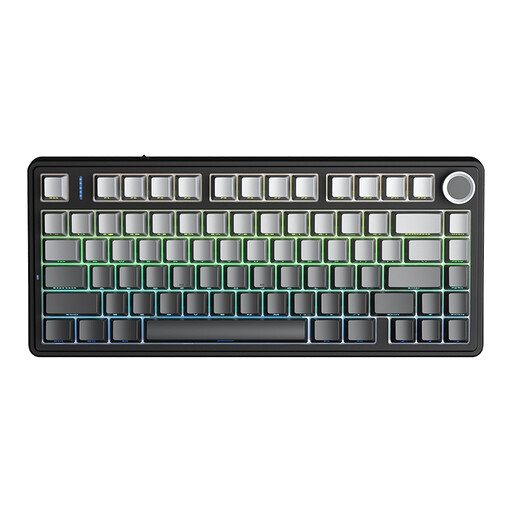 Image unavailable
This 75% model is an option if you want a compact size with customisable key functions.
The product information lists wired, Bluetooth and 2,4 GHz connections, programmable macros, hot-swap and a US layout.
 Image unavailable
A 60% layout is a good fit if desk and mouse space are your priority and you want to play with a compact keyboard.
The product name lists Hall effect switches, Rapid Trigger, RGB lighting, an 8K polling rate and adjustable actuation down to 0,01 mm.
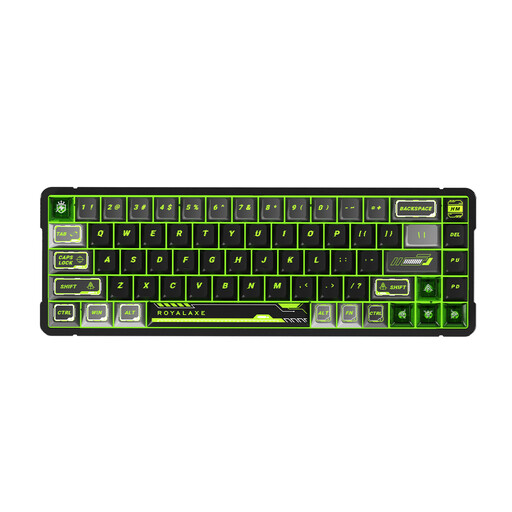 Image unavailable
The 65% layout may suit you if you want a compact keyboard with arrow and navigation keys.
The product name lists Gateron HE magnetic switches, a US layout and a wired connection.
Choose based on the commands you use directly: 75% may be more practical if you often need function keys, while 60% is a good fit if mouse space matters more and you’re happy to use secondary keys.
First, check which commands your game uses. If your chosen model supports key remapping, compare the available options with the key bindings you want, and check that the version and your computer are compatible.
ACM ConsuWijzer states that, in principle, products bought online come with a statutory cooling-off period that ends 14 days after delivery, although exceptions apply. Faulty products are also covered by the statutory guarantee; the seller must resolve the issue free of charge under the applicable conditions.
Yes. The EU Radio Equipment Directive sets requirements for placing equipment that uses radio signals on the market. Distributors must check, among other things, that the required CE marking is present; this is not a separate licence for the user.