
Home baker with perishable treats
If you store, for example, cream cakes or desserts made with crème pâtissière, you’ll want to be able to check the temperature and follow the dessert’s storage advice.


If you have limited worktop space, first choose a suitable spot and measure both that space and your largest dessert box. A slim freestanding tabletop fridge needs a clear space of its own, while an under-counter fridge will only fit a suitable alcove and requires the right installation. For perishable desserts, the Voedingscentrum recommends a fridge temperature of 4 °C. Check the actual temperature with a thermometer rather than relying on the setting alone. A thermoelectric cool box is not necessarily an equivalent alternative, as its stated cooling performance depends on the ambient temperature.
If you store, for example, cream cakes or desserts made with crème pâtissière, you’ll want to be able to check the temperature and follow the dessert’s storage advice.
If you don’t want to give up preparation space, compare a suitable freestanding spot with an appropriately sized under-counter alcove and the installation it requires.
If you store several tubs or dessert boxes at once, it’s worth checking the usable layout rather than looking only at the stated capacity in litres.
Best for: a clear spot where a narrow width is important.
Consider: the appliance takes up floor or cupboard space, and its stated capacity doesn’t tell you whether a tall cake box will fit.
Best for: several tubs or boxes, if you have enough space for a wider appliance.
Consider: a larger fridge capacity may require more space; check the actual temperature too.
Best for: a suitable alcove, if you want to keep the worktop clear.
Consider: the alcove dimensions, ventilation and door mounting must all be suitable for the model you choose.
Best for: situations where a small capacity is enough and you can check the actual storage temperature.
Consider: its stated cooling performance depends on the ambient temperature and doesn’t, by itself, prove that it will reach 4 °C.
| What to consider | What should you check? | Who is this important for? |
|---|---|---|
| Temperature for perishable desserts | Check the temperature range and, once the fridge is in place, measure it with a fridge thermometer. The Voedingscentrum recommends 4 °C. | If I store cream cakes or another perishable dessert, I want to check that the fridge is actually cold enough. Around 36% of consumers put confidence in the temperature first. |
| Keeping the worktop clear | Measure the width, height and depth of the space or alcove; check the door swing and installation requirements too. | If you want to keep preparation space on the worktop, you’ll need a suitable clear space or under-counter alcove. Around 29% of consumers make keeping their work area clear their top priority. |
| Space for boxes and tubs | Measure your largest box, including its lid, and compare it with the shelves, door opening and usable interior space. | If I chill several portions at once, I want to know whether my boxes will actually fit, not just how many litres the fridge holds. Around 21% of consumers prioritise space for dessert boxes. |
| Power consumption | Compare the stated annual energy consumption in kWh of models that meet your space and capacity requirements. Milieu Centraal highlights the annual consumption shown on the energy label. | If you’re mainly concerned about ongoing electricity use, compare the annual consumption and work out the running costs using your own tariff. Around 14% of consumers put electricity costs at the top of their list. |
The setting doesn’t show the temperature your dessert actually reaches in the spot where you’ve placed it.
Once the fridge is in place, take a measurement following the thermometer’s instructions, and follow the storage advice for the specific dessert.
An appliance may fit in the space, but the dessert box might not fit between the shelves or through the door opening. For an under-counter model, the alcove and door mounting must also be suitable.
Measure your largest box and check the usable internal dimensions, shelf positions and installation instructions for the exact model.
The right external dimensions don’t guarantee that you won’t need to rearrange the shelves or find somewhere else for your dessert boxes.
The stated maximum cooling performance may be relative to the ambient temperature. It doesn’t prove that the recommended fridge temperature for perishable desserts will be reached.
Only use this option for perishable desserts if it can reach and maintain the required temperature in your actual conditions of use.
The models reviewed offer different types of freestanding tabletop fridge.
The KK550S reviewed is a freestanding tabletop fridge with no stated freezer compartment.
The KUR21VFE0 reviewed is a built-in under-counter fridge designed for a suitable alcove and cabinet door.
The DURd 3600 reviewed is an under-counter model with specified alcove dimensions and door-on-door mounting.
The TCX 21 reviewed is a small, portable thermoelectric cool box, not an obvious substitute for a fridge for perishable baked goods.
These models are compact fridges for chilled storage near a worktop. Before you choose, check that the space available and the layout will suit your boxes and tubs.
 No image available
A freestanding tabletop model to consider if you want chilled storage without using worktop space.
Capacity: 88 litres. Three adjustable glass shelves. Energy rating E.
 No image available
A freestanding model to consider if you want to organise several tubs or dessert boxes.
Capacity: 129 litres. Dimensions: 54 × 54 × 88 cm. Two adjustable glass shelves and two door racks. Temperature controlled by a dial. Energy rating E.
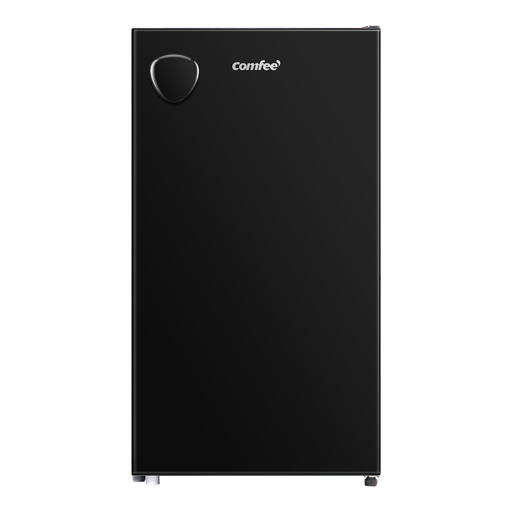 No image available
A freestanding model with a stated width of 44.5 cm, designed for a compact space. Check the room available and the door swing.
Capacity: 88 litres. Removable glass shelves, a crisper drawer, adjustable thermostat and reversible door. According to the product description, the separate chiller compartment is for short-term cooling only; don’t store anything in it for longer than 2 hours.
 No image available
A compact fridge to consider if its stated dimensions and shelf layout suit your space and dessert boxes.
Capacity: 90 litres. Dimensions: 449 × 485 × 842 mm. Three adjustable glass shelves. The chiller box has a stated temperature range of -5 °C to 5 °C, so check that the temperature is suitable for what you want to store in it.
 No image available
A freestanding model to consider if you’re looking for a compact fridge with adjustable shelves.
Capacity: 92 litres. Width: 47 cm. Adjustable glass shelves, crisper drawer and seven-position temperature control. Energy rating E.
The Voedingscentrum recommends setting the fridge to 4 °C. Place a fridge thermometer in the middle of the bottom shelf and check it after half a day or overnight; adjust the setting if needed. Follow the storage advice for the specific dessert or its packaging too.
Don’t assume so: a freestanding tabletop fridge and a built-in under-counter model are different types of appliance. Check the installation instructions, ventilation requirements and available space for the exact model. Bosch, for example, describes the KUR21VFE0 as an under-counter model with a flat hinge.
Compare the stated annual energy consumption in kWh and check for any installation costs. For a consumer purchase in the Netherlands, the seller is responsible for ensuring the product is of satisfactory quality. According to the Rijksoverheid, there is no fixed statutory two-year guarantee period; a manufacturer’s guarantee is in addition to your statutory rights.
No. Selling food means you need to consider the food safety rules that apply to your situation. The NVWA says that anyone who sells food from home several times a year must have a food safety plan. For checking the temperature of perishable food, the NVWA recommends a digital probe thermometer; a fridge display alone isn’t sufficient. These requirements apply to the sales situation described, not automatically to every private buyer.