
Vandaag of morgen in huis

Kwaliteit gegarandeerd

Welkomstaanbiedingen ontgrendelen: GRATIS bezorging | Tot 80% korting | Gratis 30 dagen JoyPlus-proefperiode
Download de app
A compact fridge may seem easy to choose: measure the space available, compare capacities and order a model that fits. But problems often only arise after delivery. A door that hits a cupboard, too little usable space or higher energy consumption than expected can make a bargain purchase less appealing.
This buying guide helps students, people living alone, homeworkers and office managers compare a mini fridge, tabletop fridge or small fridge objectively.
A fridge that is 47 cm wide will not automatically fit into every alcove. Check the height, depth, door swing and ventilation space too. Manufacturers often recommend leaving clear space around the appliance to allow heat to escape properly. The exact clearance is given in the instruction manual.
Also check which way the door opens. A fridge with a reversible door gives you more flexibility when placing it in a student room, studio flat or office.
A small internal compartment is not always suitable for long-term freezing. Some mini fridges have a compartment designed to keep already-frozen food cold for a short time. So check the capacity in litres, star rating and freezing capacity.
If you only want to store drinks, vegetables, dairy products and sandwich fillings, a fridge without a freezer compartment may be a better choice. A fridge with a freezer compartment is more practical for ice cream, frozen meals or frozen bread.
The EU energy label for fridges ranges from A to G. Lower annual consumption in kWh can matter more in the long run than a small difference in the purchase price. Always compare the figure for kWh per year, not just the letter on the label.
The actual cost depends on your energy tariff. A simple calculation is:
annual cost = kWh per year × your electricity tariff
A model listed as using 85 kWh per year consumes less energy according to its product specifications than a similar model using 139 kWh per year. The final cost may vary depending on the ambient temperature, settings and how you use it.
The right capacity depends on your shopping habits:
If you’re specifically looking for a 90-litre fridge, don’t just check the total capacity. A freezer compartment takes up some of the space, so check the fridge and freezer capacities separately.
Noise level matters in a bedroom, studio flat or open-plan office. Product information usually gives this in dB(A). Models at around 35 to 40 dB are generally considered less noticeable than appliances above 40 dB, but this can vary depending on the room and the surface they stand on.
Place the fridge on a stable, level surface and make sure it isn’t vibrating against a wall or piece of furniture. This can affect how loud it seems.
A mechanical dial is simple to use, but gives you less precise information than a digital setting. Look for:
A fridge without a freezer compartment often offers more usable fridge space. A model with a small freezer compartment is more convenient if you regularly store frozen food.
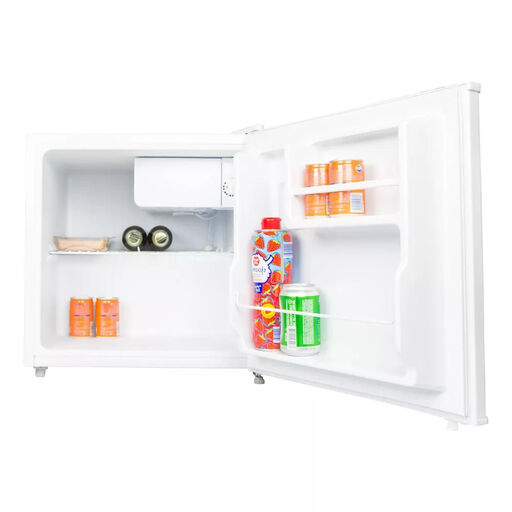
Why it suits this profile: Its 43-litre capacity is suitable for drinks, snacks and a small amount of food in a student room, guest room or office.
The product specifications list a 43-litre capacity, a noise level of 41 dB and a reversible door. According to the description, the freezer compartment is not designed for long-term freezing, so you know what to expect.
43-litre capacity, 41 dB noise level and a dial for adjusting the temperature.

Why it suits this profile: This model combines a width of 47.4 cm with 92 litres of fridge space and several storage options for everyday use.
The reversible door helps when space is limited. The product sheet lists 85 kWh per year, an E energy rating and 39 dB. No freezer capacity is specified.
92-litre capacity, adjustable glass shelves, salad drawer, chill drawer and seven temperature settings.

Why it suits this profile: With 95 litres of fridge space and a separate 14-litre freezer compartment, this model is suitable for everyday use in a studio flat, small flat or office.
The fridge and freezer capacities are listed separately. The product specifications also give an annual consumption of 89 kWh, a C energy rating and a noise level of 37 dB.
109-litre total capacity, 14 litres of freezer space, reversible door and LED interior lighting.
We’ve put together a complete, up-to-date list of products that meet these strict selection criteria and the applicable European safety regulations.
Place your compact fridge on a level surface and keep the ventilation openings clear. Don’t put the appliance right next to a radiator or in direct sunlight. After transporting a fridge, leave it upright for the time specified in the instruction manual before plugging it in. The recommended waiting time varies by model.
Don’t fill the fridge completely as soon as you switch it on. Give it time to reach the set temperature. Allow hot meals to cool to room temperature first, and check that the door closes properly. If your model needs manual defrosting, remove any ice build-up regularly.
A capacity of 43 to 60 litres may be enough for drinks, breakfast items and a few groceries. If you cook every day, you’ll generally need around 80 to 100 litres. A 90-litre fridge offers a practical middle ground, especially if you don’t need a large freezer compartment.
Check the stated annual consumption in kWh and multiply it by your electricity tariff. A model using 85 kWh per year may cost less to run than one using 139 kWh per year, but actual consumption depends on the temperature, positioning and use.
Its lifespan depends on build quality, ventilation, load and maintenance. Check the statutory guarantee and any additional manufacturer’s warranty. A model’s compressor, for example, may have a separate warranty period; check the product terms and instruction manual for details.
