
Cook with limited worktop space
You want to clean dishwasher-safe cutlery without making an already small cooking area unusable. Compare the external dimensions, the space needed for the door to open and where the appliance will stand.


First, measure the space for the appliance and its open door, then check where you can connect the water supply and waste outlet. A countertop model with a fixed connection suits a modest load; a model with a water tank is an alternative if you don’t have a fixed water supply. If you have floor space, a slimline freestanding dishwasher may offer more place settings. A smaller model isn’t automatically more energy-efficient: Milieu Centraal recommends considering the size of the appliance alongside how full you load it.
You want to clean dishwasher-safe cutlery without making an already small cooking area unusable. Compare the external dimensions, the space needed for the door to open and where the appliance will stand.
You want to wash cutlery along with plates and glasses. Check the cutlery layout and capacity, and consider whether you can usually fill the machine sufficiently.
You may be looking for a model with a water tank, but should also check where the waste water can go and whether the smaller load will be enough.
| What to consider | What should you check? | Who is this important for? |
|---|---|---|
| Installation space | Measure the width, depth and height, as well as the space needed for the open door and connections. | If I have limited kitchen space, I want to know whether the appliance will fit without blocking my worktop. Around 40% of consumers say installation space is their main concern. |
| Capacity and cutlery layout | Check the cutlery holder and make sure your cutlery won’t stop the spray arm from turning freely. | If I want to wash cutlery with my usual plates and glasses, the load needs to fit practically in the racks. Around 30% of consumers prioritise capacity and layout. |
| Water supply and drainage | For each model, check the water supply, the hose included and the route for draining water. | If there’s no fixed water supply, I need a suitable way to supply water without forgetting about drainage. Around 20% of consumers focus mainly on this. |
| Energy and water consumption | Compare the energy label on the same eco-cycle basis, taking capacity and the number of cycles needed into account. | If I want to factor in ongoing consumption, I compare the label information with the amount of washing-up I actually do. Around 10% of consumers prioritise consumption. |
A countertop model sits on the worktop, while a slimline freestanding machine also takes up height and depth. So the width alone won’t tell you whether the appliance will fit in the space.
Measure the entire installation space, the clearance for the open door and the route for the hoses and plug.
Getting the measurements wrong could make worktop space unusable or mean extra installation work.
A water tank replaces the fixed water supply, but used water still needs to be drained away.
Check the drainage route and the package contents for the exact model.
You may need a suitable drain hose or another drainage solution.
Milieu Centraal recommends considering the size of the appliance alongside how full you load it. A smaller appliance isn’t automatically more energy-efficient for the amount of washing-up you want to do.
Compare consumption on the same eco-cycle basis and consider how many cycles your load will need.
Running the machine more often means ongoing use of electricity, water and dishwasher detergent.
The number of place settings doesn’t automatically tell you whether your cutlery will fit in the basket or leave the spray arm free to turn.
Check the cutlery holder on the exact model and compare it with the pieces you use most often.
These examples cover the product ranges and models researched; their features don’t necessarily apply to every model from each brand.
The models researched include a countertop dishwasher and a slimline freestanding dishwasher.
The TDW5501B researched is a countertop model for a kitchen with space for a fixed water supply and drainage.
The Bob model researched can be supplied from a water tank, making it an option for a spot without a fixed water supply.
According to Klarstein, the Oceana model researched is a mini dishwasher that connects to a tap.
The range includes compact countertop models with different water-supply options, as well as a 45 cm-wide freestanding model for those with room for greater capacity. Check the installation requirements, connections and cutlery layout for each model.
 Image unavailable
A countertop model for a small kitchen; the product information lists manual filling or connection to the tap.
Built-in 5-litre water tank; up to 4 place settings; 9 programmes; 37 × 50 cm.
 Image unavailable
A compact model for a small load; the product information lists a tank or direct connection to the tap as water-supply options.
Room for 3 place settings; cutlery basket; 5-litre water tank; 7 programmes.
 Image unavailable
A freestanding model for those with floor space who want to wash cutlery along with a larger load of dishes.
45 cm wide; room for 13 place settings; VarioDrawer for cutlery and kitchen utensils.
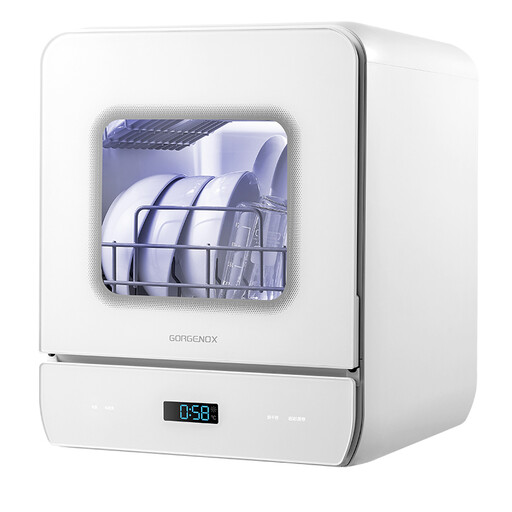 Image unavailable
A countertop model for limited worktop space and a small load.
Capacity for 3 place settings. The instructions say to use it indoors on a stable, level worktop; don’t touch hot or UV surfaces immediately after a cycle.
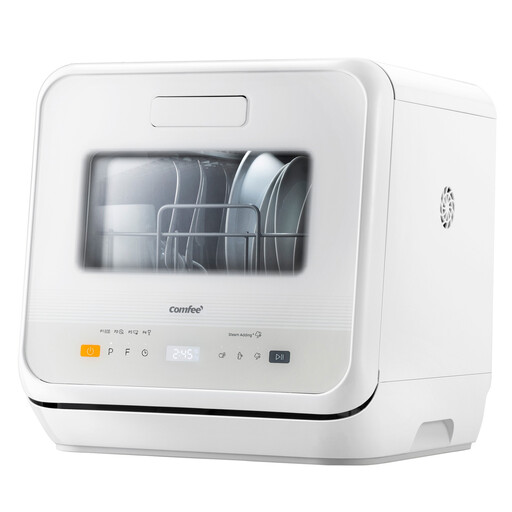 Image unavailable
The product information for this countertop model lists manual filling of the built-in tank or connection to the tap.
5-litre water tank; dimensions 420 × 435 × 435 mm; 6+3 programmes. The safety information specifies a 220–240 V earthed socket and says not to use an extension lead.
Not always. Check the care instructions for the specific cutlery and make sure it fits in the cutlery holder without blocking the spray arm. The dishwasher-safe label doesn’t tell you how much space a particular model offers.
Yes, used water still needs to be drained away. Daan Tech lists a drain hose for the Bob model researched; check the drainage route and package contents for the model you choose.
Compare the kWh per 100 eco cycles, water consumption per eco cycle and capacity shown on the energy label. The European Commission lists these as elements of the label. Also consider how many cycles you’ll need for your usual amount of washing-up.
Scrape food scraps off the dishes, avoid stacking crockery and cutlery in a way that blocks the water jets, and keep the spray arms clear. Follow the manual for the exact appliance when cleaning filters and carrying out maintenance.
The EU energy label for household dishwashers includes the energy class, energy consumption per 100 eco cycles, water consumption per cycle, capacity, programme duration and noise level. The European Commission describes these label details; compare appliances on the same basis.