Start by deciding whether you want the reflection to remain visible: a polarising filter can reduce glare, but it can also weaken the reflection you want to capture. Then choose a field of view and zoom range that will fit the windmill and the water in the frame from where you’re standing. If you can’t get closer, optical zoom range matters more. In bright light, also check the exposure options on the exact model: a built-in ND filter reduces the amount of light entering the lens, but it isn’t a polarising filter.
Who is this guide for?
Photographers who want to capture the windmill and its reflection together
You want to compose your shot carefully and decide how much of the reflection to keep in view. In this case, a wide field of view, where you’re standing and how you manage glare matter more than maximum telephoto zoom.
Photographers on the opposite bank
You can’t get closer to the windmill, so you want to use optical zoom to frame a tighter shot without losing sight of the wider landscape composition.
Photographers in changeable weather
You’re taking photos by the water and want to factor in verified protection against wet conditions, even if that means compromising on zoom range.
What should you look for?
| What to consider |
What should you look for? |
Who is this important for? |
| Reflections and glare |
Decide whether you want to keep the reflection. If you’re using a filter, check that the exact model can take it. |
If the reflection is part of your windmill photo, you won’t want to weaken it by accident. Around 36% of consumers give keeping or controlling reflections top priority. |
| Wide composition and exposure |
Check whether the windmill and water will both fit in the frame, and what exposure controls are available. An ND filter reduces the amount of light entering the lens; it doesn’t specifically reduce reflections. |
If you also want to include the surroundings and the reflection, field of view and light control are key. Around 29% of consumers prioritise this complete composition and exposure. |
| Zoom range from a distance |
Compare optical focal lengths on a like-for-like basis, and check the aspect ratio and aperture at the telephoto end. |
If you can’t get closer, you’ll want to frame the windmill larger using optical zoom. Around 21% of consumers make zoom range their top priority. |
| Protection in wet weather |
Check the protection rating and conditions for the exact model. Also make sure the zoom range suits where you’ll be standing. |
If you’re taking photos near splashing water or in changeable weather, protection may matter more than telephoto range. Around 14% of consumers prioritise this protection. |
Common pitfalls
-
Assuming less reflection is always better
A polarising filter can reduce reflections, but the reflection itself may be the subject of your photo. Nikon describes reducing reflections as one possible function of lens filters.
First decide how much of the reflection you want to keep. Before buying, check whether a suitable filter attachment is available for your camera model.
-
Confusing an ND filter with a polarising filter
Canon lists a built-in 3-stop ND filter for the PowerShot G7 X Mark III. It reduces the amount of light entering the lens, while Nikon describes polarising filters as filters that can affect reflections. They therefore serve different purposes.
Compare the effect you’re looking for, then check separately whether a filter and any necessary attachment will fit the exact model.
-
Looking only at the biggest zoom number
The stated range may depend on the aspect ratio or shooting mode. For the Panasonic TZ99, the 24–720 mm equivalent range applies to photos taken in the 4:3 aspect ratio.
Compare the range in the same photo mode, and also consider the wide-angle end, the aperture at the telephoto end and how far away you are from the windmill.
Brands to consider
Canon
The PowerShot G7 X Mark III is an option for wide compositions, with a short zoom and adjustable exposure.
- Canon specifies a 24–100 mm equivalent range, f/1.8–2.8 aperture and a built-in 3-stop ND filter.
- The ND filter isn’t a polarising filter, and the range ends at 100 mm equivalent.
Sony
The RX100 VII combines a range for wide and tighter shots with an electronic viewfinder.
- Sony specifies a 24–200 mm equivalent range, a 1.0-type sensor and an f/2.8–4.5 aperture.
- Check separately whether a filter attachment is possible for the way you want to control reflections.
Panasonic
The TZ99 is a travel zoom with an extensive range. The separate TZ300 has a shorter range and a 1.0-type sensor.
- For the TZ99, Panasonic specifies a 24–720 mm equivalent range for 4:3 photos, plus RAW shooting.
- The TZ99 has a 1/2.3-type sensor. Panasonic listed the TZ300 as unavailable on its Dutch product page; check its current status.
Ricoh
The GR IV suits photographers who prefer a fixed wide-angle lens to optical zoom.
- Ricoh specifies a fixed 28 mm equivalent field of view, a 23,3 × 15,5 mm sensor and DNG RAW storage.
- Without optical zoom, you can’t frame a distant windmill closer with the lens. These specifications don’t automatically apply to the GR IV HDF.
OM SYSTEM
The Tough TG-7 is an option if protection for wet-weather use outdoors is a major consideration.
- OM Digital Solutions specifies waterproofing to 15 m, IP6X dustproofing and a 25–100 mm equivalent range.
- These specifications alone don’t tell you how well it controls reflections or whether it can frame a distant windmill to your liking.
Compact cameras at Joybuy
These Joybuy picks are compact cameras for landscape photography and zoom framing; the type of zoom varies by model.
 No image available
Komery W6 camera, 12× optical zoom
Ideal if you want to take landscape photos and frame a tighter shot using optical zoom.
12× optical zoom; Wi-Fi.
View at Joybuy
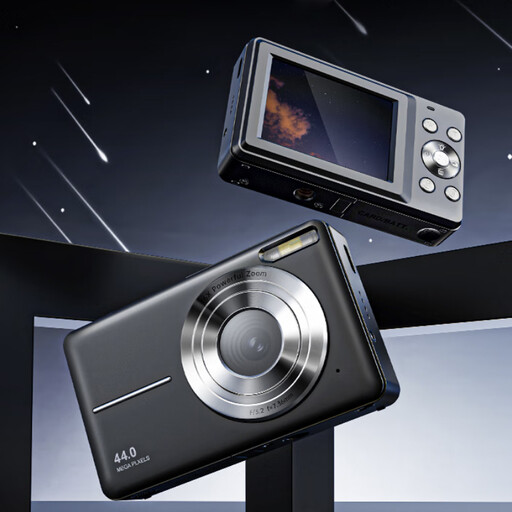 No image available
Songdian pocket camera, 4K, 44 MP
Ideal if you want a pocket camera to take with you and digital zoom for tighter framing.
16× digital zoom; autofocus.
View at Joybuy
 No image available
Songdian 5K camera, 56 MP, 10× optical zoom
Ideal if you want to frame a tighter shot using optical zoom for landscape photography.
10× optical zoom; electronic image stabilisation.
View at Joybuy
Frequently asked questions
Does an ND filter help with glare on the water?
An ND filter reduces the amount of light entering the lens, while a polarising filter can affect reflections and glare. If you want to keep the reflection, first decide whether you want to reduce it.
What should you check before buying a polarising filter?
Check whether a suitable filter attachment is available for your exact compact camera model. A built-in ND filter doesn’t mean a polarising filter will fit. Nikon explains that filters can serve different purposes, including affecting reflections.
What should you do if your camera turns out to be faulty after purchase?
According to the Dutch government, if there’s a problem with a consumer purchase, you should contact the seller. You’re entitled to a product that works properly; the seller can’t make you contact the manufacturer yourself. A manufacturer’s warranty is separate from this legal right.
Can you share a windmill photo publicly if passers-by are recognisable?
Not necessarily: according to the Dutch Data Protection Authority, identifiable people are personal data, and privacy rules are relevant when publishing images publicly. The Authority describes an exception for sharing solely for personal or household purposes within a limited circle. Which rules apply depends on how the image is used.


