
Walker who frames landscapes
You want to capture the whole windmill, the sky and the foreground in one shot from the route, without carrying interchangeable lenses.


If your main aim is to capture the windmill and its surrounding landscape, choose a fixed wide-angle lens if its field of view suits your position. If you also want to make a distant windmill appear larger in the frame, compare compact cameras with optical zoom. Also consider image stabilisation for stills, the sensor and the lens aperture. Stabilisation helps counter camera shake, but capturing moving sails still requires an appropriate shutter speed. Specifications from Sony, Canon, Panasonic, Ricoh and Fujifilm are manufacturer information, not an independent performance comparison.
You want to capture the whole windmill, the sky and the foreground in one shot from the route, without carrying interchangeable lenses.
You can’t get any closer and want to capture a distant windmill larger in the frame as well as taking a wide shot.
You take handheld photos as the light changes and want to tell the difference between camera shake and blur caused by moving sails.
Suitable for: framing a landscape from a suitable position using a single, fixed field of view. The Ricoh GR IV offers approximately 28 mm equivalent, while the Fujifilm X100VI offers approximately 35 mm, according to Ricoh and Fujifilm.
Bear in mind: both have a fixed lens and no optical zoom, so check that the windmill and the surroundings you want to include will fit in the frame.
Suitable for: a walking route where you can’t keep changing your position. Canon lists 24–100 mm, Sony 24–200 mm and Panasonic 24–360 mm equivalent for the TZ300.
Bear in mind: zoom range alone doesn’t tell you how a camera performs in low light. Compare the sensor, lens aperture and controls too.
Suitable for: framing distant windmills more tightly from a fixed, accessible position. Panasonic lists 24–720 mm equivalent for the TZ99 at a 4:3 aspect ratio.
Bear in mind: the TZ99 has a 1/2.3-inch sensor and a maximum aperture of f/6.4 at the telephoto end. Consider these features separately if you also take photos in lower light.
| What to consider | What to look for | Who should pay extra attention? |
|---|---|---|
| Framing the windmill and the landscape | Compare the field of view in 35 mm equivalent with your position, and check that the foreground and sails will fit in the frame. | If I want to capture both the windmill and its surroundings in one shot from a path, a wide-angle view is my priority. Around 28% of consumers rank landscape framing first. |
| Making a distant windmill appear larger | Compare the optical telephoto range at the same aspect ratio and check the maximum aperture at the telephoto end. | When I can’t get closer, I want to adjust my framing optically. Around 22% of consumers give reach for distant windmills their highest priority. |
| Taking handheld photos in lower light | Check what type of stabilisation applies to stills, and also look at the sensor size and lens aperture at the focal length you use. | If I’m taking photos without a tripod as the light changes, I want to minimise camera movement as much as possible. Around 22% of consumers say low-light capabilities are their main consideration. |
| Movement of the sails | Check whether you can control the shutter speed. Image stabilisation for stills doesn’t automatically correct subject movement. | If I want to show the moving sails sharply or deliberately add motion blur, shutter speed control is my first consideration. Around 17% of consumers give how the sails appear the highest priority. |
| Taking it on a walk | Compare the dimensions and weight, and try the controls and the screen or viewfinder with the camera in your hand. | When I’m walking for a long time, what matters most is whether the camera is comfortable to carry and hold. Around 11% of consumers put portability first. |
A zoom factor doesn’t tell you on its own how much of the landscape will fit in the frame. Panasonic lists different 35 mm equivalent ranges for the TZ99 at different aspect ratios.
Compare the wide-angle and telephoto ranges in 35 mm equivalent at the same photo setting, and check that both suit your position.
Camera shake and moving sails are different causes of blur. Image stabilisation for stills isn’t a substitute for an appropriate shutter speed.
Choose a shutter speed to achieve the effect you want, and review test shots in the available light.
The Ricoh GR IV and Fujifilm X100VI have fixed fields of view of approximately 28 mm and 35 mm equivalent respectively; you can’t zoom out optically.
Check the framing from an accessible position before choosing a fixed field of view. If your position or framing often changes, compare zoom models instead.
According to the Dutch government, if a product is faulty, the seller must provide a solution. An optional additional warranty package is not the same as these statutory rights.
Compare the terms of an additional package with your existing rights before deciding.
The Lumix TZ99 and TZ300 are travel compact cameras worth comparing if you want to frame both landscapes and details further away.
The RX100 VII is a compact zoom model to consider if you want to take both wide shots and tighter shots with one camera.
The GR IV is a pocket-sized fixed wide-angle option for framing landscapes from a suitable position.
The PowerShot G7 X Mark III is a compact zoom model to compare if a more limited telephoto range is enough for you.
The X100VI is an option if you want to work with a fixed, relatively narrower field of view for landscapes and a viewfinder.
This selection includes compact cameras and other camera setups for taking photos on the go. Check each model to make sure its camera type, zoom and listed features suit the way you photograph windmill landscapes.
 No image available
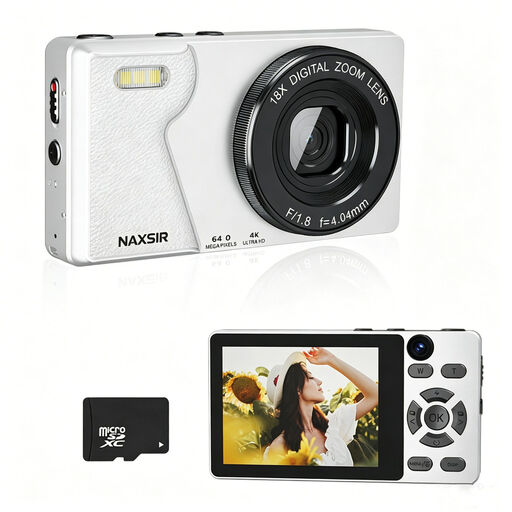
A compact camera to consider if you want to adjust the framing digitally from one position.
The product name lists 64 MP photo resolution, 4K video, autofocus, 18× digital zoom and an included 32 GB memory card. The zoom is digital, not optical.
 No image available
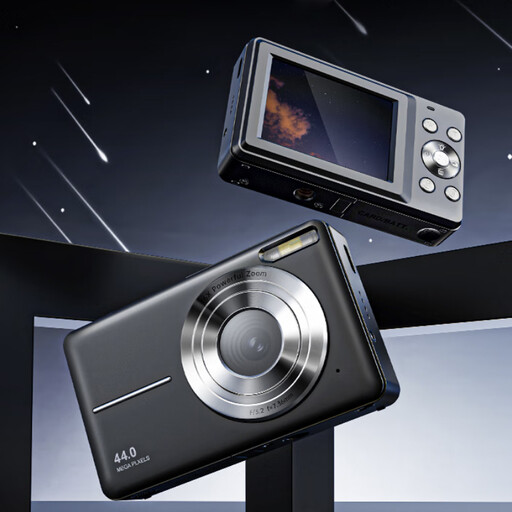
A pocket camera to consider if you want to carry a small camera and adjust the framing digitally.
The product name lists 44 MP photo resolution, 4K video and 16× digital zoom. The zoom is digital; the product information doesn’t mention optical zoom.
 No image available
A compact zoom model to consider if you want to adjust the framing from your position.
The product description lists a 24–70 mm lens, 2.7× optical zoom, a 1-inch sensor, 20 MP and image stabilisation.
 No image available
This kit is an interchangeable-lens camera setup, not a compact camera with a fixed lens. Bear that in mind if you’re looking for a camera that doesn’t require you to change lenses.
The product description lists a 24.2 MP APS-C sensor and digital Active Mode stabilisation for video. The kit includes a 16–50 mm power zoom lens.
 No image available
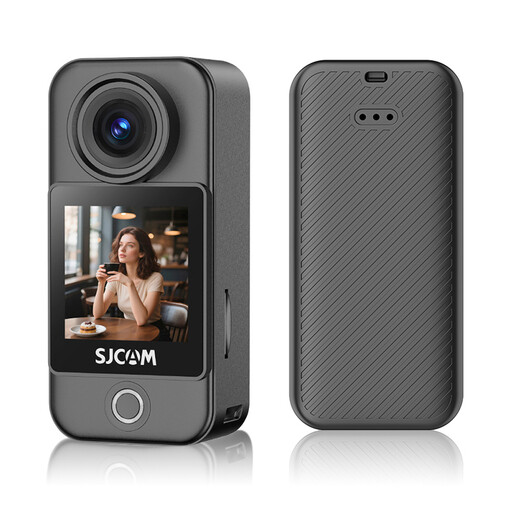
This is an action camera, not a standard compact camera. Consider this model only if you specifically want an action camera for taking out and about.
The product description lists a 154° lens, photos up to 16 MP, a weight of 54 g and six-axis gyro stabilisation for video recording.
Image stabilisation is designed to counter camera movement, not to freeze moving sails. Choose a shutter speed to achieve the effect you want: a shorter exposure to freeze more movement, or a longer one to make it visible. Canon Netherlands explains how shutter speed affects the way movement appears.
Check that your battery and a suitable storage medium are ready, practise using your chosen field of view and find the shutter speed setting. Ricoh lists internal memory and microSD support for the GR IV; don’t assume every compact camera uses the same storage medium.
Before using the camera in the rain or cleaning it, check the instructions for your exact model in its manual, including guidance on rain, dust and cleaning. Don’t assume a camera is weather-resistant just because it’s compact.
According to the Dutch government, if a product is faulty, the seller must provide a solution. The Netherlands has no fixed statutory warranty period; what you can expect depends, among other things, on the product and the purchase information. A paid additional package doesn’t replace your statutory rights.
Don’t assume that you can access every area. Staatsbosbeheer refers visitors to the access rules and signs at the entrances to its nature reserves. Also check the rules set by the manager of the specific windmill site.