What should you look for when choosing?
First decide whether the surroundings or distant details matter more. Then compare portability and the lens and sensor characteristics for the light you’ll be shooting in.
| What to consider |
What to look for |
Who is it important to? |
| Windmill and landscape together |
Compare the wide-angle view in 35 mm equivalent and check whether the windmill and its surroundings will fit in your frame. The Consumentenbond describes wide-angle lenses as a common choice for landscapes. |
I want to capture the sky, water and windmill together; around 31% of consumers say a wide landscape is their top buying priority. |
| Distant details |
Check the focal length range in mm equivalent and whether the zoom is optical. Panasonic specifies 30× optical zoom for the DC-TZ99, while Canon specifies 40× for the PowerShot SX740 HS Lite Edition. |
If I want to frame details on the other side of the water more closely from one spot, zoom range is key; around 25% of consumers give distant details top priority when buying. |
| Carrying it on a walk |
Compare weight on a like-for-like basis, and also consider dimensions, grip and controls. Panasonic and Canon both list the weight of the models mentioned with the battery and memory card included. |
I want to carry the camera comfortably throughout the walk and use it quickly; around 25% of consumers put portability first. |
| Changing light |
Compare the sensor type and maximum lens aperture at the focal length you’ll use; the Consumentenbond identifies the lens and sensor as relevant factors in photo quality. |
When the light changes during my outing, I want to take the lens and sensor into account; around 19% of consumers say photographing in changing light is their top buying priority. |
Camera brands to compare
These brands offer different choices of angle of view and zoom; the features listed apply to the specific models and versions mentioned.
Sony
The Sony RX100 VII is a compact camera with a stated range of 24–200 mm equivalent and a Type 1.0 sensor.
- Its angle of view and optical zoom range give you different ways to frame landscapes and subjects; these are Sony’s model specifications.
- Its telephoto range ends sooner than those of the Panasonic and Canon travel zoom models mentioned here. This compares stated ranges, not measured photo quality.
Panasonic
The LUMIX DC-TZ99 is a travel zoom camera for which Panasonic specifies 30× optical zoom.
- Panasonic lists 24–720 mm equivalent for 4:3 photos.
- The equivalent angle of view changes with other aspect ratios and video settings. Panasonic specifies a Type 1/2.3 sensor and a maximum lens aperture of f/3.3–6.4 for this model.
Canon
The PowerShot SX740 HS Lite Edition is a compact camera with a stated range of 24–960 mm equivalent, according to Canon.
- Canon specifies 40× optical zoom; a higher combined zoom figure is not the same as optical zoom.
- For the black Lite Edition reviewed here, Canon says USB charging is not supported. Check the exact version and the accessories included.
Ricoh
For the GR III, Ricoh lists a fixed 28 mm equivalent angle of view, designed for a wide composition.
- Its fixed angle of view can work well when you want the windmill and its surroundings in the same frame.
- The GR III has no optical zoom. Ricoh says the GW-4 wide conversion lens requires a GA-1 adapter and is not compatible with the GR IIIx.
Fujifilm
Fujifilm’s X100VI specifications list a fixed lens with a 35 mm equivalent angle of view and in-body image stabilisation.
- Its fixed angle of view gives you a clear starting point for framing; these specifications are from Fujifilm’s US product page.
- A fixed angle of view calls for a suitable viewpoint. The digital teleconverter is not optical zoom.
Compact cameras at Joybuy
These Joybuy products are compact cameras for days out, with different zoom specifications for framing subjects at a distance.
 No image available
KOMERY G7 5K digital camera – white
The product name lists 18× zoom; check that the type of zoom suits your needs for photographing distant details.
The product name also lists 80 MP; this is a product claim, not a measure of photo quality.
Joybuy
 No image available
Komery W6 4K camera with 12× optical zoom
The stated 12× optical zoom may be useful if you want to zoom in from one spot; also consider whether the wide-angle view suits the landscape.
The product name lists 4K video and WiFi.
Joybuy
 No image available
Songdian 5K camera with 8× optical zoom – white
The product name lists 8× optical zoom; compare the range with the distance from which you want to photograph the windmill.
The product name also lists a dual lens.
Joybuy
 No image available
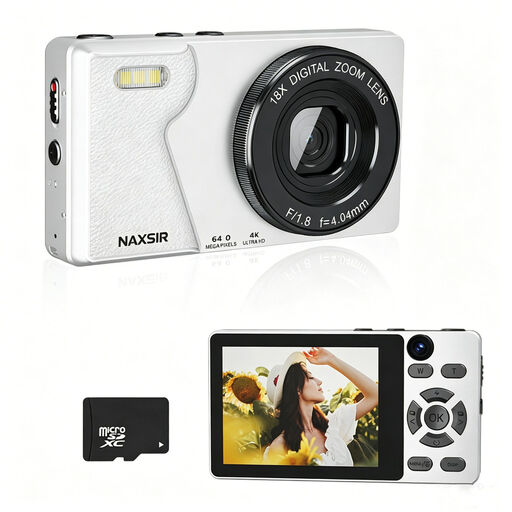
NAXSIR 4K camera with 18× digital zoom and 32 GB card
The product name lists 18× digital zoom; digital zoom is not the same as optical zoom for framing distant details.
The product name says a 32 GB memory card is included.
Joybuy
 No image available
Songdian 4K pocket camera with 16× digital zoom – pink
The product name describes a pocket camera for photos and video; its stated 16× digital zoom is not optical zoom.
The product description lists a maximum video resolution of 1920×1080P.
Joybuy
Frequently asked questions
For a windmill landscape, should I focus mainly on megapixels or the lens?
Start with the angle of view you need from your chosen spot. The Consumentenbond describes wide-angle lenses as a common choice for landscapes and lists the lens and sensor as factors in photo quality; more megapixels do not automatically mean better photos.
What should I check before taking the camera with me?
Check that the battery and memory card are suitable for the version you’ve chosen, and try the controls before you set off. Don’t assume every camera can be charged via USB: Canon says this is not supported for the black PowerShot SX740 HS Lite Edition reviewed here.
How should I protect and care for my camera after an outing involving moisture or sand?
Check the protection rating and instructions for your exact camera before exposing it to moisture or sand. The Consumentenbond says damage from moisture and sand is usually not covered by the warranty; that does not mean every model has the same level of sealing.
Who should I contact if a camera I bought in the Netherlands turns out to be faulty?
According to the Dutch government, the seller must provide a solution when a product is faulty. The Netherlands does not have a fixed statutory warranty period of two years; among other things, what you can reasonably expect from the product and the cause of the problem are taken into account.
Can I photograph identifiable visitors at a windmill and post the photo online?
Taking a photo for private use is not the same as publishing it more widely. The Dutch Data Protection Authority explains that the exception for personal or household use does not apply, for example, when posting on a public Facebook page. Whether a particular publication is permitted depends on the circumstances and an applicable legal basis.


