Start with the photo you want to take from your chosen spot: for a wide view, the wide-angle end matters, while an optical zoom helps you frame a distant detail. If you also take photos at dusk, compare the aperture and image stabilisation of the specific model; stabilisation compensates for camera shake, but it won’t freeze passers-by in motion. A camera with a fixed angle of view may suit you if you mainly photograph scenes within walking distance and don’t need zoom.
Who is this guide for?
Photographer capturing the whole square
You want to fit buildings and the space between them into one frame from a practical vantage point. So, compare the angle of view in full-frame equivalent millimetres first, not just the maximum zoom. The Consumers’ Association (Consumentenbond) identifies zoom range as something to consider when choosing a camera.
Walker in changing light
You take photos without a tripod, even as the light fades, and want to assess camera shake and people’s movement separately. Image stabilisation and shutter speed answer different questions: Canon Netherlands explains that a fast shutter speed is needed to capture movement.
Photographer capturing distant details
You want to frame an ornament or part of a façade from across the square without walking over to it. Compare the optical telephoto range and bear in mind the trade-off between zoom range and the other features that matter in your lighting conditions.
What should you look for in a camera for a town square?
Fixed wide-angle lens
Suitable if: you mainly take wide shots of squares and scenes within walking distance, and want to work with a single angle of view.
Trade-off: without optical zoom, you’ll need to change position or crop the image afterwards to capture a distant detail. Ricoh specifies an equivalent focal length of approximately 28 mm and five-axis stabilisation for the GR IV.
Short, relatively fast zoom
Suitable if: you want to switch between the square and closer details from the same spot, even as the light changes.
Trade-off: the range is shorter than on longer zoom options, and the maximum aperture changes as you zoom. Canon specifies an equivalent focal length of 24–100 mm and an aperture of f/1.8–f/2.8 for the PowerShot G7 X Mark III.
Mid-range zoom with viewfinder
Suitable if: as well as wide views, you want to frame more distant details and an electronic viewfinder is important to you.
Trade-off: Sony specifies an equivalent focal length of 24–200 mm and optical stabilisation for stills on the DSC-RX100M7; the maximum aperture ranges from f/2.8 at the wide-angle end to f/4.5 at the telephoto end.
Long travel zoom
Suitable if: capturing details on tall buildings or across the square from where you’re standing is a priority.
Trade-off: don’t choose based solely on the biggest zoom figure: assess image quality and low-light photography separately. Panasonic specifies an equivalent focal length of 24–720 mm and 30× optical zoom for the DC-TZ99.
Fixed, narrower angle of view with viewfinder
Suitable if: you’d rather have a fixed composition and viewfinder controls than the flexibility to zoom out from the same spot.
Trade-off: Fujifilm specifies an equivalent focal length of approximately 35 mm and five-axis in-body image stabilisation for the X100VI. Without optical zoom, check in advance that this angle of view will capture the square from where you’re standing.
| What to consider |
What to look for when buying |
Who is this important to? |
| Fitting the whole square into the frame |
Compare the angle of view in full-frame equivalent millimetres and check which edges of the square need to be in shot from your own vantage point. |
If I can’t move further back, I want to know in advance whether the buildings and the space between them will fit in the frame together. Around 36% of consumers put a wide view of the square first. |
| Sharp handheld photos in changing light |
Check image stabilisation for stills, the maximum aperture at the zoom setting you use and whether you can set the shutter speed. |
When I’m taking photos as the light fades, I want to assess camera shake and moving passers-by separately. Around 29% of consumers prioritise handheld photography in changing light. |
| Framing distant details |
Compare the optical telephoto range in full-frame equivalent millimetres and distinguish optical zoom from digital zoom. |
If I want to bring a façade detail closer from across the square, that matters more to me than simply getting a wide view. Around 21% of consumers put distant details first. |
| Taking a camera along for spontaneous scenes |
Compare the weight including the battery, the dimensions and whether it has a viewfinder or tilting screen. |
If I want to capture unexpected scenes while out walking, the camera needs to be comfortable to carry and quick to frame a shot with. Around 14% of consumers prioritise portability for spontaneous scenes. |
Buying pitfalls
-
Looking only at the biggest zoom figure
For a wide view, the wide-angle end matters; for a distant detail, it’s the telephoto end. A longer zoom range alone doesn’t prove that a camera performs better in low light.
Compare both ends of the range in full-frame equivalent millimetres and assess the lighting conditions separately.
-
Confusing image stabilisation with freezing passers-by in motion
Stabilisation can help compensate for camera shake, but a person walking may still look blurred in the photo.
As well as stabilisation, check which shutter speeds you can set for moving subjects.
-
Choosing a fixed angle of view without checking your vantage point
A fixed 35 mm lens, for example, gives you a different composition from a 24 mm wide-angle lens. Without optical zoom, you can’t widen the frame from the same spot.
Decide which buildings need to be in shot and whether you can step back on the square.
Camera brands to consider
Canon
The PowerShot G7 X Mark III is a compact camera with a short zoom for wide views and closer details.
- Canon specifies an equivalent focal length of 24–100 mm and an aperture of f/1.8–f/2.8.
- Its telephoto range is shorter than those of the Sony and Panasonic models discussed here; this is a comparison of specifications, not an independent performance test.
Sony
The DSC-RX100M7 combines a wide-angle lens, mid-range zoom and electronic viewfinder.
- Sony specifies a 24–200 mm range and optical stabilisation for stills.
- The maximum aperture changes from f/2.8 to f/4.5; the specifications describe features of this model, not a quality claim about all Sony cameras.
Panasonic
The LUMIX DC-TZ99 is designed for anyone who wants to frame details from a long distance.
- Panasonic specifies an equivalent focal length of 24–720 mm and 30× optical zoom.
- Check that the specific variant is available from the retailer before making your choice.
Ricoh
The GR IV is a compact camera with a fixed wide-angle lens for square scenes within walking distance.
- Ricoh specifies an equivalent focal length of approximately 28 mm, an APS-C sensor and five-axis stabilisation.
- There’s no optical zoom, which makes it less flexible for framing a detail on a distant building from the same spot.
Fujifilm
The X100VI has a fixed angle of view and a viewfinder for anyone who deliberately chooses a narrower composition.
- Fujifilm specifies an equivalent focal length of approximately 35 mm and five-axis stabilisation under the stated measurement conditions.
- The lens has no optical zoom; check whether its fixed angle of view will capture the whole square from where you’re standing.
Joybuy cameras for handheld use
The Joybuy options below include handheld cameras, pocket gimbals and action cameras. For each model, check that the stated lens angle, zoom and photo or video features suit the way you want to photograph town squares.
 No image available
DJI Osmo Pocket 4 Standard Combo
The stated 20 mm wide-angle lens is worth considering if you want to capture a wide scene handheld.
The product information lists a 20 mm f/2.0 wide-angle lens and 2× lossless zoom. According to the product information, 4K/240fps is only available in slow-motion mode.
View at Joybuy
 No image available
Komery W6 camera
The stated optical zoom may be useful if you want to frame a distant detail from the same spot.
The product title lists 12× optical zoom and 4K video.
View at Joybuy
 No image available
DJI Osmo Pocket 3
The product information mentions both photos and video; check that the features described suit the balance you want between the two.
The title lists a 1-inch CMOS sensor and 4K/120fps video. The product information describes mechanical 3-axis stabilisation for video.
View at Joybuy
 No image available
Songdian 5K digital camera, 10× optical zoom
The stated optical zoom may be useful if you want to frame a façade detail more closely from the same spot.
The product title lists 10× optical zoom. The product information mentions a front and rear camera.
View at Joybuy
 No image available
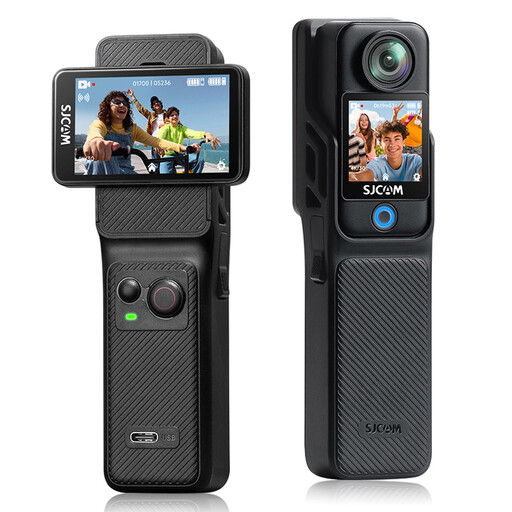
SJCAM C400 4K action camera
The stated wide lens angle may be useful if you want to capture an expansive scene; check that the camera also suits the way you want to take photos.
The product title lists a 154° lens angle and photos up to 16 MP. The stated 6-axis gyro-EIS is for video.
View at Joybuy
Frequently asked questions
Does image stabilisation also help keep people walking in sharp focus?
Not on its own. Stabilisation is designed to compensate for camera shake; to freeze a person’s movement, shutter speed is what matters most. Check both features separately.
What should you do after a walk if there’s dust or sand on your camera?
Keep the camera in a clean case or bag and carefully remove any grains of sand. The Consumers’ Association (Consumentenbond) recommends using a blower brush and a microfibre cloth on the lens, and not applying cleaning fluid directly to it.
Do you need to buy an extra warranty for a camera in the Netherlands?
No, you don’t need an extra warranty to have statutory rights. According to the Dutch government, there is no fixed statutory warranty period in the Netherlands; what you can expect from a product depends on the circumstances. If you’re considering a paid extended warranty, check whether it actually gives you additional rights.
Can you publicly share photos of the square that show identifiable passers-by?
Not necessarily. According to the Dutch Data Protection Authority, the exception for personal or household use does not apply when photos are shared more widely, for example on a public social media page. Such a publication needs an applicable GDPR legal basis; this is neither a blanket ban nor general permission for every individual publication.


