Which compact camera is right for you?

Panorama and reflection photographer

You want to frame both the buildings and their reflection in a single shot from the riverbank. Start by considering the field of view and the composition from a spot you can actually reach. Canon Netherlands also recommends varying the camera height.

Evening photographer by the water

You’re photographing an illuminated skyline and want to control exposure and movement in the water. Compare aperture, sensor size and manual settings; image stabilisation and a steady camera setup are not the same thing.

Detail seeker on the opposite bank

You want to frame individual buildings on the opposite bank as well as the wider scene. Optical zoom gives you more scope to do this than a fixed wide-angle lens, without needing to change your position.

What should you look for when choosing?

Compact wide-angle zoom

Best for: a wide river panorama with some room to zoom in, such as the 24–100mm-equivalent range of the Canon PowerShot G7 X Mark III.

Trade-off: the telephoto range is shorter than on a travel zoom. The built-in 3-stop ND filter controls light for longer exposures, not the strength of the reflection. Canon Netherlands lists these specifications too.

Compact camera with a fixed field of view

Best for: composing your shot from a fixed position. The Ricoh GR IV has a fixed field of view of around 28mm equivalent; the Fujifilm X100VI is around 35mm equivalent.

Trade-off: there’s no optical zoom. Especially with a field of view of around 35mm equivalent, check that the skyline and its full reflection will fit in the frame. Fujifilm lists a built-in 4-stop ND filter for the X100VI.

Compact zoom for distant buildings

Best for: framing individual buildings on the opposite bank. The Sony RX100 VII has a 24–200mm-equivalent range; the Panasonic TZ99 offers 24–720mm equivalent in 4:3 photo mode.

Trade-off: Sony lists a maximum aperture of f/2.8–4.5 for the RX100 VII and no built-in ND filter. Panasonic specifies a 1/2.3-inch sensor and f/3.3–6.4 for the TZ99. Compare these features individually for evening photography.

Consideration What should you check? Who should prioritise this?
Framing the skyline and its reflection together Check the widest field of view in 35mm equivalent and assess the frame from a position you can reach. With a fixed lens, you’ll need to move rather than zoom in. If I want to include both the buildings and their reflection in one composition from the riverbank, the field of view is the first thing I check. Around 36% of consumers prioritise this framing.
Photographing in evening light Compare sensor size, maximum aperture, RAW support and manual exposure for each model. A specification alone doesn’t guarantee image quality. When photographing an illuminated skyline, I want to set the exposure myself and account for dark areas in the image. Around 29% of consumers put this exposure flexibility first.
Keeping the reflection sharp or showing movement in the water Decide whether you want a clear reflection or blurred movement in the water. For a long exposure, check the available settings and how you can keep the camera steady. If I want to control how reflections and movement in the water look, I consider exposure controls and filter choice. Around 21% of consumers put this creative control first.
Picking out buildings on the opposite bank Check the optical zoom range and the aperture at the telephoto end. A long telephoto range is no substitute for the wide field of view needed for a panorama. When I want to capture an individual building on the opposite bank as well as the skyline, optical zoom is essential. Around 14% of consumers prioritise these distant details.

Common buying mistakes

  • Buying a polarising filter to make the reflection stronger

    A polarising filter can actually reduce reflections on water, as Canon Netherlands explains. This means it may weaken the effect you’re trying to capture.

    First decide whether the reflection is your subject or whether you’re trying to reduce distracting glare. Then check whether any filter you’re considering is compatible with your camera model.

  • Assuming the biggest zoom range is automatically the best choice

    For a distant view with a reflection, a wide field of view is important so you can fit both into the composition. Telephoto zoom is most useful for tighter shots of buildings on the opposite bank.

    Compare the widest equivalent field of view, the telephoto range and the aperture at the telephoto end.

  • Expecting image stabilisation to freeze moving water

    Image stabilisation is designed to counter camera movement; water movement is a different cause of blur. A longer shutter speed can actually blur the water.

    Choose a shutter speed to achieve the look you want for the water, and think in advance about how you’ll keep the camera steady.

Brands to consider

Canon

The PowerShot G7 X Mark III combines a compact zoom with a wide starting range for panoramas.

  • Canon lists a 1.0-type sensor, f/1.8–2.8, a 24–100mm-equivalent range and a built-in 3-stop ND filter.
  • Its optical telephoto range is shorter than that of the travel zoom models described here.

Sony

The RX100 VII combines a wide field of view with zoom for more distant buildings.

  • Sony lists a 1.0-type sensor, optical stabilisation and an electronic viewfinder, alongside a 24–200mm-equivalent range.
  • The maximum aperture ranges from f/2.8 to f/4.5; the specifications state that there’s no built-in ND filter.

Fujifilm

The X100VI is designed for those who prefer a fixed field of view and direct exposure control.

  • Fujifilm specifies an APS-C sensor, 40.2 megapixels, image stabilisation and a built-in 4-stop ND filter.
  • The fixed lens has no optical zoom. Check whether its field of view of around 35mm equivalent leaves enough room for the reflection from the riverbank.

Ricoh

The GR IV offers a fixed field of view of around 28mm equivalent for a spacious composition.

  • Ricoh lists an APS-C sensor, around 25.74 effective megapixels, RAW and manual exposure.
  • The fixed lens can’t optically magnify distant buildings.

Panasonic

The Lumix TZ99 is a travel zoom for capturing a range of compositions from one spot on the riverbank.

  • Panasonic specifies 30× optical zoom and RAW. Its stated 24–720mm-equivalent range applies in 4:3 photo mode.
  • The specifications list a 1/2.3-inch sensor and f/3.3–6.4; bear this in mind when considering it for evening photography.

Joybuy products

Joybuy product picks related to this topic, including compact and pocket cameras for photography and video.

DJI Osmo Pocket 4 Standard Combo pocket gimbal camera

DJI Osmo Pocket 4 Standard Combo

For anyone looking for a compact pocket camera for photography and video. For a river panorama, check that the field of view suits your chosen composition from the riverbank.

The product name lists a 1″ CMOS sensor, 4K/240fps, 3-axis stabilisation, 2× lossless zoom and 107 GB of built-in storage.

The name also lists a 2-inch rotatable screen.

Joybuy

Komery W6 digital camera

Komery W6 digital camera

For anyone looking for a digital camera with optical zoom. When photographing a skyline, check the field of view you’ll need from the riverbank too.

The product name lists 12× optical zoom, Wi-Fi and 64 MP.

Joybuy

DJI Osmo Pocket 3 pocket camera

DJI Osmo Pocket 3

For anyone looking for a compact pocket camera for photography and video. For a river panorama, check that the field of view suits your chosen composition from the riverbank.

The product name lists a 1″ CMOS sensor, 4K/120fps, 3-axis stabilisation and fast focusing.

The name also lists face and object tracking and a 2-inch rotatable touchscreen.

Joybuy
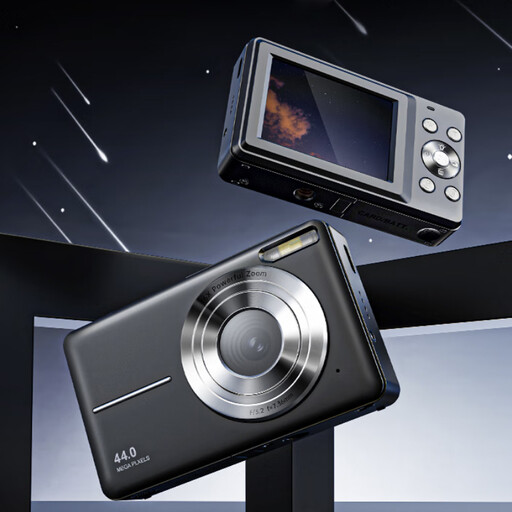
Songdian Pocket Camera 4K, black

Songdian Pocket Camera 4K, black

For anyone looking for a pocket camera for photography and video. For a skyline composition, check the field of view from where you’ll be standing.

The product name lists 44 MP and 16× digital zoom; the stated zoom is digital, not optical.

Joybuy
Songdian 5K digital camera, black

Songdian 5K digital camera, black

For anyone looking for a digital camera with optical zoom. For a river panorama, also check that the field of view suits your chosen shooting position.

The product name lists 56 MP and 10× optical zoom, with front and rear cameras.

Joybuy

Frequently asked questions

Which field of view helps you photograph buildings and their reflection?

Start with the widest optical setting and check from your position on the riverbank whether both fit in the frame. Canon Netherlands also recommends varying the camera height; the condition of the water affects how clearly the reflection appears.

Should I use a polarising filter for a strong reflection?

Not necessarily: a polarising filter can reduce reflections on water. First decide whether you want to keep the reflection, then check whether any filter you’re considering is compatible with your camera model.

Does image stabilisation help with a long exposure of flowing water?

Image stabilisation is designed to reduce camera movement, not to freeze moving water. A longer shutter speed can actually blur the water, so make sure you can keep the camera steady if that’s the look you want.

What are my rights if a camera I bought online isn’t right for me or develops a fault early?

In the Netherlands, online purchases generally come with a statutory 14-day cooling-off period after delivery. If a product develops a fault too soon under normal use, the seller is responsible for providing an appropriate free remedy, such as a repair, replacement or refund, according to ACM ConsuWijzer.

Can I publish a skyline photo showing identifiable passers-by?

According to the Dutch Data Protection Authority, the exception for personal or household use doesn’t apply when you share photos more widely. Before publishing, consider whether people can be identified and which privacy rules apply to the purpose and distribution of the photo.
