Choose according to what needs to fit in the frame from where you’re standing: a wide angle for the whole skyline, optical zoom for details on the opposite bank, or a faster lens if you mainly shoot at dusk. Then compare size, controls and stabilisation. A big zoom range doesn’t automatically mean a camera is also the most convenient for wide-angle shots or the best choice in low light.
Who are these cameras for?
The quick skyline photographer
You want to frame your shot as soon as you arrive at the quay, without changing lenses or setting up extensively. So look for a camera that’s easy to handle and operate; the Consumentenbond highlights ease of use and straightforward setup as factors to consider.
The photographer across the river
You can’t get any closer to the buildings on the opposite bank, and want to capture details as well as the whole skyline. Optical zoom range is an important factor when choosing a camera.
The dusk photographer
You mainly take photos as the light fades and want to weigh up how a faster lens, stabilisation and a long zoom suit where you’re standing.
What should you look for when choosing?
Compact camera with a moderate zoom
A good fit if: you want to switch between the skyline and a building detail without changing lenses. Sony specifies 24–200 mm-equivalent optical zoom for the RX100 VII; Canon lists 24–100 mm for the G7 X Mark III.
Trade-off: the Canon has less telephoto reach; according to Sony, the maximum aperture on the Sony narrows to f/4.5 at the telephoto end.
Travel zoom compact camera
A good fit if: you want to frame distant details from one spot. Panasonic specifies 30× optical zoom for the DC-TZ99; Canon lists 40× for the SX740 HS Lite Edition.
Trade-off: according to their manufacturers, both models mentioned have a 1/2.3-inch-type sensor. The Consumentenbond warns that framing can become more difficult when you zoom in a long way.
Compact camera with a fixed focal length
A good fit if: you know in advance which angle of view suits where you’ll be standing. Ricoh specifies a 28 mm-equivalent angle of view for the GR III; Fujifilm lists 35 mm-equivalent for the X100VI.
Trade-off: you can’t adjust the framing optically, so check in advance that the skyline will fit in the frame from your chosen spot.
Larger compact camera with a fixed wide-angle lens
A good fit if: a fixed 28 mm angle of view suits your composition and a jacket-pocket size is less important. Leica describes the Q3 as a compact camera with a full-frame sensor.
Trade-off: Leica specifies a weight of approximately 743 g including the battery; the camera has no optical zoom.
| What to consider |
What to look for |
Who should pay particular attention? |
| Quick to set up and carry |
Try out the controls and how the camera feels in your hand; compare its dimensions and weight, including the battery, with the bag or coat you plan to carry it in. |
If I want to start taking photos straight away during a short stop and don’t want to fit a lens, accessible controls and ease of carrying are my priorities. Around 33% of consumers prioritise being able to get started quickly and carry the camera easily. |
| Framing the whole skyline |
Compare the 35 mm-equivalent wide-angle setting and check from where you’ll be standing whether it fits the framing you want. |
If I can’t move any further back and want to capture the entire skyline, a suitable wide angle matters more than extra telephoto reach. Around 27% of consumers prioritise fitting the whole skyline in the frame. |
| Details on the opposite bank |
Compare the optical zoom and check whether the camera also has a suitable wide-angle setting. |
If I can’t get closer to the buildings, I want to frame distant details using optical zoom. Around 20% of consumers say details on the opposite bank are their top priority. |
| Shooting at dusk |
Compare the maximum aperture at the zoom setting you’ll use, the sensor type and image stabilisation for photos. A stated stabilisation specification doesn’t guarantee a sharp shot. |
If I mainly take photos as the light fades, I want to weigh up the lens and stabilisation against extra telephoto reach. Around 20% of consumers name shooting at dusk as their main consideration. |
Pitfalls to avoid
-
Comparing only the highest zoom ratio
A high zoom ratio can make framing more difficult at the longest setting. The Consumentenbond points out that cameras with a large zoom range generally have a small sensor; the Canon and Panasonic travel zoom models mentioned have a 1/2.3-inch-type sensor.
First decide whether you’ll usually photograph the whole skyline or distant details. Then compare the optical range, sensor and aperture of the exact model.
-
Choosing a fixed 35 mm lens without checking where you’ll be standing
According to Fujifilm, the X100VI has a fixed 35 mm-equivalent lens. If you can’t move any further back, you won’t be able to widen the frame optically.
Check in advance which buildings need to fit in the frame from your chosen spot. If necessary, compare it with an option offering a 28 mm- or 24 mm-equivalent angle of view.
-
Assuming ‘compact’ means pocket-sized
The dimensions and weight vary between the camera models mentioned. Leica specifies a weight of approximately 743 g for the Q3, including the battery.
Compare the dimensions and weight, including the battery, with the bag or coat you’ll actually carry the camera in.
Camera brands to consider
Sony
The RX100 VII is an option if you’re looking for one small camera with a wide angle and moderate telephoto reach.
- Sony specifies a 1.0-type sensor, 24–200 mm-equivalent optical zoom and an electronic viewfinder for this model.
- According to Sony, the maximum aperture ranges from f/2.8 at the wide-angle end to f/4.5 at the telephoto end. These are specifications, not independent performance measurements.
Canon
The G7 X Mark III has a shorter, faster zoom, while the SX740 HS Lite Edition offers greater telephoto reach.
- Canon specifies a 1.0-type sensor and 24–100 mm-equivalent lens with an f/1.8–2.8 aperture for the G7 X Mark III.
- According to Canon, the SX740 HS Lite Edition has 24–960 mm-equivalent optical zoom and a 1/2.3-inch-type sensor. This difference applies to these models, not all Canon cameras.
Panasonic
The LUMIX DC-TZ99 is a travel zoom option if you want to switch between the skyline and distant details from one spot.
- Panasonic specifies 30× optical zoom and a 1/2.3-inch-type sensor.
- Panasonic lists an f/3.3–6.4 aperture. According to Panasonic, the specified 5-axis HYBRID O.I.S.+ applies to video under the stated conditions; don’t assume this specification applies to photos too.
Fujifilm
The X100VI is an option if you specifically want a fixed 35 mm-equivalent angle of view and don’t need optical zoom.
- Fujifilm specifies an APS-C sensor, a fixed f/2 lens and in-body image stabilisation for this model.
- Check whether the fixed angle of view captures the whole skyline from where you’ll be standing.
Ricoh
The GR III offers a fixed, wider 28 mm-equivalent angle of view; with its 40 mm-equivalent angle, the GR IIIx gives you a different framing option.
- Ricoh describes the lens as the difference between the GR III and GR IIIx.
- The GR IIIx isn’t an equivalent replacement if you need the wider angle of view offered by the GR III.
Cameras at Joybuy
These Joybuy options include zoom cameras and a camera with a 16–50 mm zoom lens. For a skyline photo, check that the angle of view, controls and portability suit where you’ll be standing and how much time you have to get the camera ready.
 No image available
KOMERY G7 5K digital camera, white
A zoom camera for photography, suited to anyone who wants to frame subjects at a distance.
The product title mentions 5K and 18× zoom, but doesn’t say whether the zoom is optical or digital.
View at Joybuy
 No image available
KOMERY W6 4K camera with 12× optical zoom
The stated zoom may suit anyone looking to frame subjects on the opposite bank; also check that the wide-angle setting suits your skyline.
The product title mentions 12× optical zoom, 4K, WiFi and 64 MP.
View at Joybuy
 No image available
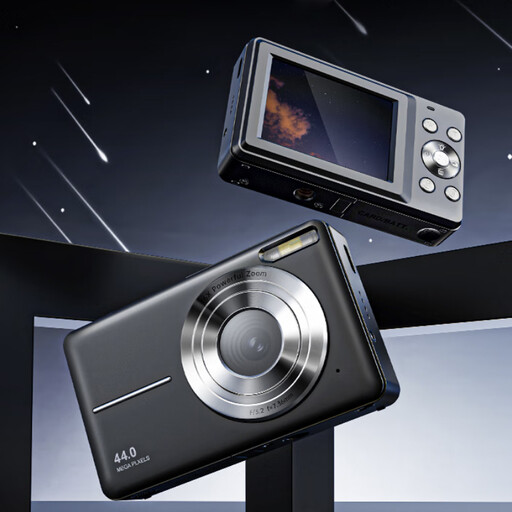
Songdian Pocket Camera 4K 44MP, black
A pocket camera for photos and video; check whether the framing suits the skyline from where you’ll be standing.
The product title mentions 4K, 44 MP and 16× zoom, but doesn’t specify the type of zoom.
View at Joybuy
 No image available
Sony ZV-E10 with 16–50mm zoom lens, black
The included zoom lens offers a range of focal lengths; bear in mind that you’ll need to take an extra step to get the camera ready.
The product title mentions a 16–50 mm zoom lens. Attach the lens before switching on the camera.
View at Joybuy
Frequently asked questions
What should you do before a quick photo stop by the river?
Check in advance that the battery is charged, a suitable memory card is in place and the camera is set to the mode you want. The Consumentenbond highlights ease of use, an extra battery and an SD memory card as factors to consider; practise using the exact model.
Can digital zoom replace optical zoom when photographing a distant tower?
Don’t treat digital zoom as the same as optical zoom. Sony, Canon and Panasonic list optical and digital or additional zoom ranges separately; when comparing cameras for distant details, check the stated optical range of the exact model.
Who can help if a camera develops a fault after you buy it in the Netherlands?
According to ACM ConsuWijzer, the seller is responsible for the statutory guarantee if a product doesn’t meet what you could reasonably expect during normal use. A manufacturer’s guarantee doesn’t replace this statutory right; there is no single fixed statutory guarantee period for every camera.
Can I publish skyline photos online if passers-by are recognisable?
Bear privacy rules in mind when publishing photos. The Dutch Data Protection Authority distinguishes between private use and sharing with a wider audience: recognisable people are personal data, and the exemption for personal or household use doesn’t apply to wider publication. Whether a specific publication is allowed depends on how it is used and the applicable legal basis.


