What should you look for when choosing?
Wide-angle zoom for changing your composition
Choose this if: you want to capture both the wide skyline and a tighter crop from the quayside; Canon lists a 24–100 mm full-frame equivalent for the G7 X Mark III.
Bear in mind: the zoom range ends at 100 mm, so check whether that’s enough for distant buildings.
Fixed wide-angle lens for a chosen viewpoint
Choose this if: you mainly want a wide composition and can choose your viewpoint in advance; Ricoh lists a fixed 28 mm equivalent lens for the GR IV.
Bear in mind: the fixed lens has no optical zoom to bring buildings on the opposite bank closer.
Mid-range zoom for individual buildings
Choose this if: you sometimes want to pick out façades without opting for a travel zoom with 30× optical zoom; Sony lists a 24–200 mm full-frame equivalent for the RX100 VII.
Bear in mind: Sony specifies f/2.8 at the wide-angle end and f/4.5 at the telephoto end; check which setting suits the light you’ll be shooting in.
Travel zoom for distant details
Choose this if: you need plenty of optical zoom from one side of the water; Panasonic lists 30× optical zoom for the LUMIX TZ99.
Bear in mind: Panasonic lists a 1/2.3-inch sensor and f/3.3–6.4 for the TZ99, so maximum zoom isn’t the only point to compare.
Fixed 35 mm equivalent angle of view with RAW
Choose this if: a 35 mm full-frame equivalent is wide enough from your viewpoint and RAW matters to your workflow; Fujifilm lists RAW for the X100VI.
Bear in mind: the fixed angle of view is narrower than the 24 mm and 28 mm options considered here.
For shoppers choosing a compact camera for a waterside skyline, these are five distinct buying priorities.
| What to consider |
What to look for |
Who should pay particular attention? |
| Exposure for skies and buildings |
Check for RAW support, exposure compensation or exposure bracketing, and review the highlights on the screen. |
If I’m photographing bright clouds and dark façades together, I want to be able to assess the exposure and edit the files if needed; around 36% of shoppers prioritise this exposure flexibility. |
| Fitting the whole skyline in the frame |
Compare the full-frame equivalent wide-angle focal length and check whether it gives you enough room in the frame from your planned viewpoint. |
From a fixed spot on the quayside, I want to frame the whole skyline without stepping backwards; around 29% of shoppers prioritise this wider composition. |
| Portability |
Compare dimensions and weight, including the battery where that information is available; try the controls too, if possible. |
If I’m taking the camera on a walk, I want its size and weight to suit my bag and the way I hold it; around 21% of shoppers put convenience first. |
| Buildings on the opposite bank |
Check that the zoom is optical and compare the equivalent telephoto focal length and aperture at that setting. |
When I can’t walk to the opposite bank, I want to bring individual façades closer with optical zoom; around 14% of shoppers prioritise reach for distant details. |
Joybuy products for this use
These Joybuy products are suited to anyone looking for a portable compact camera for photographing a skyline, with framing and optional zoom in mind.
 No image available
KOMERY G7 5K 80MP UHD camera, white
The product information lists optical zoom, which may help bring distant buildings closer from the same side of the water. Also check whether the wide-angle setting is broad enough for the whole skyline.
View at Joybuy
 No image available
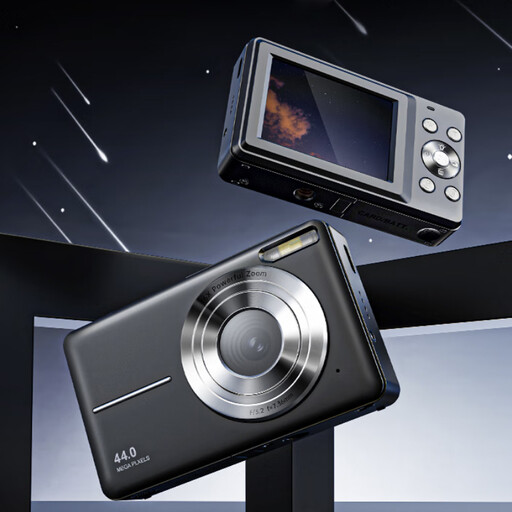
Songdian Pocket Camera 4K 44MP, black
Its pocket-sized design suits anyone who wants to take a camera on a walk. The listed zoom is digital, so check that it gives you the crop you want and don’t compare digital zoom directly with optical zoom.
View at Joybuy
 No image available
Sony ZV-1 compact camera
This compact camera suits anyone who wants to compose a wide shot from a chosen viewpoint and review the cloudy sky afterwards. Check that the lens and file options fit your workflow.
View at Joybuy
Frequently asked questions
What helps when the sky is bright and the buildings are dark?
Check the exposure of the sky on the camera screen and try a different exposure if needed. Adobe says RAW can give you more flexibility when editing; exposure bracketing captures shots at different exposures. Neither guarantees you can recover details that weren’t captured.
Should I always use the widest aperture in cloudy weather?
No. A wider aperture lets in more light, but also reduces depth of field. When photographing a skyline, check that the parts of the foreground and buildings you want are still in focus. A support or tripod can help if you’re using a slower shutter speed.
What should I check before using the camera for the first time?
Check which battery, charger and memory card are included or required for the exact version. Take a test shot in RAW if that’s how you plan to work, and check that you can open the files. The Consumentenbond lists an extra battery and SD card as separate points to consider.
Does the manufacturer’s warranty always provide full protection in the Netherlands?
No. ACM ConsuWijzer explains that your statutory guarantee exists alongside any retailer’s or manufacturer’s guarantee. If a product is faulty despite being used normally, the retailer is responsible for providing an appropriate solution free of charge; the statutory period isn’t simply a fixed two years for every product.
Can I publicly share a skyline photo that includes identifiable passers-by?
First, consider which privacy rules apply to sharing the photo. According to the Autoriteit Persoonsgegevens, identifiable people count as personal data. There is an exception for personal or household use when photos remain private, but it doesn’t automatically apply to public or commercial sharing. Which legal basis under the GDPR is sufficient depends on how the photo is used.


