Who is this camera guide for?

Walker who likes to frame landscapes

Wants to fit windmills, water and the surrounding scenery into a single shot. So, check the angle of view of the lens that actually comes with the camera. The Consumentenbond highlights angle of view and zoom range as things to consider when choosing a camera.

Day-tripper travelling light

Wants to carry as little as possible on a walk and would rather not change lenses. So, compare a compact camera with a mirrorless camera and lens, rather than comparing it with the camera body alone. Canon Netherlands and Panasonic Netherlands publish weights that include different components.

Photographer in changeable weather

Wants to take photos even when rain is possible, and checks the protection offered by the complete camera-and-lens combination. OM SYSTEM lists a protection rating for the OM-5 Mark II body; check the lens separately.

What should you look for when buying?

Mirrorless camera with interchangeable lens

Best for: anyone who wants to frame the landscape and choose a different angle of view later.

Trade-off: you’ll carry a camera body and lens. You’ll need to choose an additional lens separately, which could mean carrying more kit.

Compact camera with fixed zoom

Best for: anyone who wants to switch between a wide view and a tighter shot of a distant windmill without changing lenses during a walk.

Trade-off: the lens can’t be changed, so check in advance that the stated zoom range suits the way you want to frame your shots.

What to consider What should you check? Who should pay extra attention?
Wide views Check the lens included in the kit and its wide-angle setting. For the intended APS-C combination, Canon Netherlands gives an equivalent range of 29–72 mm for the RF-S 18-45mm. If I want to frame windmills, water and the surrounding scenery together, I focus on the angle of view of the included lens. Around 33% of consumers make wide landscapes their top buying priority.
Ease of carrying Compare weights for cameras ready to use. Canon Netherlands gives an approximate weight of 375 g for the EOS R50 body with card and battery, excluding the lens; Panasonic Netherlands gives an approximate weight of 322 g for the DC-TZ99 with battery and SD card. If I want to travel light and avoid changing lenses, I compare the complete kit I’ll be carrying. Around 27% of consumers prioritise carrying less and not having to change lenses.
Distant details Compare the optical zoom range and the aspect ratio used to calculate the equivalent range. Sony Netherlands gives an equivalent range of 24–200 mm for the RX100 VII; Panasonic Netherlands gives an equivalent range of 24–720 mm for the DC-TZ99 when shooting photos in 4:3. If I want to make a distant windmill appear larger in the frame, I look at the optical range and the wide-angle setting I need. Around 20% of consumers make distant details their top buying priority.
Rain protection Check the protection offered by both the camera body and lens. OM SYSTEM lists IP53 for the OM-5 Mark II body; that specification alone says nothing about an individual lens. If I want to take photos in changeable weather, I check the protection offered by the complete combination and its operating limits. Around 20% of consumers put weather protection ahead of other buying priorities.

Common mistakes

  • Comparing the weight of a camera body alone with that of a complete compact camera

    A mirrorless camera body may be weighed without a lens, while the weight of a compact camera may include a built-in lens and accessories. That means you’re not comparing the kits you’d actually take on the same walk.

    Compare the weight of the mirrorless camera with your chosen lens against that of the compact camera ready to use.

    An extra lens or camera bag could become part of your kit and take up space on your walk.

  • Assuming every camera body or lens has image stabilisation

    Canon states that the EOS R50 body does not have in-body image stabilisation, but the RF-S 18-45mm kit lens in question does have optical stabilisation. Nikon describes VR stabilisation in the lens supplied with the Z50II kit mentioned here.

    Check the specifications for the exact camera body and the lens in the kit; don’t assume other combinations offer the same stabilisation.

  • Assuming a weather-resistant body makes the whole kit waterproof

    OM SYSTEM’s IP53 specification applies to the OM-5 Mark II body. The protection offered by your chosen lens needs to be assessed separately.

    Check the camera-and-lens combination and follow the manufacturer’s instructions for using it in the rain.

Camera brands and models to consider

Canon

The EOS R50 with RF-S 18-45mm is an entry-level interchangeable-lens combination for taking landscape photos on a walk.

  • Canon Netherlands lists RF and RF-S lens compatibility for the EOS R50, and optical stabilisation in the RF-S kit lens mentioned here.
  • The EOS R50 body does not have in-body image stabilisation. Check whether your chosen kit includes the lens and accessories you want.

Nikon

The Z50II with NIKKOR Z DX 16-50mm VR is a mirrorless camera kit with a standard zoom lens to get you started.

  • Nikon lists a retractable 16-50mm lens with VR stabilisation in the lens for this kit.
  • The standard zoom won’t automatically replace a longer telephoto lens; consider the range you’ll need for your walk.

Sony

The RX100 VII is a compact camera with a fixed lens, for anyone who wants to frame different shots without changing lenses.

  • Sony Netherlands lists an equivalent range of 24–200 mm, a type 1.0 sensor and an electronic viewfinder for this model.
  • The lens can’t be changed; this model’s specifications don’t, on their own, tell you about the entire camera range.

Panasonic

The LUMIX DC-TZ99 is a compact travel zoom for anyone who wants to frame different shots without changing lenses.

  • Panasonic Netherlands lists 30× optical zoom and an approximate weight of 322 g with battery and SD card.
  • The stated equivalent range of 24–720 mm applies to photos in 4:3. A greater zoom range doesn’t, by itself, mean better image quality.

OM SYSTEM

The OM-5 Mark II is worth considering if protection is a key priority when walking in changeable weather.

  • OM SYSTEM lists IP53 for the body and a weight of 418 g including battery and card.
  • The stated weight excludes the lens. Check the protection offered by your chosen lens separately.

Cameras at Joybuy

These cameras list features for wide framing, zoom or a standard interchangeable zoom lens. Check each model to see whether its range and complete kit suit your windmill landscape and walk.
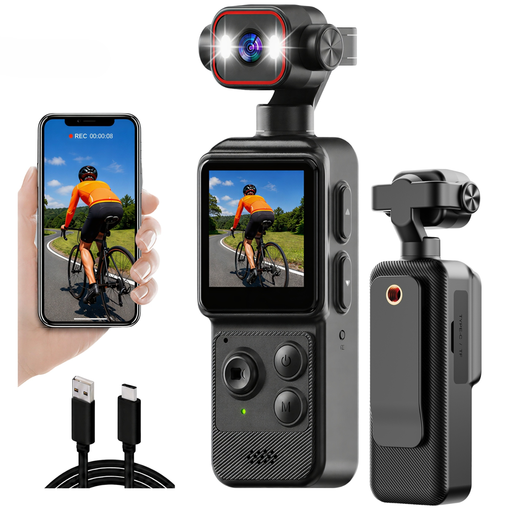
4K mini action camera with clip and 140° wide-angle lens

4K mini action camera with clip, 140° wide-angle lens

The product name lists a 140° wide-angle lens; check that its angle of view suits the landscape composition you want.

The product name also lists 4K recording and a 1.54-inch display.

View at Joybuy

Komery W6 camera with 12× optical zoom

Komery W6 camera, 12× optical zoom

The product name lists 12× optical zoom; compare the wide-angle setting and range you want for distant windmills.

The product name also lists 4K recording and Wi-Fi.

View at Joybuy
Songdian 5K camera with 10× optical zoom

Songdian 5K camera, 10× optical zoom

The product name lists 10× optical zoom; check whether the range suits both wide landscape shots and the distance to the windmill.

The product name lists a front and rear camera.

View at Joybuy
Sony ZV-E10 with 16-50mm zoom lens

Sony ZV-E10 with 16-50mm zoom lens

The product name describes a mirrorless camera with a 16-50mm zoom lens for adjusting your framing.

The product information advises against exposure to moisture; bear this in mind in changeable weather.

View at Joybuy
Sony Alpha A6100 with 16-50mm f/3.5-5.6 OSS II lens

Sony Alpha A6100 with 16-50mm f/3.5-5.6 OSS II

The product name lists an interchangeable 16-50mm lens for adjusting your framing. Check the weight of the complete camera and lens before your walk.

The product information warns against exposure to rain or moisture.

View at Joybuy

Frequently asked questions

Do I need an ultra-wide-angle lens for a sweeping windmill landscape?

No. Start by considering the angle of view of the lens you’ll actually be taking with you, and how far you’ll be from your subject. Canon doesn’t recommend automatically using a wide-angle lens for every landscape photo; choose a wider lens if you otherwise can’t fit the surroundings you want into the shot.

How can I avoid camera shake when the light fades?

A low ISO setting and a small aperture may mean you need a slower shutter speed. Canon recommends using a tripod and the self-timer or a remote control in this situation. Also check what type of stabilisation your chosen camera body and lens actually offer.

What if my camera breaks too soon during normal use?

According to ACM ConsuWijzer, Dutch statutory consumer rights apply alongside any commercial warranty. If a product breaks sooner than you could reasonably expect with normal use, the seller must resolve the issue free of charge under the applicable rules, for example by repairing or replacing it, or issuing a refund. There is no fixed two-year statutory warranty period for every camera.

Can I share photos of identifiable passers-by publicly?

That depends, among other things, on how you share the photos. The Dutch Data Protection Authority distinguishes between images kept private or shared with a very limited group and wider publication. If people are identifiable, the GDPR may apply when you share the images more widely; a public social media page isn’t covered by the household exemption. Before publishing, consider how people appear in the photos and the legal basis for sharing them.
