
Photographing the whole harbour panorama
You can’t step back and want to frame the skyline with the water and foreground. Compare the wide-angle setting and the crop at the aspect ratio you use.


Start by thinking about what you want to capture from your chosen spot: a wide view calls for a suitable wide-angle setting, while distant buildings or ships call for optical telephoto zoom. Panasonic specifies an equivalent focal length of 24–720 mm at 4:3 for the LUMIX DC-TZ99. Canon lists an equivalent focal length of 24–960 mm for the PowerShot SX740 HS Lite Edition. If you plan to take photos at dusk, compare the sensor and lens too, and make sure the camera is stable. These specifications alone cannot guarantee sharp evening shots.
You can’t step back and want to frame the skyline with the water and foreground. Compare the wide-angle setting and the crop at the aspect ratio you use.
You’re staying in the same spot but also want to capture a crane, ship or building on the opposite bank on its own. The stated optical telephoto range is an important factor when choosing.
You take photos as the harbour lights come on and want to weigh up the sensor, lens, exposure and a stable setup.
First compare the field of view you need from your chosen spot, then decide how much optical zoom matters for distant details. For consumers who want to photograph a harbour from one fixed position, each row focuses on one main priority.
| What to consider | What to look for | Who is this important for? |
|---|---|---|
| The whole harbour skyline | Compare the shortest focal length in 35mm equivalent and check which aspect ratio it applies to. | If I want to fit the water, skyline and foreground into one frame from the same spot, a wide-angle view comes first. Around 33% of consumers make the full panorama their main priority. |
| Distant buildings and ships | Compare the optical telephoto end of the range and check the crop at the shooting setting you use. | If I can’t get closer and want to make a ship or building appear larger in the frame, telephoto range matters. Around 27% of consumers make distant details their top priority. |
| Photographing at dusk | Compare sensor size and lens specifications. Also check whether you can set the camera up securely and operate it without touching it. | When I’m photographing in fading light, I want to take the sensor, lens and exposure into account without losing sight of moving ships. Around 27% of consumers make low-light photography their main priority. |
| Portability and ease of use | Check the size, weight and controls, as well as the battery and charger supplied with the exact version. | If I want a camera that’s easy to carry and simple to use, these practical details matter more than a high zoom figure alone. Around 13% of consumers put portability and simplicity first. |
The telephoto end of the range doesn’t tell you whether the wide-angle setting can fit the whole skyline into the frame. From the same spot, the start of the range is what matters if you want to photograph the water, buildings and foreground together.
Compare both ends of the optical range in 35mm equivalent and check which aspect ratio the figures are based on.
With a longer exposure, camera movement can affect the shot. Keeping the camera steady won’t stop a moving ship from changing position during the exposure.
Check whether the camera has a self-timer or a suitable remote control, and whether you can use a stable setup at your chosen photo spot.
A tripod or other suitable support can take extra time to carry and set up.
A fixed field of view of around 28 mm or 35 mm equivalent may suit your panorama, but it won’t give you optical telephoto zoom for distant details from the same spot.
Before you buy, decide what you want to frame from the actual place where you’ll be taking photos.
Canon states that the PowerShot SX740 HS Lite Edition cannot be charged via USB. Check the exact version and charging equipment before taking the camera with you.
Take the supplied charger for this Lite Edition if you’ll need to charge it while you’re out.
An extra battery can be useful for a longer photo session. Remember to bring the charger needed to recharge it.
The LUMIX DC-TZ99 is a travel zoom camera to consider if you want to frame both a wide view and distant details from the same spot.
The PowerShot SX740 HS Lite Edition is worth comparing if a long optical telephoto range from one viewpoint is important.
The RX100 VII is a compact zoom camera to consider when weighing up telephoto range against the sensor dimensions specified by Sony.
Consider the GR IV if a field of view of around 28 mm equivalent gives you the composition you want from your fixed position.
The X100VI is an alternative if a fixed field of view of around 35 mm equivalent suits your composition.
This selection includes digital cameras, including models described as compact cameras or travel cameras. For a fixed harbour viewpoint, check that the field of view and stated type of zoom suit your composition.
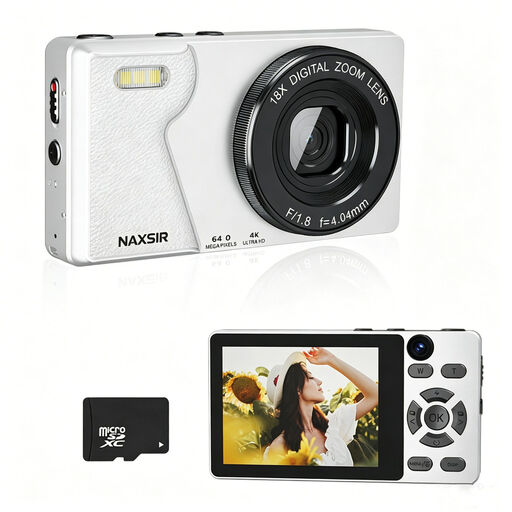 No image available
The product name describes this model as a compact vlog camera for beginners. For a harbour panorama, check whether its field of view suits your position.
The product name lists 64 MP photo resolution, 18× digital zoom and an included 32 GB memory card.
 No image available
The product name mentions travel and point-and-shoot use. For a fixed harbour composition, check that the field of view and zoom are suitable.
The product name lists 80 MP and 18X zoom. Check whether the zoom is optical or digital before you buy.
Start with the widest optical setting and check whether the water, skyline and foreground all fit in the frame. Then zoom in for individual details. Before you buy, compare the focal lengths and the aspect ratio they’re based on.
Set the camera up securely and, if the model supports it, use a self-timer or remote control so you don’t move the camera when pressing the shutter button. This reduces camera shake, but it won’t stop a moving ship.
You don’t need an extra warranty package to exercise your statutory rights. According to the Government of the Netherlands, there is no fixed two-year term for the Dutch statutory guarantee; if there’s a problem with a product, the seller must provide a solution. An additional package is only worth considering if its terms genuinely provide extra cover.
That depends on the specific harbour and photo spot. The Port of Rotterdam Authority states that its business premises aren’t accessible without permission and provides separate guidance on photos of business premises and people. Don’t automatically apply this information to every harbour in the Netherlands.
The Dutch Data Protection Authority distinguishes between images you keep for private use and images you share more widely or use for business. If the exception for personal or household use doesn’t apply, privacy rules are relevant. Consider sharing the photo separately from taking it.