What should you look for when choosing?
First decide which part of the harbour you want to capture from your shooting spot, and which subjects you want to frame separately. The Consumers’ Association highlights both the lens and image sensor as important factors in photography, so megapixels alone don’t tell the whole story.
| What to consider |
What to look for |
Who should give this more weight? |
| Fine surface details |
Compare the sensor size and lens of the exact model; don’t look at megapixels alone. |
If I want to preserve fine textures in buildings and quaysides, I compare the sensor and lens together. Around 31% of consumers give detail reproduction top priority. |
| Capturing the whole skyline |
Check the shortest full-frame equivalent focal length and whether the lens is fixed or offers optical zoom. |
If I can’t move further back but still want to frame the whole panorama, I check whether the field of view works from that spot. Around 25% of consumers prioritise capturing the whole harbour scene. |
| Distant subjects |
Compare the longest optical focal length, given in full-frame equivalent millimetres. |
If I want to capture a ship or crane on the opposite side on its own, and can’t get closer, I look at the optical range. Around 25% of consumers make this their top priority when choosing. |
| Taking photos in low light |
Check the maximum aperture at the zoom setting you use, and look at the sensor size too. |
If I regularly take photos as the light fades, I compare the aperture at the field of view I plan to use and check the sensor too. Around 19% of consumers prioritise low-light photography. |
Cameras at Joybuy
This Joybuy selection features digital cameras for photography, with different zoom specifications in their product names.
 No image available
KOMERY G7 5K digital camera, 80MP, 18X zoom
The product name lists 18X zoom for anyone who wants to frame different shots from one spot.
The product name lists 80MP and 5K.
View at Joybuy
 No image available
Komery W6, 12X optical zoom, 4K, 64MP
The product name lists optical zoom for anyone who wants to adjust the frame without moving.
The product name lists 12X optical zoom, 4K and 64MP.
View at Joybuy
 No image available
Songdian digital camera, 8X optical zoom, 5K, 64MP
The product name lists optical zoom for anyone who wants to frame different shots.
The product name lists 8X optical zoom, 5K and 64MP.
View at Joybuy
 No image available
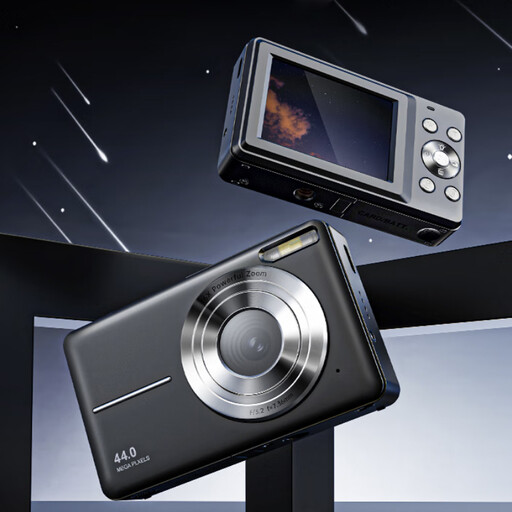
Songdian pocket camera, 4K, 44MP, 16X zoom
The product name describes a pocket camera for photography and video.
The product name lists 4K, 44MP and 16X zoom.
View at Joybuy
Frequently asked questions
How do you choose between a fixed lens and zoom for a harbour panorama?
Choose a fixed lens only if its field of view suits the view from your shooting spot. Ricoh lists a fixed 40 mm-equivalent field of view for the GR IIIx; Sony lists a 24–200 mm-equivalent optical range for the RX100 VII. With zoom, you can adjust the frame without changing position.
What about warranties and cooling-off periods when buying online in the Netherlands?
According to the Government of the Netherlands, there’s no fixed period for the statutory guarantee in the Netherlands; what you can expect from a product depends on the product and the circumstances. For distance purchases from a business, you’ll often have a 14-day cooling-off period. Check the terms that apply to your purchase.
Can you take photos anywhere in a Dutch harbour?
Check the rules for the harbour location you’re visiting. The Port of Rotterdam Authority specifically states that, in the Port of Rotterdam, you must stay on public roads. You must also ask the relevant company for permission to take photos or film on or of business premises.
Can you publish a harbour photo online if people can be recognised in it?
This depends, among other things, on how you use and share the images. The Dutch Data Protection Authority distinguishes between private use and wider publication: the household exemption may apply to images kept for private use. If you share them more widely or use images of identifiable people for business purposes, the GDPR may apply and you’ll need a lawful basis.
How should you store your photos after a shoot?
Make a backup before deleting files from your memory card. After using your camera near water or in dusty conditions, check the care instructions for the exact model. Don’t assume it’s waterproof unless this is stated for that model.


