For a detailed view of the whole courtyard, a fixed wide-angle lens is a good choice if you have enough room from a suitable vantage point. A zoom compact is more convenient if you want to switch between a wide view and more distant details from one spot. For close-ups, the focusing distance at your chosen zoom setting matters. In shady conditions, consider image stabilisation; if it’s wet, check the protection rating for the exact model. A higher zoom ratio or more megapixels won’t, on their own, guarantee that finer stone texture will be visible.
Who is this buying guide for?
Photographing the whole courtyard
You want to capture the courtyard and its repeating stone patterns in a single image. Consider the angle of view and your position, then assess how clearly the details show up in the overall shot. Ricoh Imaging Europe and Fujifilm describe models with fixed lenses and different angles of view.
Photographing stone details
You want to fill the frame with mortar joints, texture or individual stones. Check the focusing distance at the zoom setting you plan to use. Sony, Canon and OM System list close-up and small-subject capabilities for specific models.
Photographing in shade or wet conditions
You’re taking photos in low light or close to a wet surface. Compare the image stabilisation on the exact model, and check its protection rating if it’s likely to be exposed to water. OM System lists water and dust resistance for the TG-7.
What should you look for when buying?
Start with the type of shot you’ll take most often: a wide view, a close-up, a handheld photo in low light, or different framings from one spot.
| What to consider |
What to look for |
Who is this important for? |
| Detail in a wide view |
Compare the angle of view and sample images with a similar framing; megapixels alone don’t predict how much detail will be visible. |
If I want to show the whole courtyard and keep the stone texture visible in the same shot, I’ll look at the framing and the results. Around 40% of consumers prioritise detail in a wide view. |
| Close-ups of stones |
Check the focusing distance at your chosen zoom setting and whether it’s measured from the front of the lens. |
If I mainly want to fill the frame with mortar joints or texture, I’ll check that the camera can focus from the distance I’ll be working at. Around 30% of consumers prioritise close-up detail. |
| Sharpness in shade |
Check the image stabilisation on the exact model and whether you can use a stable support on location. |
When taking a handheld shot in the shade, I want to minimise camera shake as much as possible. Around 20% of consumers prioritise stable shots in low light. |
| Different framings |
Compare the optical zoom range and the size of the camera; look at sample images rather than assuming zoom means more detail. |
If I want to take both a wide view and other framings from one spot, I’ll look for a camera that suits that. Around 10% of consumers prioritise portability and different framings. |
Common buying mistakes
-
Assuming a high zoom ratio means more stone texture
Zoom changes the framing, but the sensor, lens, lighting and camera movement all play a part too. Canon says the PowerShot SX740 HS Lite Edition has a 1/2.3-type sensor; the zoom ratio alone doesn’t tell you how much fine texture the photo will show.
Compare sample images at the focal length and in the lighting conditions you expect to use.
-
Expecting a short focusing distance at wide angle to apply at telephoto too
Canon lists a minimum focusing distance of 5 cm at wide angle and 40 cm at telephoto for the PowerShot G7 X Mark III, measured from the front of the lens.
Check the distance for the zoom setting you want to use for close-ups, and make sure you have enough room to work.
-
Assuming every compact camera can withstand rain
Water and dust resistance depend on the model. OM System lists these features for the TG-7; don’t assume they apply to other cameras too.
Check the protection rating for the exact model if you’ll be photographing close above wet cobblestones.
Camera brands to consider
Ricoh
The GR IV has a fixed 28 mm-equivalent angle of view, making it suited to a wide view from a carefully chosen position.
- Ricoh specifies approximately 25.74 effective megapixels and five-axis stabilisation.
- The fixed lens has no optical zoom, so check that its angle of view suits the space available for your chosen position.
Sony
The RX100 VII combines a built-in zoom with a 1.0-type sensor, making it suitable for different framings.
- Sony specifies a 24–200 mm-equivalent range.
- The minimum focusing distance varies by zoom setting, so check the distance for the close-up you want to take.
Canon
The G7 X Mark III is a zoom compact for wide views and close-ups; the SX740 HS Lite Edition has a much greater stated zoom range.
- Canon specifies a 1.0-type sensor and a 24–100 mm-equivalent range for the G7 X Mark III. For the SX740 HS Lite Edition, Canon lists a 24–960 mm-equivalent range.
- Canon lists a focusing distance of 5 cm at wide angle and 40 cm at telephoto for the G7 X Mark III. The SX740’s greater range doesn’t, on its own, prove that fine details will be more visible.
Fujifilm
The X100VI has a fixed 35 mm-equivalent angle of view and suits a wide view from a carefully chosen position.
- Fujifilm specifies an APS-C sensor and 40.2 megapixels.
- The lens has no optical zoom, so check that you can step far enough back to get the framing you want.
OM System
The TG-7 is a rugged compact camera to consider if photographing small subjects or protection from water and dust are important to you.
- OM System lists a microscope mode, RAW shooting, and water and dust resistance.
- OM System specifies 12 megapixels; consider whether this suits the framing or print size you want.
Cameras at Joybuy
These Joybuy products are digital cameras with zoom, suited to anyone who wants to switch between different framings from one spot. When comparing them, check whether the stated zoom is optical or digital, and look at sample images taken in conditions similar to your own.
 No image available
Komery W6 camera, 12× optical zoom, 4K
The stated optical zoom offers different framing options. Use sample images to assess whether the camera captures the stone texture you want.
The product name lists 12× optical zoom, 4K and Wi-Fi.
View at Joybuy
 No image available
Songdian camera, 8× optical zoom, dual lens, white
The stated optical zoom may suit you if you want to take different shots. Check sample images before choosing based on the zoom ratio.
The product name lists 8× optical zoom, 5K, 64 MP, a dual lens and a white finish.
View at Joybuy
 No image available
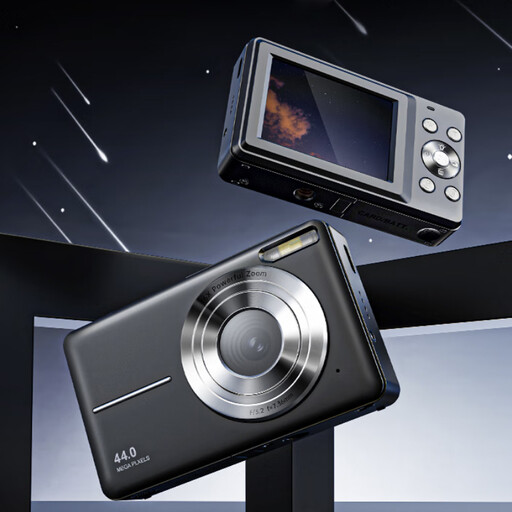
Songdian pocket camera, 4K, 44 MP, black
This pocket-sized model may suit anyone looking for a camera for different framings. Check how the stated zoom works and use sample images to assess the stone texture.
The product name lists 4K, 44 MP and 16× zoom.
View at Joybuy
 No image available
Songdian camera, 5K, 10× optical zoom, black
The stated optical zoom could be useful if you want to switch between different framings from one spot. The zoom specification alone doesn’t predict how much fine texture will be visible.
The product name lists 5K, 56 MP and 10× optical zoom.
View at Joybuy
Frequently asked questions
How can you check whether a compact camera can focus up close?
Check the minimum focusing distance at the zoom setting you plan to use, and note where the distance is measured from. Canon lists 5 cm at wide angle and 40 cm at telephoto for the PowerShot G7 X Mark III, measured from the front of the lens; Sony lists approximately 8 cm and 100 cm for the RX100 VII.
What can you do to capture small details more sharply?
Check the focus point and, if the camera is moving, use a stable support or a tripod if one is practical on location. Image stabilisation works differently from model to model; Canon explains how it can help compensate for camera movement.
Can you photograph a courtyard and publish photos showing identifiable people?
The rules on access to a courtyard depend on its location; identifiable people may also raise privacy concerns. According to the Dutch Data Protection Authority, photos kept for private use generally fall under the exemption for personal or household activities. That exemption does not apply to wider publication of identifiable people, which may require a lawful basis under the GDPR. This is neither general permission nor a general ban on photographing a courtyard.


