
Reflection photographer
You want to capture reflections of buildings and the sky, and need control when bright and dark areas appear in the same shot.


If you want to preserve the reflection, choose a camera that lets you adjust the exposure, and check the highlights in your shot. If you want to reduce distracting glare, see whether a polarising filter fits the exact model. Then choose a field of view or zoom range that suits where you’ll be standing. A built-in ND filter reduces the amount of light, but it is not a substitute for a polarising filter.
You want to capture reflections of buildings and the sky, and need control when bright and dark areas appear in the same shot.
You want to reduce distracting glare on the water and check whether a polarising filter fits your camera model.
You can’t get any closer and want to frame details on the opposite bank as well as a wide view of the canal.
First decide whether you want to preserve reflections or reduce unwanted glare. Then choose a field of view or zoom that suits your spot by the water.
| What to consider | What should you check? | Who is this important for? |
|---|---|---|
| Reflections and exposure | Check the exposure compensation and any exposure bracketing options; see whether the highlights are preserved in your photos. | If you want to capture bright reflections alongside a dark canal bank, look for control over exposure. Around 33% of consumers prioritise preserving reflections. |
| Glare on the water | Decide which reflections you want to keep, then check that the filter and its fitting are suitable for the exact model. | If you want to reduce glare without losing the reflections you want, check filter compatibility first. Around 27% of consumers prioritise reducing distracting glare. |
| Framing the opposite bank | Compare the field of view and the stated zoom range in 35mm-equivalent terms with the shots you want to frame. | If you want to photograph details on the opposite bank from a fixed spot, the available optical zoom range will be a key factor in your choice. Around 20% of consumers prioritise this kind of shot. |
| Taking it along in low light | Compare the size and stabilisation specifications of the exact model; stabilisation won’t freeze moving water. | If you want a camera to take on a walk that’s still useful as the light fades, consider its size and controls. Around 20% of consumers prioritise portability and shooting in low light. |
A polarising filter can reduce the very reflection you want to photograph. First decide which reflection is your subject and which glare is distracting; then check that the filter fitting is right for the exact model.
These filters do different things: an ND filter reduces the amount of light, while a polarising filter can reduce reflections. Choose a filter based on the effect you want.
Features can vary depending on the exact model and the accessories used. Before buying, check the full model name, field of view and the conditions for any weather protection.
Canon says the PowerShot G7 X Mark III combines a 24–100 mm 35mm-equivalent zoom with exposure compensation, AEB and a built-in 3-stop ND filter. This may be useful if you want to try different canal compositions and exposure settings.
Fujifilm says the X100VI has a fixed 35mm-equivalent field of view, RAW shooting, in-body stabilisation and a built-in 4-stop ND filter. Fujifilm lists the AR-X100 adapter ring as compatible with this model.
Sony specifies a 24–200 mm 35mm-equivalent zoom range and an electronic viewfinder for the RX100 VII. This may be useful if you want to frame a more distant subject from the canal bank.
Ricoh says the GR IV has a fixed field of view of around 28 mm in 35mm-equivalent terms, an APS-C sensor and five-axis stabilisation. It’s an option for a wide canal composition without zooming.
Panasonic specifies a 1.0-type sensor and a 24–360 mm 35mm-equivalent zoom range for the LUMIX TZ300. This range may be useful if you want to vary your composition considerably as you walk along the canal.
These cameras at Joybuy list features such as zoom or portability. Check each model to see whether it meets your needs for a compact camera with a fixed lens, and whether the stated type of zoom suits the composition you want.
 No image available
The stated 18x digital zoom may be useful if you want to try different compositions from the canal bank; check whether digital zoom suits the framing you want.
The product name lists 4K Ultra HD, 64 MP and an included 32 GB memory card. Check whether this exact model is a compact camera with a fixed lens.
 No image available
The product name lists 18x zoom and positions this model for beginners; check which type of zoom it refers to if you want to frame details on the opposite bank.
The name lists 4K and 80 MP. Also check whether this exact model is a compact camera with a fixed lens.
 No image available
The description lists 18x optical zoom, which may be useful if you want to take different shots from one spot.
The product name lists 5K, 80 MP and the white version. Check whether this exact model meets your needs for a compact camera with a fixed lens.
 No image available
The product name lists 12x optical zoom, which may suit framing more distant details from a fixed spot.
The name also lists 4K, Wi-Fi and 64 MP. Check whether this exact model is a compact camera with a fixed lens.
 No image available
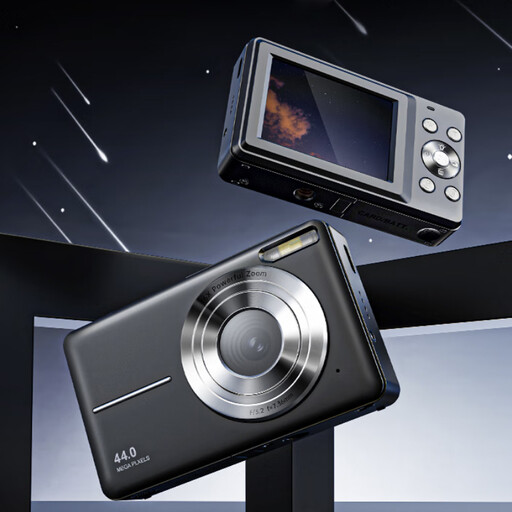
The product name lists a pocket camera with 16x zoom; check that the type and range of zoom suit the shots you want to take from the canal bank.
The name lists 4K, 44 MP and the black version. Check whether this exact model meets your needs for a compact camera with a fixed lens.
No. Nikon explains that a polarising filter can reduce reflections from water. If the reflection is your subject, try taking a photo without a filter first. If you want to reduce distracting glare, check that the filter fitting is suitable for your exact camera.
An ND filter reduces the amount of light, which can give you more options when choosing your exposure. Canon says the PowerShot G7 X Mark III has a built-in 3-stop ND filter; Fujifilm lists 4 stops for the X100VI. Neither is a polarising filter for water reflections.
Check the protection offered by the exact model and the conditions for any accessories. Fujifilm says the stated weather resistance of the X100VI depends on using the AR-X100 with the PRF-49. Sony warns that damp conditions or moving from cold to warm surroundings can cause condensation in camera equipment.
No. In the Netherlands, the legal guarantee doesn’t have a fixed two-year period for every product. ACM ConsuWijzer explains that the seller is responsible for providing an appropriate solution at no cost if a product breaks during normal use sooner than you could reasonably expect. A manufacturer’s or seller’s guarantee may also have its own terms.
That depends on the circumstances and the applicable privacy rules. The Dutch Data Protection Authority distinguishes between images kept private or shared with a limited group and wider publication; the exception for personal or household use doesn’t automatically apply to public posts. Also consider the rules that apply to business use or events.