Choose a camera with a fixed field of view if you can change your position and want to compose a particular shot deliberately. Optical zoom is more convenient if you want to frame both the whole canal and details on the other side from the same spot. Check the field of view, controls, aperture and stabilisation on the exact model. Stabilisation helps reduce camera shake, but choosing a suitable shutter speed is still important for capturing moving water.
Who is this for?
Taking photos while walking along the canal
You can choose where to stand and want to compose the buildings and their reflections together. A fixed field of view and manual controls are worth comparing. Canon Netherlands explains how the movement of water affects its reflection.
Taking photos from one spot by the water
You want to capture both a wide view of the canal and a detail on the opposite bank from the same spot. Compare the optical zoom range of the exact model, as specified by the manufacturer.
An evening walk with light equipment
You take photos handheld as the light changes and don’t want to carry interchangeable lenses. Compare the aperture, stabilisation and weight; stabilisation won’t freeze moving water.
What to consider when choosing
Fixed field of view
A good fit if: you can change position along the canal and the fixed framing suits your composition. The RICOH GR IV offers the equivalent of around 28 mm in full-frame terms; the FUJIFILM X100VI offers around 35 mm, according to the manufacturers.
Trade-off: you can’t optically zoom from one spot, so assess the composition where you’re taking the photo.
Optical zoom
A good fit if: you want to switch between a wide view and a close-up from the same spot. Canon specifies 24–100 mm for the PowerShot G7 X Mark III and Sony specifies a 24–200 mm full-frame equivalent for the RX100 VII.
Trade-off: also compare the aperture across the zoom range. The figures alone don’t prove which camera will take the sharpest photos in your lighting conditions.
With canal reflections, both camera shake and movement in the water matter. So check the stabilisation and the camera’s shutter speed controls.
| What to consider |
What to look for |
Who it matters most to |
| Sharp reflections when shooting handheld |
Check the image stabilisation and whether you can set the shutter speed on the model. Canon Netherlands explains that a faster shutter speed captures movement differently. |
I want to reduce camera shake, but also decide how ripples appear in the photo. Around 33% of consumers prioritise keeping reflections sharp. |
| Framing the canal and its details |
Compare the full-frame equivalent field of view at both ends of the optical lens range. Digital magnification is not optical zoom. |
I want to capture both the whole canal and details on the opposite bank from the same spot on the quay. Around 27% of consumers prioritise framing. |
| Changing light |
Compare the maximum aperture at the focal length you use and check the available exposure settings. A fast shutter speed lets in less light. |
When the light changes during my walk, I want to be able to adjust the exposure without assuming that one specification determines photo quality. Around 20% of consumers prioritise exposure in changing light. |
| A camera you can take with you |
Compare weight and dimensions on the same basis, preferably including the battery and card. Also consider whether you find the screen or viewfinder comfortable to use. |
I want a camera that’s easy to carry and use on a walk. Around 20% of consumers prioritise portability. |
Common pitfalls
-
Assuming stabilisation guarantees sharp water
Stabilisation is designed to reduce camera shake; movement in the water is a separate cause of changes in the image.
Check both the stabilisation and the shutter speed controls, then choose a shutter speed that suits the effect you want to capture in the reflection.
-
Choosing a polarising filter when you want to keep the reflection
A polarising filter can reduce glare on water, which may also reduce the reflection you’re trying to photograph.
First decide whether you want to remove the glare or keep the reflection. Then check whether and how a filter fits the camera model you’ve chosen.
-
Comparing digital magnification with optical zoom
According to Canon, the Canon PowerShot SX740 HS Lite Edition’s 40× optical zoom and 80× ZoomPlus use different magnification methods.
For framing from the quay, compare the optical focal length in full-frame equivalent terms.
-
Assuming all compact cameras are equally portable
The compact label alone doesn’t tell you how much a camera weighs or how easy it is to carry on a walk. Leica lists the Q3 at around 743 g including the battery; Canon lists the PowerShot G7 X Mark III at around 304 g including the battery and memory card.
Compare weights on the same basis and consider whether you want to carry the camera in a coat pocket, a bag or on a strap.
Camera brands compared
Sony
Compare the RX100 VII if you want a compact camera with a wide field of view, greater optical reach and a viewfinder.
- Sony specifies a 1.0-type sensor, a 24–200 mm full-frame equivalent zoom and optical SteadyShot for stills.
- According to Sony, the maximum aperture ranges from f/2.8 to f/4.5; this specification isn’t an independent assessment of low-light performance.
Canon
Compare the PowerShot G7 X Mark III for a shorter stated zoom range, or the SX740 HS Lite Edition if a longer optical range matters more.
- Canon specifies 24–100 mm and f/1.8–f/2.8 for the G7 X Mark III; for the SX740 HS Lite Edition, Canon lists 24–960 mm optical zoom.
- According to Canon, the SX740 HS Lite Edition has a 1/2.3-type sensor. ZoomPlus is not the same as optical zoom.
Panasonic
Compare the LUMIX DC-TZ99 if you want to frame distant details and a wide view of the canal from one spot.
- Panasonic specifies 30× optical zoom, equivalent to 24–720 mm, and a tilting screen.
- Check current availability with the retailer for the model you’ve chosen.
RICOH
Compare the GR IV if you deliberately shoot with a fixed, fairly wide field of view.
- RICOH specifies around 28 mm in full-frame equivalent terms, an APS-C sensor and five-axis sensor stabilisation.
- This model has no optical zoom; its fixed field of view calls for a suitable position or cropping.
FUJIFILM
Compare the X100VI if a fixed field of view equivalent to 35 mm suits your usual shooting position.
- FUJIFILM specifies an APS-C sensor, a fixed f/2 lens, RAW and five-axis sensor stabilisation.
- The fixed lens has no optical zoom; stabilisation doesn’t guarantee sharp photos of moving water.
Leica
Compare the Q3 if you want a fixed field of view and don’t necessarily need a larger camera to fit in a coat pocket.
- Leica specifies a fixed 28 mm f/1.7 lens and stabilisation. Its technical specifications from May 2023 list a weight of around 743 g including the battery.
- Digital crops aren’t optical zoom; also bear the stated weight in mind.
Joybuy cameras
These Joybuy picks are digital cameras for photography on the go. For each model, check whether the stated zoom is optical or digital, and which features suit the framing you want.
 No image available
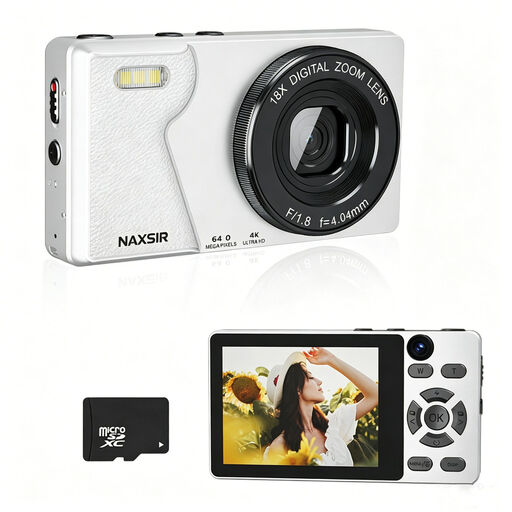
NAXSIR 4K Ultra HD digital camera, 64 MP, 18× digital zoom, 32 GB memory card
An option to compare if you’re looking for a camera for photography on the go and digital zoom may be sufficient for your crops.
The product title lists 64 MP photo resolution, 18× digital zoom and a 32 GB memory card.
View at Joybuy
 No image available
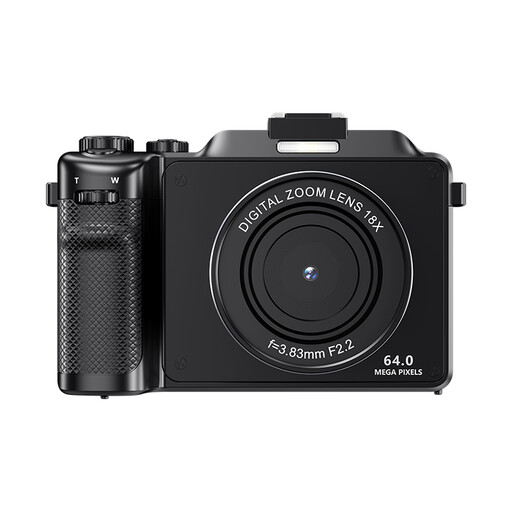
KOMERY X9 4K camera, 64 MP, 18× digital zoom, black
Compare this model if you’re looking for a camera for handheld photography and want to assess its stated anti-shake feature.
The product title lists 18× digital zoom; the product description mentions anti-shake and autofocus.
View at Joybuy
 No image available
KOMERY G7 5K camera, 80 MP, 18× optical zoom, white
An option to compare if you want to switch between different framings from one spot.
The product title lists 80 MP; the product description mentions 18× optical zoom.
View at Joybuy
 No image available
KOMERY W6 camera, 12× optical zoom, 64 MP, Wi-Fi
Compare this model if optical zoom from a fixed position is important for your framing.
The product title lists 12× optical zoom, 64 MP and Wi-Fi; the product description also mentions 4K video.
View at Joybuy
 No image available
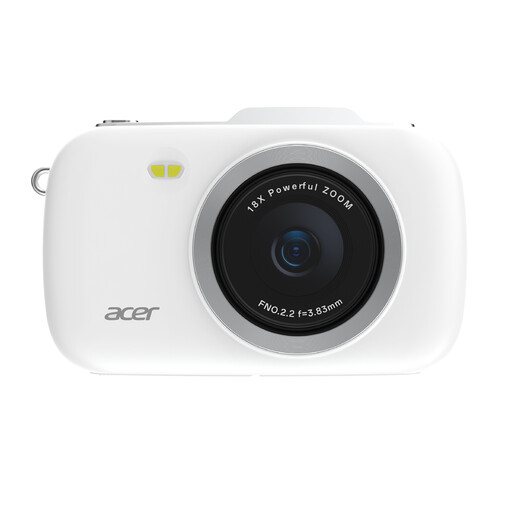
KOMERY G7-A 4K camera, 80 MP, 18× zoom, white
An option to compare if you’re looking for a portable camera for photography on the go.
The product title lists 80 MP and 18× zoom; the product description mentions photography and 4K video.
View at Joybuy
Frequently asked questions
Does image stabilisation help capture ripples sharply?
Image stabilisation is designed to reduce camera shake, not to freeze movement in the water. Shutter speed also affects how that movement appears in the photo; check both features on the exact model.
From what height should I photograph a reflection?
Try both a higher and a lower camera position, as the visibility and composition of a reflection can change. Canon Netherlands describes this effect; a tilting screen can help with framing from a low angle if the model you’ve chosen has one.
Do I need a polarising filter for this setup?
Not necessarily: a polarising filter can reduce glare on water, and with it the reflection you want to photograph. First check whether and how a filter fits the camera model you’ve chosen.
What should I check about costs and the guarantee after buying online in the Netherlands?
Check delivery, the battery or charger included and any extra items you may need in advance. According to ACM ConsuWijzer, for a standard online consumer purchase you generally have a statutory cooling-off period of up to 14 days after delivery, with some exceptions. The statutory guarantee isn’t automatically limited to two years: what you could reasonably expect from the product under normal use is what matters; the retailer is your point of contact.
Can I publicly share canal photos showing identifiable passers-by?
Not without considering the circumstances. The Dutch Data Protection Authority treats identifiable people in photos as personal data. The exception for strictly personal use applies when images remain private or are shared with only a very limited group; for wider or commercial publication, you must assess whether an appropriate legal basis under the GDPR applies. This isn’t a general ban on photographing a canal.


