Want to photograph an entire canal house from a narrow quay? Pay particular attention to the shortest focal length for stills: a wider angle of view may be more useful than extra telephoto zoom. For ornaments on the opposite bank, optical reach matters more. A wide-angle lens won’t automatically keep façades straight, and a big zoom range doesn’t guarantee better photos in low light.
Who this choice matters to
Photographers who want to capture the whole building
You’re often standing close to a tall canal house and want to fit the whole building into one frame without carrying separate lenses. The shortest focal length and how you capture perspective are important considerations.
Photographers looking for brickwork details
You alternate between wide shots and close-ups of ornaments, brickwork or windows across the canal. The optical zoom range helps determine how you can frame those details from where you’re standing.
City photographers who like to travel light
You take your camera on long walks and weigh up size, weight and photographic capabilities. A wide zoom range isn’t necessarily the most important feature for your compact kit.
What should you look for?
Start with the angle of view you need from your usual vantage point, then consider detail reach, performance specifications and portability.
| What to consider |
What to look for when buying |
Who is this important to? |
| Fitting the whole building in the frame |
Compare the shortest full-frame-equivalent focal length for stills. For tall façades, also consider your viewpoint and whether you’ll need room for perspective correction. |
If I want to photograph the whole building from a cramped quay, a wide angle of view is a major priority. Around 36% of consumers have this as their first priority. |
| Brickwork in changing light |
Compare the sensor size and lens aperture, including at the telephoto end. Check whether the model saves RAW photos if you want to edit them yourself. |
When I want to capture façade textures in the shade, I look at the lens and the scope for editing afterwards. Around 29% of consumers prioritise light performance and editing flexibility. |
| Taking a compact kit with me |
Check the dimensions and compare weights on a like-for-like basis, for example including the battery and memory card if that information is available. |
For a long walk around the city, I want a camera that’s practical to carry; the stated weight and size help me assess that. Around 21% of consumers put portability first. |
| Details at a distance |
Compare the longest optical focal length and the lens aperture at that setting. For the Panasonic TZ99, also check which aspect ratio the stated range applies to. |
If I want to frame ornaments across the canal from the same spot, optical zoom matters more than a fixed wide-angle lens. Around 14% of consumers put distant details first. |
Things to consider when buying and using a camera
-
Focusing only on the maximum zoom setting
For a nearby building, it’s the shortest focal length for stills that determines whether you can fit it in the frame. The Consumentenbond notes that cameras with a large zoom range often have a smaller image sensor.
First compare the widest full-frame-equivalent setting for stills, then assess the telephoto reach and sensor.
-
Expecting a wide-angle lens to keep façades straight
Angle of view and perspective are two different things. When photographing tall façades, your camera position can make the lines appear to converge.
Nikon recommends paying attention to your viewpoint and correcting images afterwards when photographing architecture. If necessary, leave room in your composition for this.
Choosing a suitable viewpoint and editing images afterwards can take extra time.
-
Confusing a warranty period with your full statutory rights
There is no fixed statutory warranty period in the Netherlands. The Dutch government advises consumers to contact the seller if a product is faulty.
Compare any manufacturer’s or seller’s warranty on offer with your statutory rights; a voluntary warranty does not replace those rights.
Brands and relevant models for reference
Canon
The PowerShot V1 has an extra-wide setting for stills, while the G7 X Mark III has a more compact standard zoom.
- Canon lists the V1’s full-frame-equivalent range for stills as approximately 16–50 mm.
- Canon lists the V1’s weight as 426 g. The G7 X Mark III starts at 24 mm and offers 24–100 mm, with a stated aperture of f/1.8–2.8. These are specifications for these models, not an assessment of every Canon camera.
Ricoh
The GR IV is a compact camera with a fixed lens of approximately 28 mm full-frame equivalent.
- Ricoh lists 25.74 effective megapixels and sensor-shift stabilisation for the GR IV.
- The fixed lens has no optical zoom for distant façade details; these specifications alone do not prove that it outperforms other models.
Sony
According to Sony, the RX100 VII combines a 24–200 mm range with a 1.0-type sensor.
- According to Sony, the range extends from 24 mm wide-angle to 200 mm telephoto.
- According to Sony, the aperture ranges from f/2.8 at the wide-angle end to f/4.5 at the telephoto end. The 24 mm setting isn’t as wide as the PowerShot V1’s setting for stills.
Panasonic
The Lumix DC-TZ99 is a travel zoom model for anyone who also wants plenty of optical reach for details beyond façades.
- Panasonic lists 30× optical zoom and RAW photos.
- The specifications list a 1/2.3-inch sensor and an aperture of f/3.3–6.4. The 24–720 mm equivalent range applies to 4:3 stills and not necessarily to other aspect ratios.
Leica
The D-Lux 8 has a built-in zoom lens and DNG storage for anyone looking for this range and shooting workflow.
- Leica lists a full-frame-equivalent lens range of 24–75 mm and a weight of approximately 397 g including the battery.
- The lens doesn’t start as wide as the V1 and doesn’t reach as far as the RX100 VII. These specifications don’t support any general conclusion about image quality or value.
Joybuy cameras for photography on the go
This selection ranges from compact digital cameras and a vlogging camera to a mirrorless camera with a kit lens. Check each model to make sure its lens and controls suit the façade and detail shots you want to take.
 No image available
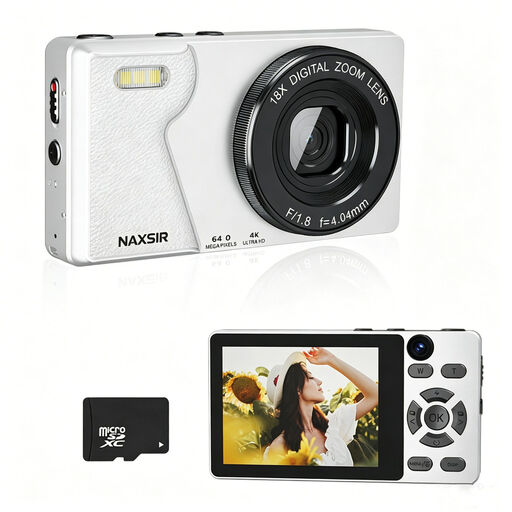
NAXSIR digital camera, 64 MP, with 32 GB memory card
A compact camera option for anyone who wants to take a memory card along on an outing.
The product name lists 64 MP photo resolution, 18× digital zoom, autofocus and an included 32 GB memory card.
View at Joybuy
 No image available
KOMERY G7 5K digital camera, white
A portable camera option for anyone who wants to shoot video as well as take photos.
The product name lists 80 MP photo resolution, 5K video and 18× zoom.
View at Joybuy
 No image available
DJI Osmo Pocket 3
This compact camera is positioned as a vlogging camera in the product name; check whether its controls suit your still architectural photography.
The product name lists a 1-inch CMOS sensor, 4K video up to 120 fps, 3-axis stabilisation and a 2-inch rotating touchscreen. The description lists a weight of 179 g.
View at Joybuy
 No image available
Songdian digital camera with 8× optical zoom, white
The stated optical zoom may be useful if you want to frame façade details from the same vantage point.
The description lists autofocus and manual focus. The product name also mentions 5K and 64 MP.
View at Joybuy
 No image available
Sony ZV-E10 with 16–50 mm kit lens, black
This kit could suit you if you’re looking for a camera with an interchangeable E-mount lens; it isn’t a compact camera with a fixed lens.
The description lists an APS-C sensor and an E PZ 16–50 mm kit lens.
View at Joybuy
Frequently asked questions
Is the camera with the biggest zoom range the best choice for photographing an entire canal house?
Not necessarily. If you’re photographing a building from close up, first check the shortest focal length for stills. Telephoto reach is mainly useful for framing details further away. The Consumentenbond notes that a large zoom range often goes hand in hand with a smaller image sensor.
What can I do if a tall façade looks as though it’s leaning backwards?
Try a different viewpoint and, if necessary, leave room in the frame for correction afterwards. Nikon recommends paying attention to camera position and post-processing when photographing architecture; a wider lens won’t automatically straighten perspective.
What should I check in my camera kit before I set off?
Check that you have a battery and a suitable memory card, and that the exact model supports the photo format you want. Panasonic lists RAW photos for the TZ99; for other models, check the specifications of the variant you’ve chosen.
What warranty rights do I have if a camera I bought online develops a fault?
In the Netherlands, there is no fixed two-year statutory warranty period; according to the Dutch government, the seller is your point of contact if a product is faulty. Online consumer purchases usually also come with a cooling-off period: according to the ACM, it ends 14 days after the product has been delivered. Exceptions and conditions may apply.
What should I consider before publicly sharing a photo that shows identifiable passers-by?
Check the privacy rules before sharing such images publicly. The Dutch Data Protection Authority considers identifiable people in photos to be personal data; the context in which the image is used is relevant.


