What should you consider when choosing?
Standard zoom compact
Best for: composing both a façade and closer details from one spot. Canon lists a 24–100 mm full-frame equivalent range for the PowerShot G7 X Mark III.
Trade-off: the telephoto range tops out at 100 mm; check whether the 24 mm wide-angle view is wide enough from your shooting position.
Fixed wide-angle lens
Best for: prioritising a pre-selected façade composition and brickwork pattern over optical zoom. Ricoh lists a fixed angle of view equivalent to around 28 mm for the GR IV.
Trade-off: you can’t bring a distant ornament closer optically, and you’ll need to check the framing from the spot where you’ll actually be standing.
Mid-range optical zoom
Best for: composing both façades and details across the street from one spot. Sony lists 24–200 mm for the RX100 VII, while Panasonic gives 24–360 mm for the TZ300; both are full-frame equivalent.
Trade-off: Sony’s stated maximum aperture changes from f/2,8 to f/4,5 as you zoom in. Specifications alone can’t tell you which camera will produce the best print in your lighting conditions.
Long-range travel zoom
Best for: making a high-up or distant façade detail your main subject. Panasonic lists a 24–720 mm full-frame equivalent range and 30× optical zoom for the TZ99.
Trade-off: a wider zoom range doesn’t, by itself, tell you about image quality or ease of use in low light. The Consumers' Association also points out that a subject at high magnification can be harder to keep in frame.
| What to consider |
What should you check? |
Who is this important for? |
| Framing the entire façade |
Compare the stated wide-angle focal length in full-frame equivalent terms, and try framing the building from a spot you can realistically reach. |
If I can’t step further back on the quayside, I want to know whether the façade will fit in a single frame. Around 29% of consumers prioritise capturing the entire façade. |
| Printing brickwork |
Decide on the print size and crop; inspect the original file and, if possible, make a test print. |
For my exhibition, I want the brick texture to remain visible in the chosen crop. Around 29% of consumers prioritise detailed prints. |
| Distant details |
Compare the optical telephoto range in full-frame equivalent millimetres and try pointing the camera at the desired zoom setting. |
If I can’t get closer to an ornament across the street, I want to be able to frame it on its own. Around 21% of consumers prioritise distant façade details. |
| Changing light |
Check the maximum aperture at the zoom setting you use and look at the exposure and stabilisation options. |
When I’m taking photos in the shade or later in the day, I want to know which settings will suit my shooting position. Around 21% of consumers prioritise photography in changing light. |
The millimetre figures given are full-frame equivalents where stated. The Consumers' Association notes that both the lens and sensor play a part in the resulting image; a zoom, pixel or aperture figure alone can’t predict whether a print will turn out well.
Joybuy products
These Joybuy products range from compact digital cameras to a pocket-sized video camera that also takes photos. For each model, check whether the stated features suit still architectural photography, your desired crop and the optical range you need.
 No image available
NAXSIR digital camera, 4K Ultra HD, 64 MP, 18x digital zoom
Could suit you if you’re looking for a compact camera with autofocus and an included memory card; the stated 18x zoom is digital, not an optical range for distant details.
The product name lists 64 MP photo resolution, 18x digital zoom and a 32 GB memory card.
View at Joybuy
 No image available
KOMERY G7 5K digital camera, 80 MP, 18x optical zoom
Worth considering if you want optical zoom for individual façade details, but check the focal length range in millimetres before comparing this model with other zoom cameras.
The product information lists 80 MP photo resolution and 18x optical zoom.
View at Joybuy
 No image available
KOMERY W6 digital camera, 64 MP, 12x optical zoom, Wi-Fi
Could suit you if you want to compare optical zoom for distant details; check that the available angle of view and range work for your position along the canal.
The product name lists 12x optical zoom and Wi-Fi; the product information gives 64 MP photo resolution and autofocus.
View at Joybuy
 No image available
DJI Osmo Pocket 3, 1-inch CMOS, 4K/120fps video
This is a pocket-sized video camera whose product information also mentions still images; consider whether its controls and photo features suit your exhibition images.
The product name lists a 1-inch CMOS sensor, 4K/120fps video, 3-axis stabilisation and a rotating touchscreen.
View at Joybuy
 No image available
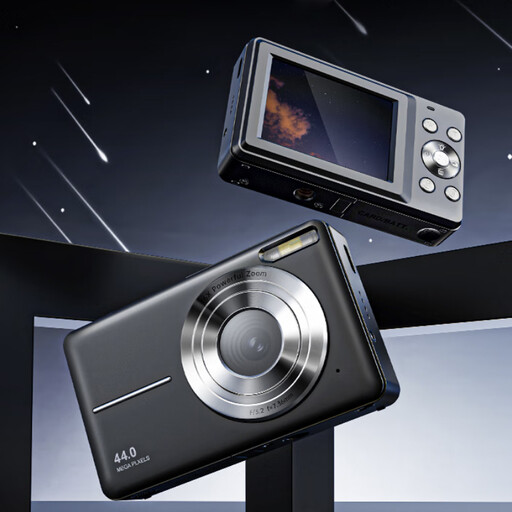
Songdian Pocket Camera, 4K, 44 MP, 16x digital zoom, black
Could suit you if you’re looking for a pocket camera for photos; the stated 16x zoom is digital and shouldn’t be mistaken for an optical telephoto range for distant façade details.
The product name lists 44 MP photo resolution and autofocus.
View at Joybuy
Frequently asked questions
How can you tell whether an entire façade will fit in the frame?
Compare the wide-angle focal length in full-frame equivalent terms and try composing the shot from somewhere you can actually stand. Canon lists 24 mm for the PowerShot G7 X Mark III and Ricoh around 28 mm for the GR IV; those figures alone can’t tell you how wide your street or façade is.
What should you prepare before printing photos for an exhibition?
Agree on the print size and crop, inspect the original file for detail and, if possible, make a test print. Canon describes RAW as an option that lets you adjust settings such as white balance later; check that the exact camera model supports this file format.
What should you take on a photography walk along the canal?
Take a charged battery and a suitable memory card, and get familiar with the controls beforehand. Start with wide shots, then take separate close-ups; when you zoom in, check your framing and focus again. The Consumers' Association includes these practical points in its buying advice.
What are your rights if the camera you bought is faulty?
According to the Dutch Government, you’re entitled to a product that works properly in the Netherlands, and you can contact the retailer if there’s a problem. There is no fixed statutory guarantee period of two years; a manufacturer’s guarantee is in addition to your statutory rights.
Can you exhibit photos of canal houses?
This depends, among other things, on what is shown in the photo and how the building is depicted. Auteursrecht.nl describes an exception for buildings that are permanently in a public place, shown as they appear there. Recognisable people in the photo may raise separate privacy questions: the Dutch Data Protection Authority notes that recognisable images may be personal data. Assess such photos individually, and don’t assume you automatically have permission.


