
Bridge photographer with a fixed viewpoint
You can’t simply change position, so you want to work out in advance whether you can frame a wide view or a tighter crop from where you’ll be standing.


Start by choosing the angle of view you need from the spot available to you. A fixed lens will work only if you can frame the scene from that position, while a zoom gives you more flexibility to adjust the composition. For a bridge silhouette, assess the exposure against the bright background and keep the bridge dark. Weigh this against the zoom range, viewfinder and what you’re prepared to carry. This is a choice based on specifications and photography advice, not a head-to-head test for this particular scene.
You can’t simply change position, so you want to work out in advance whether you can frame a wide view or a tighter crop from where you’ll be standing.
You want to capture the bridge as a recognisable dark shape against a bright sky, and need control over exposure and composition.
You want a camera that’s easy to carry, and are weighing up a fixed lens or built-in zoom against a mirrorless camera with a separate lens.
A good fit when: you can frame the whole bridge from your position using a single angle of view. According to Fujifilm, the X100VI has a fixed lens with a 35 mm full-frame equivalent focal length.
The trade-off: you can’t adjust the angle of view optically. Moving closer or cropping won’t be practical in every location.
A good fit when: you want to capture both a wide view and a tighter crop with one camera. Sony lists the RX100 VII as having a 24–200 mm full-frame equivalent focal length; Canon gives the G7 X Mark III a 24–100 mm equivalent range.
The trade-off: compare the telephoto reach you need and the maximum aperture at that end of the zoom. The specifications alone won’t tell you which model will perform better in your lighting conditions.
A good fit when: you want to fill the frame with a smaller section of the bridge from a distant, fixed position. Panasonic lists the TZ99 as having 30× optical zoom and a 24–720 mm equivalent range for 4:3 photos.
The trade-off: according to Panasonic, the TZ99 has a 1/2.3-inch sensor and a maximum aperture of f/3.3–6.4. A long zoom range doesn’t mean a camera is suitable for every lighting situation.
A good fit when: you want to choose between different angles of view using separate lenses.
The trade-off: factor your lens or lenses into the size and weight of the kit. The weight of the camera body alone doesn’t tell you how much you’ll actually be carrying.
| What to consider | What should you look for? | Who should pay extra attention? |
|---|---|---|
| Fitting the whole bridge in the frame | Choose your viewpoint and compare the angle of view you want with the stated full-frame equivalent focal length. | If I want to show the whole bridge from where I’m standing, I want to avoid cutting off the ends. Around 31% of consumers prioritise framing the whole bridge. |
| Exposure when shooting into the light | Check whether the camera offers exposure control and assess whether the bridge stays dark against the sky. | If I want to keep the bridge’s dark outline against a bright sky, I pay attention to exposure. Around 25% of consumers prioritise exposure control when shooting into the light. |
| Taking photos from a distance | Compare the optical telephoto range at the same aspect ratio, and look at the sensor and maximum aperture too. | If I can’t get closer to the bridge, I want enough zoom from my fixed position. Around 25% of consumers mainly take photos from a distance. |
| A small camera kit | Compare weights on the same basis, preferably including the battery and memory card, and remember to count any separate lenses. | If I want to take my camera on a walk, the whole kit matters more to me than extra reach. Around 19% of consumers prioritise portability. |
A long zoom range alone doesn’t tell you how the sensor and aperture will suit the lighting. According to Panasonic, the TZ99 has a 1/2.3-inch sensor and a maximum aperture of f/6.4 at the telephoto end.
First, work out what crop you need from your actual viewpoint. Then compare the zoom range, sensor and aperture.
The Fujifilm X100VI has a fixed 35 mm full-frame equivalent angle of view. From a particular viewpoint, it may be too narrow or too wide for the bridge.
Check the angle of view you need from the spot where you’ll actually be taking photos before choosing a fixed lens.
With a mirrorless camera, the lens you choose is part of the kit you’ll carry. With a compact camera, the lens is built in.
Compare complete, ready-to-use kits and check what’s included in the stated weights.
A separate lens—and sometimes a second one—is part of the kit you’ll need to carry.
The RX100 VII is a compact camera with a built-in lens, for anyone who wants to capture both a wide view and a tighter crop with one device.
The PowerShot G7 X Mark III has a shorter built-in zoom, making for a small kit with flexibility for framing the bridge in different ways.
The LUMIX TZ99 has a long built-in travel zoom for framing a bridge from a distant viewpoint.
The X100VI suits photographers who want to work deliberately with a single fixed angle of view.
This selection includes cameras listed with a zoom and a mirrorless camera with a kit lens. For each model, compare the stated type of zoom and lens setup with the crop you need from your viewpoint.
 No image available
The product title describes this model as a pocket gimbal camera. Compare its stated zoom and size with the crop you want and the camera kit you’re looking for.
1-inch CMOS sensor, 2× lossless zoom and 107 GB of built-in storage, according to the product title.
The product title also lists 4K/240fps, 3-axis stabilisation and a 2-inch rotating screen.
 No image available
The product title mentions optical zoom. Compare the stated range with your distance from the bridge and the crop you want to capture.
12× optical zoom and 4K video, according to the product title.
The product title also lists Wi-Fi and a 64 MP resolution rating.
 No image available
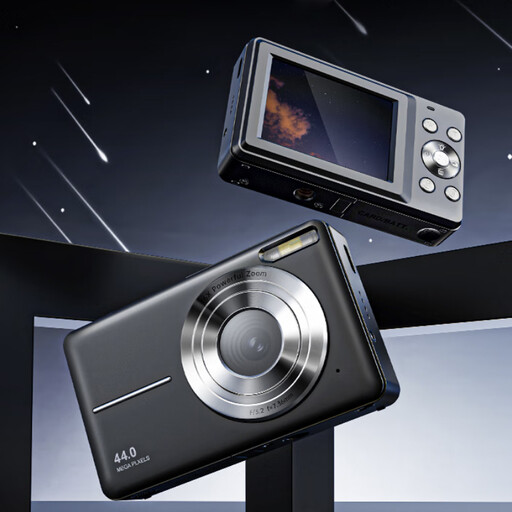
The pocket camera description suggests a small kit. Bear in mind that the stated zoom is digital if you plan to use it for framing from a distance.
4K video and 16× digital zoom, according to the product information; this is not optical zoom.
 No image available
The product title lists optical zoom. Compare the stated range with the crop you need from your viewpoint.
10× optical zoom and a 56 MP resolution rating, according to the product title.
The product title lists front and rear cameras.
 No image available
The 16–50mm kit lens offers different angles of view to compare with the framing you want from your viewpoint.
APS-C sensor and 16–50mm kit lens, according to the product information.
Check whether you’re comfortable framing shots without an electronic viewfinder. In bright sunlight, reflections on the screen can make it harder to assess the image.
Choose a viewpoint where the bridge stands out against a brighter sky, and assess the exposure against that background. Nikon describes backlighting and a recognisable outline as key to creating a silhouette.
A viewfinder can help you avoid reflections on the rear screen in bright sunlight. Before buying, check whether the specific camera has a viewfinder and whether you find it comfortable to use.
Not with a compact camera that has a fixed lens or built-in zoom, as the lens is part of the camera. If you choose a mirrorless camera, assess the complete kit with the lens that gives you the angle of view you want.
In the Netherlands, the retailer is responsible for the legal guarantee if a product is faulty. Depending on the circumstances, ACM ConsuWijzer lists a free repair, replacement or refund as possible solutions. A manufacturer’s guarantee period does not replace this legal right.
First, check the privacy rules that apply to the publication. According to the Dutch Data Protection Authority, recognisable people are personal data. Private images that stay private fall under a different exception from wider public or commercial publication. This is not a general statement about all local photography rules.