Who is this camera guide for?

Photographers interested in light and bridge texture

You want to show the structure as well as the dark shape of the bridge, and be able to assess the exposure carefully. When shooting against the light, pay attention to both the sky and the shadow areas.

Photographers shooting from the opposite bank

You can’t get any closer to the bridge and want to make its structural details appear larger in the frame. Compare the zoom range with the distance from which you’ll actually be taking photos.

Walkers with a camera

You want to take your camera on a walk while still being able to choose your framing and settings carefully. Consider how much zoom you need in relation to the size and weight you’re happy to carry.

What should you look for when choosing?

What to consider What should you check? Who should consider this?
Exposure control Check the exposure compensation, metering modes and whether you can assess overexposed highlights. If you want to preserve the dark shape of the bridge while capturing its texture, precise exposure control is important. Around 33% of consumers prioritise exposure and bridge texture.
Optical zoom range Compare the optical zoom range in 35 mm equivalent with your shooting distance; don’t treat digital zoom as equivalent to optical magnification. If you can’t get closer and want to frame a section of the bridge to fill the picture, telephoto reach matters. Around 27% of consumers prioritise zoom range for photographing a distant bridge.
Portability Compare the size and weight, and consider whether a fixed focal length, travel zoom or larger superzoom will suit your walk. If you want to take your camera with you regularly but still frame your shots carefully, the balance between weight and field of view is crucial. Around 20% of consumers prioritise portability.
Taking photos at dusk Compare the maximum aperture at the telephoto end, the stated image stabilisation and how easily you can keep the camera steady. If you mainly take photos as the light fades and want to retain fine detail, look at both the lens aperture and how steadily you can shoot. Around 20% of consumers prioritise detail at dusk.

Common mistakes when choosing

  • Looking only at megapixels or the biggest zoom figure

    The lens, sensor, lighting and a steady shot all play a part in capturing detail. The Consumers’ Association warns that heavy zooming makes it harder to keep your subject in the frame.

    Compare the optical zoom range with your shooting distance, and assess the sensor and lens aperture separately.

  • Expecting a pure silhouette with fine detail in the dark bridge

    A completely dark bridge won’t also show clear surface texture. If you brighten the shadows, you’ll also need to watch out for detail being lost in the lighter parts of the image.

    Take a test shot and assess the sky and the bridge separately before adjusting the exposure.

  • Treating a fixed wide-angle lens and a large superzoom as interchangeable pocket cameras

    Ricoh specifies a fixed 28 mm-equivalent field of view for the GR IV; Nikon lists the COOLPIX P1100 as weighing around 1.4 kg. These features suit different shooting distances and carrying preferences.

    First decide where you can stand and how much weight you want to carry. Then choose the camera type and zoom range.

Camera brands to compare

Sony

The RX100 VII is a compact zoom option for anyone looking to frame both a wide view of the bridge and distant details.

  • Sony specifies a 1.0-type sensor, a 24–200 mm-equivalent optical zoom range, an electronic viewfinder and manual focus.
  • According to Sony, the maximum aperture ranges from f/2.8 at the wide-angle end to f/4.5 at the telephoto end. These specifications alone can’t predict how much detail you’ll capture of a particular bridge.

Panasonic

The Lumix DC-TZ99 is designed for framing distant parts of a bridge with a compact travel zoom camera.

  • Panasonic specifies 30× optical zoom, equivalent to 24–720 mm.
  • The Consumers’ Association warns that heavy zooming makes it harder to keep a subject in the frame. Also check whether the specific variant is available.

Canon

The PowerShot G7 X Mark III is an option for a relatively close-up bridge shot where you want to control the exposure as the light fades.

  • Canon specifies a 1.0-type sensor, a 24–100 mm-equivalent zoom range, f/1.8–2.8, spot metering and exposure compensation.
  • Its telephoto reach is shorter than that of a longer zoom. The specifications don’t prove that the camera will produce better images of every bridge.

Ricoh

The GR IV is a fixed wide-angle option if you want to photograph the bridge and its surroundings from a suitable, relatively close position.

  • Ricoh specifies an APS-C-size sensor and a fixed 28 mm-equivalent field of view.
  • There’s no optical zoom to bring a distant detail closer in the frame.

Nikon

The COOLPIX P1100 is designed for anyone who wants to fill the frame with distant details and is happy to carry a larger camera.

  • Nikon specifies a 24–3000 mm-equivalent zoom range and RAW support.
  • Nikon lists the weight as around 1.4 kg. An exceptionally long zoom range doesn’t automatically mean you’ll capture more detail.

Joybuy product pick

This pick is a camera-and-light bundle for photography. Check that this camera type and bundle contents suit your preferred field of view and way of taking photos.
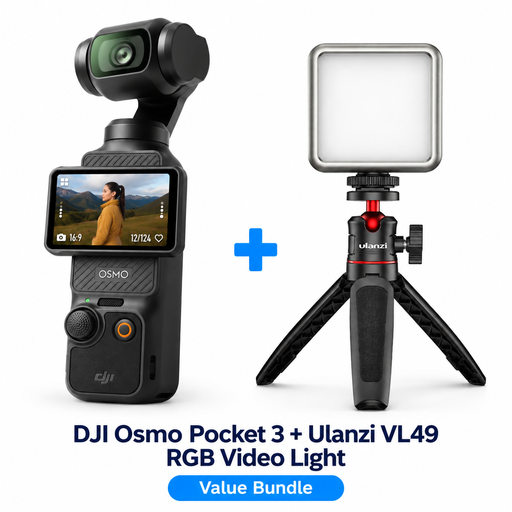
DJI Osmo Pocket 3 Creator Combo with Ulanzi VL49 RGB LED video light

DJI Osmo Pocket 3 Creator Combo with Ulanzi VL49 RGB LED Video Light

This bundle combines the DJI Osmo Pocket 3 Creator Combo with a Ulanzi VL49 RGB LED video light. Check whether a camera-and-light bundle is right for your bridge shot.

Joybuy

Frequently asked questions

How can you keep both the sky and part of the bridge visible when shooting against the light?

Take a test shot, check the brightest areas and adjust the exposure if needed. Canon Netherlands explains that blown highlights lose detail; a completely dark silhouette won’t meet your aim of showing texture in the bridge too.

Do you always need the longest zoom for a distant bridge?

Not necessarily. First decide how much of the bridge you want to photograph from where you’re standing. The Consumers’ Association warns that heavy zooming makes framing more difficult, so compare the optical zoom range and the weight you’ll need to carry with your shooting location.

Which accessories should you check before a photo shoot?

Check which memory card and battery are compatible with your chosen camera, and what’s included in the specific offer. The Consumers’ Association lists an extra battery and an SD card as separate purchases to consider.

What are your rights if a camera bought in the Netherlands turns out to be faulty?

According to the Dutch government, you’re entitled to a product that works as it should, and the seller must resolve problems with a faulty product. The Netherlands has no fixed statutory two-year guarantee period; what you can reasonably expect depends, among other things, on the product.

Can you publish online a photo of a bridge showing identifiable passers-by?

That depends on the circumstances and how you share the images. According to the Dutch Data Protection Authority, the exception for personal or household use only applies while images remain private or are shared with a very limited group. Publishing identifiable people more widely requires a lawful basis under the GDPR; consent is often, but not always, the appropriate basis.
