
Wide canal-scene photographer
You want to capture the row of trees, a bridge and their reflections together from the canal bank. In that case, the wide-angle setting and room to choose your viewpoint matter more than maximum telephoto zoom.


Start with the framing you need from the canal bank: a wide-angle lens for the whole row of trees, an optical telephoto zoom for details on the opposite bank, or a prime lens if you want to work with a single angle of view. Then compare the exact model’s sensor, aperture at the zoom setting you’ll use and RAW support. More zoom doesn’t automatically mean the same performance in low light or the same scope for editing.
You want to capture the row of trees, a bridge and their reflections together from the canal bank. In that case, the wide-angle setting and room to choose your viewpoint matter more than maximum telephoto zoom.
You’re staying on one side of the canal and want to bring a colourful treetop or branch on the opposite bank closer. Compare the optical range and aperture at the telephoto end, not just the advertised zoom factor.
You select images for discussion or printing and want control over your shots and files in changing autumn light. Check RAW support for the exact model, as it varies between cameras.
Best for: If you want to frame both the whole canal and nearby trees on one walk, you could compare a short standard zoom, such as the Canon PowerShot G7 X Mark III.
Trade-off: Its stated 100 mm-equivalent telephoto limit offers less reach for details on the opposite bank than the travel zoom models mentioned here.
Best for: If you want to isolate details from the same spot on the canal bank, you could compare the Panasonic LUMIX DC-TZ99 and Canon PowerShot SX740 HS Lite Edition.
Trade-off: According to their manufacturers, both have a 1/2,3-type sensor. Panasonic lists RAW for the TZ99, while Canon lists JPEG as the photo file format for the SX740 HS Lite Edition.
Best for: If you want a built-in viewfinder and 200 mm-equivalent reach is enough, you could consider the Sony RX100 VII.
Trade-off: Sony gives this model an aperture of f/2.8 at the wide-angle end and f/4.5 at the telephoto end, so the maximum aperture doesn’t stay the same as you zoom in.
Best for: If you mainly photograph nearby trees and are happy with one angle of view, you could compare the Fujifilm X100VI with its 35 mm-equivalent lens or the Ricoh GR IIIx with its 40 mm-equivalent lens.
Trade-off: These prime lenses don’t offer optical telephoto zoom for details on the opposite bank. A different composition means changing your viewpoint or cropping the image.
| What to consider | What should you check before buying? | Who should pay particular attention? |
|---|---|---|
| Fitting the whole canal into the frame | Compare the shortest focal length in 35 mm-equivalent terms and consider whether you can frame the row of trees, the bank and the reflections together from your viewpoint. Canon lists a 24 mm equivalent for the G7 X Mark III, and Panasonic lists a 24 mm equivalent for the TZ99 at 4:3. | If I can’t move further back and want to capture the whole row of trees and their reflections, a wide composition comes first. Around 31% of consumers make a wide canal scene their top buying priority. |
| Details on the opposite bank | Compare the longest optical focal length in 35 mm-equivalent terms: Panasonic lists 720 mm for the TZ99 at 4:3, Canon lists 960 mm for the SX740 HS Lite Edition and Sony lists 200 mm for the RX100 VII. Digital zoom is not the same as optical zoom. | If I want to make a branch or colourful treetop appear larger from the same spot on the canal bank, I focus on optical reach. Around 25% of consumers make distant tree details their top buying priority. |
| Files and control in changing light | Check RAW support, the available exposure modes and the maximum aperture at the zoom setting you’ll use. Panasonic lists RAW for the TZ99 and Fujifilm for the X100VI; Canon lists JPEG as the photo file format for the SX740 HS Lite Edition. | If I want to edit camera club photos and control my files in the shade or later in the day, file format and settings matter. Around 25% of consumers prioritise editing and control in changing light. |
| Portability and handling | Compare weights on the same basis and check screen movement, grip and viewfinder. Canon lists approximately 304 g for the G7 X Mark III and Panasonic approximately 322 g for the TZ99, both including battery and memory card. | On a walk, I want a camera that’s easy to carry and lets me frame shots from low down by the water’s edge. Around 19% of consumers prioritise portability and ease of use. |
Canon lists 40× optical zoom for the SX740 HS Lite Edition, alongside higher figures for ZoomPlus and combined magnification. These are different specifications.
For a tree on the opposite bank, compare the longest optical focal length, not the biggest magnification figure in an advert.
Panasonic lists RAW for the TZ99 and Fujifilm for the X100VI. Canon lists JPEG as the photo file format for the SX740 HS Lite Edition. This difference matters if you want to edit your camera club photos yourself.
Check the file formats for the exact model variant before you buy.
The stated maximum aperture changes with the zoom setting. Panasonic lists f/3.3–6.4 for the TZ99 and Sony f/2.8–4.5 for the RX100 VII.
Compare the range, sensor and maximum aperture for the framing you need and the time of day you’ll mainly be taking photos.
The Fujifilm X100VI has a fixed 35 mm-equivalent lens and the Ricoh GR IIIx a fixed 40 mm-equivalent lens. Neither offers the optical telephoto zoom of a travel zoom model.
Consider whether you can change your viewpoint along your route or whether you need optical zoom for details on the opposite bank.
The RX100 VII is worth comparing if you want a compact zoom with a built-in electronic viewfinder.
The PowerShot G7 X Mark III and SX740 HS Lite Edition offer different zoom ranges to compare side by side.
The LUMIX DC-TZ99 is a travel zoom worth comparing if you want to capture both a wide canal scene and distant details.
The X100VI is a prime-lens option if you enjoy composing with a single angle of view and want to shoot RAW.
The GR IIIx is a prime-lens option to compare if a 40 mm-equivalent angle of view suits your compositions.
This selection of Joybuy products includes portable cameras for photography, video and action footage. For each model, check that its shooting features suit taking still autumn photos and that it can give you the framing you need.
 No image available
The title describes this model as a pocket gimbal camera; check that its still photography features suit your camera club needs.
The title lists a 1″ CMOS sensor, 2× lossless zoom, 4K/240fps, 3-axis stabilisation and 107 GB of built-in storage.
 No image available
The product title describes this model as a portable point-and-shoot camera; check which features are available for still photos and camera club editing.
The title lists 80 MP and 18× zoom.
 No image available
The title describes this model as a small vlogging camera; check whether its still photography features suit your needs.
The title lists a 1″ CMOS sensor, 4K/120fps, 3-axis stabilisation and a 2″ rotating touchscreen.
 No image available
The title describes this as a pocket camera for photography and video; check the still photo options and whether it offers the angle of view you need.
The product information lists 16× digital zoom; this is not optical zoom.
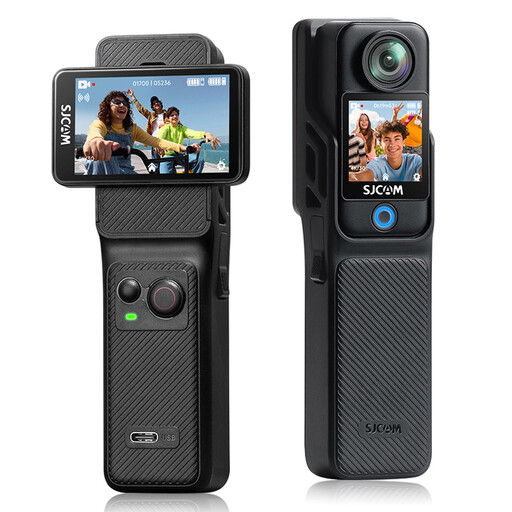 No image available
The product title describes a compact action camera; check whether its photo features and controls are suitable for your still autumn shots.
The product information lists photos up to 16 MP and a 154° wide-angle lens.
No. Telephoto zoom helps if you want to make a detail on the opposite bank appear larger, but the wide-angle setting is what matters for the whole row of trees. Compare optical focal lengths in 35 mm-equivalent terms, along with the aperture at the zoom setting you plan to use.
Carry your camera in a protective bag and be mindful of condensation when moving from cold air outdoors to a warm room. Sony warns that condensation in a humid environment or during a sudden change in temperature can cause problems. Check the instructions for your exact model and don’t assume it’s water-resistant unless this is confirmed for that model.
According to the Dutch government, you should contact the retailer about your statutory guarantee. The Netherlands doesn’t have one fixed statutory guarantee period for all products; what you can reasonably expect from the product is what matters. A manufacturer’s warranty or extended warranty doesn’t replace this right.
First, consider the privacy rules that apply to the specific photo and publication. The Dutch Data Protection Authority treats identifiable people as personal data; in most cases, you need consent to publish images online. Whether a photo can be shared depends, among other things, on whether people can be identified, the purpose and the applicable legal basis.