
Smoothie maker with limited kitchen space
You make peach smoothies and want to be able to put the appliance away or store it after use without giving up too much space.


For a single smoothie made with soft, fresh fruit, a compact blender with a cup sized to suit your portion is a sensible place to start. The Consumers' Association describes small blending cups as handy for preparing a smoothie directly in the cup and taking it with you. If you often use frozen peaches or ice, check the instructions for the exact model: not every blender is suitable, and wattage alone is no guarantee of blending performance.
You make peach smoothies and want to be able to put the appliance away or store it after use without giving up too much space.
You want to make a small portion in a suitable cup and perhaps take it with you. The Consumers' Association describes this as a common use for a smoothie blender.
You often use frozen peaches or ice and want to check in advance whether your chosen model is designed for them.
Measure the space where you plan to keep the blender, as well as the space for storing separate cups and lids. Then choose based on portion size and the ingredients you actually want to blend.
| What to consider | What to look for | Who is this for? |
|---|---|---|
| Worktop and cupboard space | Compare the dimensions of the complete appliance with the space available, and think about where you will store the cup and lid. | If your kitchen has limited worktop or cupboard space, you will need room for the separate parts too. Space is the top priority for around 36% of consumers in this breakdown. |
| Portion size and travel cup | Check the cup capacity, the maximum fill level and whether a drinking lid is included with that version. | If you want to make a smoothie directly in a cup and perhaps take it with you, the main thing is whether the cup suits your portion size and needs. Around 29% of consumers say portion size for taking a smoothie with them is their main buying concern. |
| Fresh or frozen peaches | Check the instructions for the exact model to see which ingredients are suitable; don’t assume that wattage proves it is suitable. | If you often use frozen peaches or ice, you will want to know whether those ingredients are suitable for your model. For around 21% of consumers, suitability for frozen fruit is the top priority. |
| Cleaning | Check which parts can be removed and which are dishwasher-safe according to the manual. | If you make smoothies often, you won’t want to clean more parts than necessary afterwards. Easy cleaning is the deciding factor for around 14% of consumers. |
The stated motor power does not, by itself, show whether a blender can handle frozen fruit or ice.
Check the manual for the exact model to see which ingredients are suitable and what conditions apply.
The assembled cup may be taller than the base, while extra cups and lids also need storage space.
Measure the space with the appliance assembled and compare it with the dimensions of the complete version.
Versions with similar product names may differ in the cups and lids included.
Before buying, compare the full model number and the parts list for the specific version.
Philips says the Blend & Go 3000 Series, including the HR2670/01, is designed for making smoothies in a compact cup.
According to nutribullet, the Original 600, including model NB603DG, is designed for small portions in a personal blender.
Tefal describes the Blend Up BL19H4F0 as a compact blender with travel cups and automatic programmes.
Braun positions the PowerBlend 1 JB1051BK as a compact jug blender for anyone who wants to use a jug as well as make smoothies.
This selection features compact blenders with either a jug or a cup for a smoothie to take with you. When comparing them, consider the space the complete appliance takes up, the portion size and the ingredients you want to use.
 Image unavailable
The jug makes this one worth considering if you’re looking for a jug blender as well as a smoothie maker.
The product name lists a 1.5 l jug, three speeds and an ice-crushing function. Check the instructions for the ingredients you want to blend.
 Image unavailable
The product information mentions soft, juicy fruit and smoothies, making this a good match for peach smoothies made with fresh fruit.
The jug has a capacity of 0.6 l. Its stated dimensions are 123 × 119 × 350 mm and its power is 350 W. The product name mentions ice crushing; check which frozen ingredients are suitable.
 Image unavailable
The product information lists a 500 ml cup with a drinking spout lid, designed for taking a smoothie with you.
The stated dimensions are 13 × 13 × 35 cm. Check that the cup capacity suits your portion and how much space the appliance will take up when stored.
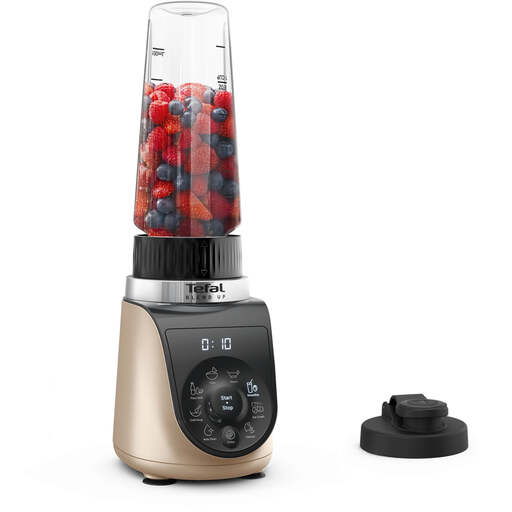 Image unavailable
This personal blender is worth considering if you want to make a smoothie for one.
The product information says it can be used with frozen fruit. Check the manual for the exact ingredients and conditions of use; the product claim is not an independent test.
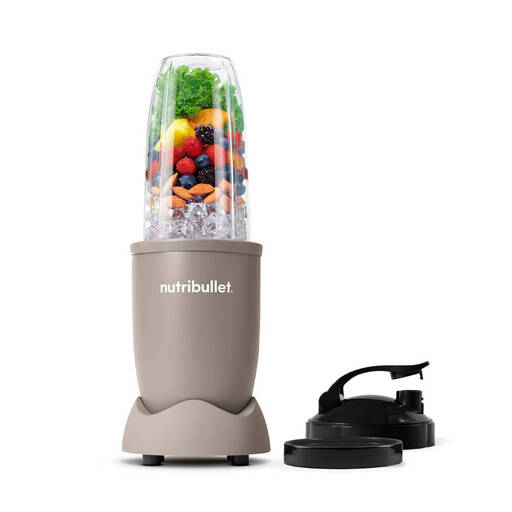 Image unavailable
The drinking cup and to-go lid are handy if you want to make your smoothie directly in a cup and take it with you.
The product name lists a 700 ml capacity and 900 W. The product information mentions a pulse function and use with frozen fruit and ice cubes; check the instructions to see which ingredients are suitable.
Not necessarily: soft, fresh fruit calls for different checks from frozen fruit. The Consumers' Association notes that many basic blenders can handle soft fruit, but not every blender can process frozen fruit or ice. So check the instructions for the exact model.
Don’t fill the blender beyond the stated maximum fill level, and make sure the cup or jug is properly secured. The Consumers' Association recommends following the cleaning instructions for each part; clean the motor housing with a damp cloth, as advised in the usage guidance.
If a product is faulty, the seller is responsible for the statutory guarantee. Repair or replacement, and sometimes a refund, may be appropriate, as explained by the Netherlands Authority for Consumers & Markets. For online purchases, you generally have a statutory 14-day cooling-off period after delivery, subject to legal exceptions set out by ACM ConsuWijzer.
Electrical kitchen appliances must meet the applicable electrical safety requirements, while parts that come into contact with food must meet the requirements for food contact materials. The Netherlands Food and Consumer Product Safety Authority explains when electrical rules apply, including by reference to nominal voltage; the European Commission outlines the EU framework for food contact materials. A product listing alone does not confirm that a specific item meets all applicable requirements.