
Vandaag of morgen in huis

Kwaliteit gegarandeerd

Welkomstaanbiedingen ontgrendelen: GRATIS bezorging | Tot 80% korting | Gratis 30 dagen JoyPlus-proefperiode
Download de app
Finding the right colouring pens and fineliners seems straightforward until you have to choose between dozens of sets. An inexpensive pack may contain very few useful colours, while a large set can sometimes give you more pens than you will ever use. A nib that is too thick, ink that bleeds through or caps that are difficult to close can also quickly spoil the experience.
These checks make it easier to see which STABILO colouring pens, Faber-Castell pens, brush pens or gel pens suit the way you plan to use them.
A set of 50 colours sounds appealing, but also consider what you want to use the pens for. For school notes, a set of 10 or 15 clear basic colours may be more practical. For illustrations, journalling or hand lettering, a larger range offers more variety.
Also pay attention to the colour distribution. Some sets contain many shades that are very similar. This is useful for shadows and colour gradients, but less helpful if you mainly want a selection of different highlighting colours.
A 0.4 mm fineliner is suitable for small lettering, outlines, planners and precise details. A marker with a nib of 1 mm or more works faster for colouring in, but may go over the edges of small areas. Brush pens are flexible: with light pressure, you can create a narrow line, while more pressure produces a wider line.
So always check the nib thickness and material. A firm nib is useful for children or users who apply more pressure. A flexible brush nib is better suited to hand lettering and drawings with varying line widths.
Washable pens are practical for children, but the result depends on the fabric, the colour and how quickly you treat a stain. According to Faber-Castell’s product information, the Castle colouring pens are washable from hands and skin and from many fabrics at 30 degrees. This is the brand’s product information; nevertheless, treat stains as quickly as possible and follow the garment’s care label.
Alcohol markers have a different use profile. They dry quickly and can be suitable as markers for drawing and sketching, but the ink may bleed through thin paper. Use marker paper or thicker paper for these applications.
Use this guide as a practical reference:
According to the product description, STABILO point 88 fineliners have a metal-encased 0.4 mm nib and water-based ink. The cap can be placed on the back of the pen. This prevents a loose cap from cluttering your desk, but still close the fineliner securely after use to help prevent it from drying out.
Water-based ink is a sensible choice for writing and drawing pens used on standard paper. According to the brand description, the STABILO Pen 68 uses water-based, odourless ink and has a nib of approximately 1 mm. The product information also states that the ink can be lifted with water to create a watercolour effect. When using techniques like these, choose thicker paper to help prevent buckling and bleed-through.
Gel pens are particularly suitable for writing, colour-coding and colouring pens for journalling. Pay attention to the difference between 0.5 mm and 0.7 mm. A 0.5 mm nib produces a finer line, while 0.7 mm often feels fuller and smoother during longer writing sessions. With gel ink, drying time is important, especially for left-handed users.
For a pen set for children, the recommended age, small parts and relevant safety markings are important points to check. According to the product details, the Faber-Castell Castle set is intended for children aged 4 and over and carries EN 71. According to the product description, the STABILO Trio Scribbi is offered for children aged 3 and over and has a thick, springy nib.
Always check the packaging and product page for the latest safety information. No washable ink makes a pen suitable for use on skin, food or other unsuitable surfaces.
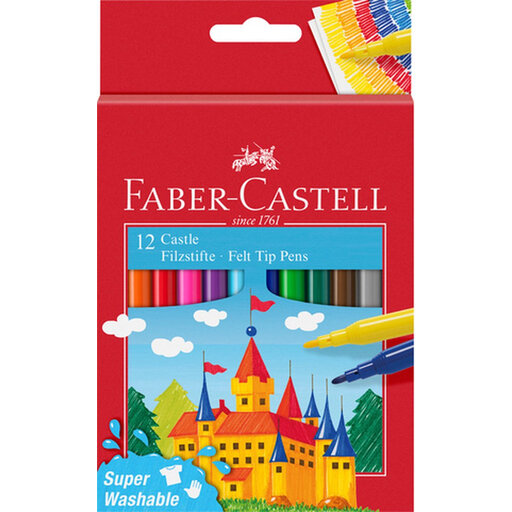
Why it suits this profile: A clear set of 12 colours is suitable for children, schoolwork and first drawing projects without having to buy a large collection straight away.
The set keeps the colour range compact and lists a strong nib, a recommended age of 4 and over, and EN 71 in the product details.
12 colours, suitable for paper and card, and, according to Faber-Castell, easy to wash off hands and skin.
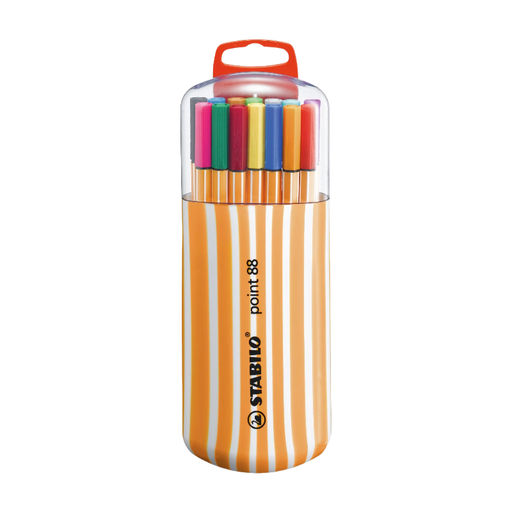
Why it suits this profile: The 0.4 mm nib is ideal for students, journalers and anyone who wants to structure text or draw precise lines.
The nib thickness is clearly specified, and the set contains 20 assorted colours in a storage case.
Water-based ink, a ventilated cap, a cap that can be placed on the back, and a metal casing around the nib.
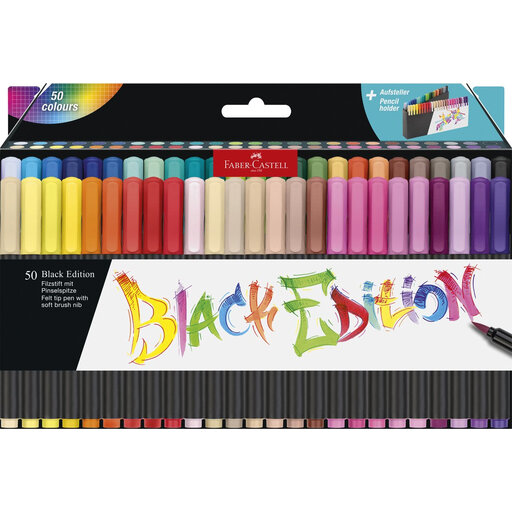
Why it suits this profile: This large set is ideal for creative hobbyists, hand lettering, colour studies and users who want to combine multiple shades.
The product description mentions both broad and narrow lines created by the brush nib and states that the ink is washable.
50 colours, food-colouring-based ink according to Faber-Castell, and a cardboard storage box.
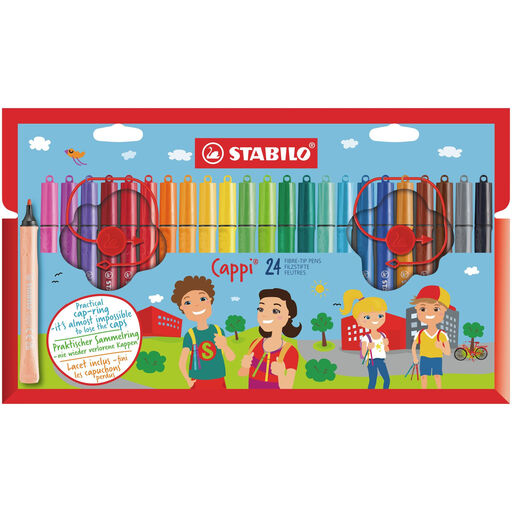
Why it suits this profile: The cap ring helps keep loose caps together, for example during a car journey, at school or when using the pens at a desk.
The cap ring reduces the chance of caps being lost; the product description also mentions an ergonomic grip and washable ink.
24 colours, a medium 1 mm nib and a shape that, according to the product details, is less likely to roll off the table.
We have put together a complete, up-to-date list of products that fully meet these strict selection criteria and the applicable European safety regulations.
For small lettering and fine borders, 0.4 mm or 0.5 mm is usually practical. If you want to colour-code or create fuller lines, 0.7 mm may feel more comfortable for writing. If possible, test the pen on the paper you use every day.
Replace the cap immediately after use and store fineliners according to the product instructions. According to the product description, the STABILO point 88 can be left without its cap for a short time, but that is no reason to leave the pen open regularly. Store the set away from direct sunlight and extreme temperatures.
That depends on the nib, age guidance and safety information. A thick, pressure-resistant nib may be easier for younger users. Always check the recommended minimum age. For children who mainly want to colour, washable colouring pens are often more practical than alcohol markers, which can bleed through thin paper.
