
Vandaag of morgen in huis

Kwaliteit gegarandeerd

Welkomstaanbiedingen ontgrendelen: GRATIS bezorging | Tot 80% korting | Gratis 30 dagen JoyPlus-proefperiode
Download de app
Coloured pens and markers are useful for school, work, journaling, hand lettering and creative projects. However, a large colour set is not automatically practical. A fineliner for small lettering works differently from a marker for wood, glass or canvas. The type of ink, nib size and washability can also determine whether a purchase suits the way you intend to use it.
Pay particular attention to these three common pitfalls:
The nib determines how much control you have. For notes, diagrams and outlines, fineliners of around 0.4 to 0.5 mm are practical. The STABILO point 88, for example, has a metal-encased 0.4 mm nib. This makes it suitable for writing, drawing, sketching and working with a ruler or stencil.
For colouring and larger areas, felt-tip pens with a medium or XL nib make more sense. A brush tip offers flexibility for hand lettering, while a chisel tip can create both broad and narrow lines. So don’t just check the number of colours; look at the nib shape too.
The type of ink determines where you can use the marker:
For children, CE or EN 71 markings are relevant product information, but they do not replace supervision and correct use. Also check the recommended minimum age and whether the product contains small parts. Washable ink can be helpful for arts and crafts, but “washable” does not mean that every mark will disappear from every material without treatment.
With alcohol and acrylic markers, it is a good idea to test them on a small area first. When using water or paint techniques, choose thicker paper to reduce bleed-through and warping. Cap pens after use and store them according to the product information, for example horizontally or with the nib facing downwards.
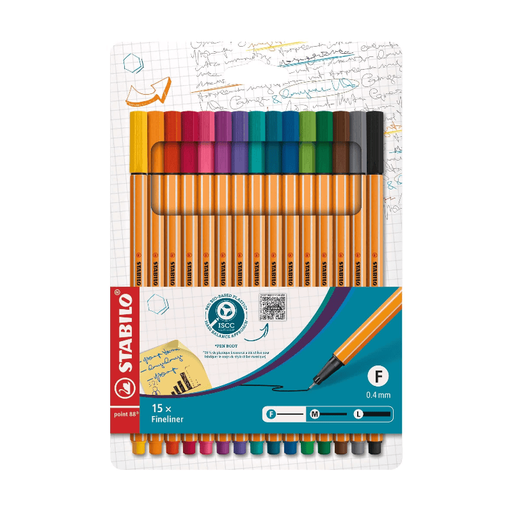
Why it suits this profile: This set combines 15 colours with a fine 0.4 mm nib. That makes it suitable for notes, colouring, drawing and simple hand lettering.
The fixed nib size makes it clear what the pen is designed for: precise lines on paper, not broad areas or hard surfaces.
Water-based ink, metal-encased nib, cap that can be attached to the back and an assortment of 15 colours.

Why it suits this profile: Ideal for illustrators, students and creative hobbyists who want to sketch with multiple colours and different line widths.
The set specifies both a 1 to 5 mm brush tip and a 0.6 mm fineliner nib. This tells you in advance which lines you can create.
24 colours, alcohol ink, quick-drying ink and two nib shapes for sketching and detailed work.

Why it suits this profile: Suitable for projects where you work on more than just paper, including wood, glass, plastic, ceramics or canvas.
The product information explicitly lists several surfaces and an activation procedure. This makes it clear that the marker works differently from an ordinary felt-tip pen.
Six metallic colours, opaque water-based acrylic ink, 1 mm and 3 mm nibs and an ink-level indicator.
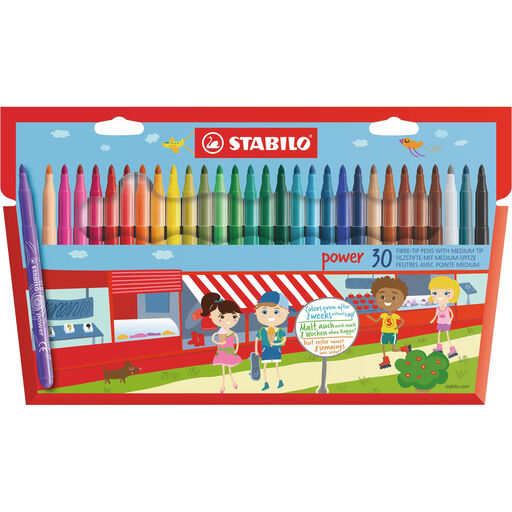
Why it suits this profile: A practical choice for children and families who want plenty of colours and a medium nib for larger drawing areas.
The product description specifies a pressure-resistant nib and washable ink. This is better suited to intensive colouring than a fine writing pen.
30 colours, a 2 mm medium nib, pressure-resistant nib and washable ink according to the product information.
We’ve put together a complete, up-to-date list of products that fully meet these strict selection criteria and the applicable European safety regulations.
For journaling, fineliners and gel pens with a fine nib are generally practical. A 0.4 or 0.5 mm nib gives you control when writing small letters and colour coding. Retractable gel pens are handy when you’re out and about, but check the drying time to minimise smudging.
Choose a marker that the product description states is suitable for smooth surfaces. OHP markers are designed for transparency film and other smooth materials. According to the manufacturer’s description, acrylic markers can be used on a range of surfaces. Always test adhesion and removability on a small area first.
Replace the cap immediately after use, store the set according to the instructions and avoid direct sunlight and extreme temperatures. Store fineliners and many markers horizontally when recommended. With markers that have a pumping or shaking function, you must also activate the pen correctly before colouring large areas.
