
Vandaag of morgen in huis

Kwaliteit gegarandeerd

Welkomstaanbiedingen ontgrendelen: GRATIS bezorging | Tot 80% korting | Gratis 30 dagen JoyPlus-proefperiode
Download de app
Choosing a new set of coloured pens and coloured pencils may seem straightforward. Yet many shoppers are drawn to a wide range of colours, eye-catching packaging or sustainability claims without considering the practical details. Whether you’re shopping for school, journalling, drawing or hand lettering, it’s the nib, ink type and paper compatibility that make the real difference.
A set with 24 or 48 colours isn’t automatically suitable for every task. A broad fibre tip is ideal for filling in large areas, but less practical for small lettering. A 0.4 mm fineliner is suitable for details and lines, but not for quickly colouring a large area.
So first decide what you’ll use the set for:
Water-based ink, gel ink and coloured pencil behave differently on paper. Thin exercise-book paper may allow ink to show through, while thicker drawing paper can handle more colour and water. So don’t just check the colour range — also consider the recommended surface.
With brush pens and felt-tip pens, it’s wise to test them on a small piece of paper first. Claims such as ‘no bleed-through’ or ‘quick drying’ come from product information provided by the brand or seller and may work differently depending on the type of paper.
Children sometimes press hard when using a felt-tip pen, while students may use a pen continuously for hours. A fragile nib, loose cap or smooth barrel can quickly become frustrating. Look for a pressure-resistant nib, a comfortable grip and a cap that closes securely.
Small parts are particularly important for young children. Check the recommended age, any warnings and product markings such as CE or EN 71. Such a marking doesn’t replace supervision, but it can help you check the product information.
For precise writing, line widths of around 0.4 to 0.5 mm are practical. According to the product description, the STABILO point 88 features a metal-clad nib measuring 0.4 mm. This makes the fineliner suitable for small text, rulers and stencils.
A nib of around 1 mm is more versatile for drawing and colouring. A brush tip offers even more variation: use light pressure for a narrow line and more pressure for a broader stroke. For large areas, nibs measuring 2 to 3 mm are more efficient.
Water-based ink is common in fineliners and felt-tip pens. According to the manufacturer, the STABILO point 88 uses water-based ink, as does the STABILO Pen 68. The product information also states that these models can be left uncapped for a while, but always replace the cap securely after use.
Gel pen sets are suitable for colour coding and writing. Pay attention to the exact nib size: a 0.5 mm gel pen writes more precisely than a 0.7 mm model, while the broader nib often delivers more colour.
With coloured pencils, the shape of the pencil, the type of wood and the core all matter. According to the product details, the Faber-Castell Black Edition has a triangular shape and a 5 mm core. The manufacturer states that it features special SV bonding to help reduce breakage during normal use. This is a product claim from Faber-Castell, not a guarantee that a pencil will never break.
For children, a triangular or thicker barrel may be more comfortable to hold. For prolonged writing, a rubber grip or matt, non-slip finish are useful features to consider when comparing products.
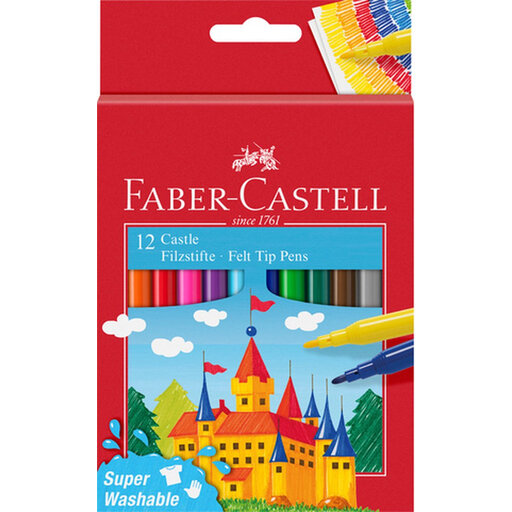
Why it suits this profile: A straightforward set for children who mainly want to colour and draw without immediately needing lots of different nibs.
According to the product information, the sturdy nib is designed for use by children. The set contains 12 colours, so you don’t pay for an unnecessarily large collection.
12 varied colours, a sturdy nib and, according to Faber-Castell, ink that washes off hands and most fabrics.
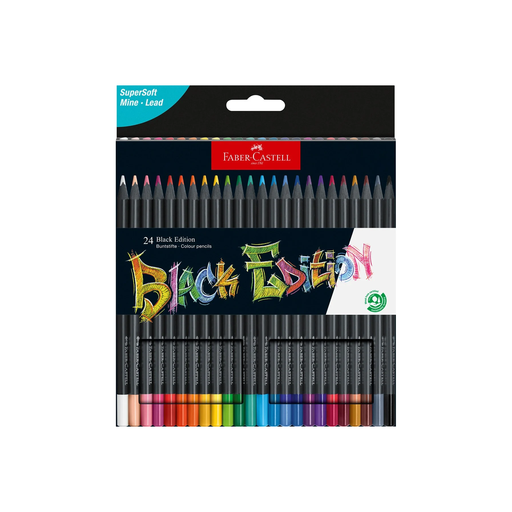
Why it suits this profile: Suitable for adults, students and children who want to use softer coloured pencils for shading, layering and drawing on both light and dark paper.
The triangular shape helps prevent slipping, while the product description mentions special break-resistant bonding. However, check the nib regularly during intensive use.
24 colours, a soft B core, a 5 mm core thickness and suitability for both dark and light paper according to the product specifications.
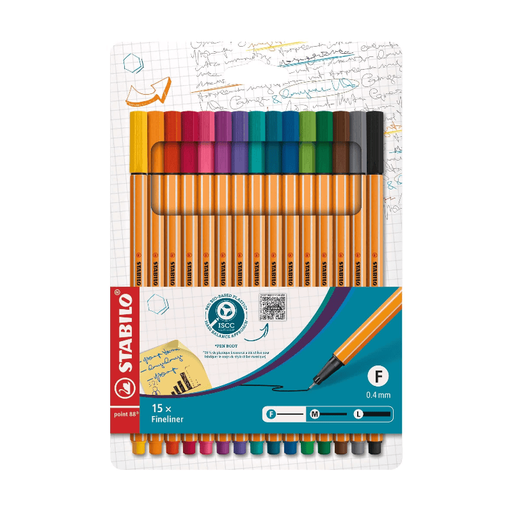
Why it suits this profile: A practical choice for precise writing, sketching, colour coding and hand lettering, at home or at school.
The 0.4 mm metal-clad nib is designed for precise lines. The set contains 15 colours rather than just the basic shades, without switching to a broad felt-tip nib.
Water-based ink, 15 standard colours, a cap that can be attached to the end and, according to STABILO, the ability to remain uncapped for several days without drying out.
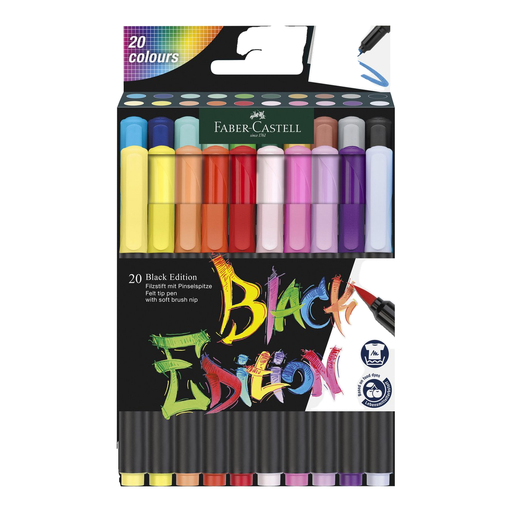
Why it suits this profile: For hand lettering, small drawings and creative writing where you want to switch between thin and thicker lines.
The flexible brush tip is better suited to hand lettering than a standard fineliner. Replace the cap immediately after use to help prevent the ink from drying out.
20 colours, lines in different thicknesses and, according to Faber-Castell, washable ink made with food colourings.
We’ve put together a complete, up-to-date list of products that fully meet these strict selection criteria and the applicable European safety regulations.
The lifespan of coloured pens and coloured pencils depends heavily on how they’re used. These simple habits can help you avoid unnecessary waste:
For school, fineliners such as the STABILO point 88 are useful for underlining, diagrams and small notes. For colouring sheets and larger areas, felt-tip pens with a medium-sized nib are a better choice. Also consider the size of the pencil case and whether the caps are easy to replace.
Colouring pens generally have a broader nib for colouring and drawing. Fineliners are designed for thin, controlled lines. Brush pens have a flexible tip that changes line width according to the pressure applied. Brush pens are often more practical for hand lettering, while fineliners are usually easier to control for small text.
Replace the cap after every use, store the pens according to the product instructions and keep them away from direct sunlight and extreme temperatures. A cap ring, as found on some STABILO Cappi sets, can help prevent caps from getting lost. Drying out isn’t an issue with coloured pencils, but dry storage and careful sharpening help reduce breakage.
