
Vandaag of morgen in huis

Kwaliteit gegarandeerd

Welkomstaanbiedingen ontgrendelen: GRATIS bezorging | Tot 80% korting | Gratis 30 dagen JoyPlus-proefperiode
Download de app
Coloured pens and markers are handy for notes, bullet journals, drawings and creative projects. Yet a large colour range doesn’t tell you everything. A pen might write beautifully but bleed through paper too quickly. A marker might be described as washable, while stains on clothing still need immediate treatment.
As Joybuy Product Recommendation Officer, I therefore focus on verifiable details: tip size, ink type, material, drying time, washability and suitable surface. That way, you choose stationery that suits your actual use, rather than just the packaging.
A set of 20 or 30 colours looks appealing, but a broad fibre tip isn’t practical for small notes. For school pens, planners and journaling pens, tips of 0.4 to 0.7 mm are usually more practical. For large areas of colour or posters, a wider tip works faster instead.
Also pay attention to the difference between the tip size and the actual line width. A 0.5 mm gel pen, for example, can produce a written line of around 0.25 to 0.3 mm according to the product specification.
Drying time depends on the ink type, the amount of ink and the paper. Gel ink can be richly coloured, but may show through on thin school paper. Alcohol markers generally dry quickly, but can bleed through standard paper. Water-based felt-tip pens are often more suitable for children and everyday colouring, although prompt cleaning is still wise.
According to one brand’s product description, “washable” also doesn’t mean every stain disappears without pre-treatment. So check whether the claim applies to skin, most fabrics or specific surfaces.
If you’re buying acrylic markers for glass, wood, ceramic or metal, you need to look at the listed surfaces and how the ink is activated. A marker with a pump or shake mechanism requires more preparation than a standard fineliner. Also test on an inconspicuous spot first: coverage and removability can vary by surface.
Choose the tip based on your task:
A dual-tip marker offers more flexibility, but also takes up more space in a pencil case. Check that both caps close properly; drying out often starts with a cap that isn’t fully secured.
The ink type determines the experience and maintenance:
Claims about drying time, colour intensity or washability are based on the brand’s product information. So treat them as product specifications and take paper, pressure and surface into account.
Sets with caps and small parts often carry a warning for children under three years old. When children are using them, also check whether there is information about CE marking, EN 71 or ventilated caps. These mentions do not replace supervision.
For a longer lifespan:
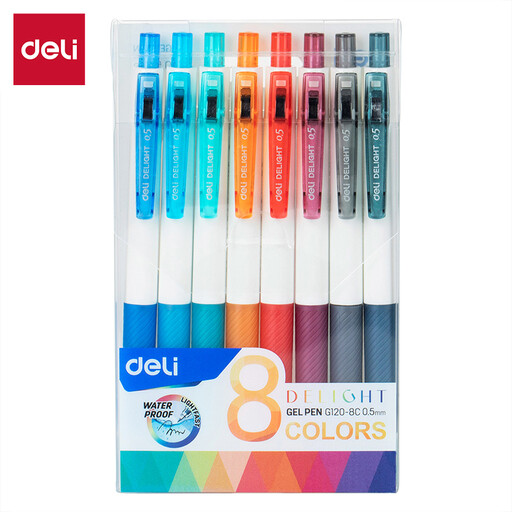
Why this fits the profile: The eight-colour set is suitable for school notes, simple colour-coding and a first bullet journal without immediately buying a large collection.
The 0.5 mm tip is more precise than a general broad felt-tip pen, and the product description mentions less show-through on most standard papers.
Gel ink, rubber grip and eight different colours for everyday writing and colour-coding.

Why this fits the profile: For artists, illustrators and creative hobbyists who want a brush tip and a fineliner tip in one marker set.
The specifications list both a flexible brush tip of 1–5 mm and a metal fineliner tip of 0.6 mm, so you don’t need a separate pen for every detail.
24 alcohol markers with quick-drying, water-resistant ink according to the product description; close the caps properly to reduce drying out.

Why this fits the profile: Intended for creative projects on surfaces including paper, wood, glass, ceramic, plastic, canvas and stone, according to the product information.
The packaging clearly describes the suitable surfaces and lists two tip sizes. This means the marker isn’t selected on colour alone.
Six colours, water-based acrylic ink, an ink level indicator and a shake-and-pump function.
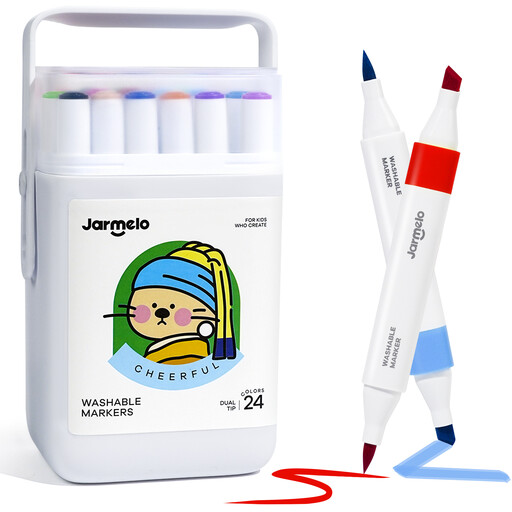
Why this fits the profile: The combination of brush and chisel tip is suitable for colouring, drawing and lettering at home, at school or on the go.
The set states water-based ink, ventilated caps and a carry case. According to the product description, the ink is 90% washable from skin and most fabrics.
24 colours, two tip shapes per marker and a storage case with handle.
We’ve put together a full, up-to-date list of products that fully meet these strict selection criteria and current European safety regulations.
Choose a fine tip and test the ink on a corner of the paper. Fineliners of around 0.4 mm and 0.5 mm gel pens generally offer more control than broad markers. Bear in mind: paper quality and writing pressure remain decisive for show-through.
Put the cap back on immediately and check that it closes fully. Store markers according to the product instructions, away from direct sunlight and extreme heat. With dual-tip markers, both caps must be securely fastened. Acrylic markers also require activation by shaking and pumping before the ink flows evenly.
No. “Washable” is a product specification with a certain scope, for example skin or most fabrics. According to the product information from some brands, pre-treatment is needed for clothing. So rinse a stain with water as soon as possible and follow the fabric’s care label.
