
Vandaag of morgen in huis

Kwaliteit gegarandeerd

Welkomstaanbiedingen ontgrendelen: GRATIS bezorging | Tot 80% korting | Gratis 30 dagen JoyPlus-proefperiode
Download de app
Coloured pens and markers might seem easy to pick, but the difference between a handy set and a disappointing purchase often comes down to the details. A brush tip that deforms quickly, ink that bleeds through paper, or a marker that isn’t suitable for the surface can seriously limit how you use it.
So don’t just focus on the number of colours. Also consider the pen type, tip size, ink base, surface, and the age group the product is intended for. Below are the key points to look out for, along with some popular choices for school, office, creative hobbies and journaling.
A set of 24 or 50 colours sounds appealing, but it isn’t automatically right for every task. Brush pens are handy for hand lettering and small drawings, while gel pens are mainly designed for writing, colour-coding and planners. Alcohol markers, on the other hand, are aimed at sketching and smooth colour blocks.
Think about what you need the set for beforehand:
Erasable gel pens usually use heat-sensitive ink. The text can disappear through friction, but heat can have the same effect. This makes these pens practical for planners, notes and schoolwork, but less suitable for documents that need to be kept unchanged for a long time.
Also check whether the pen has a built-in eraser and whether it uses black or blue ink. Some sets look colourful but actually contain only blue or black ink.
According to the product description of certain brands, ink from felt-tip pens or markers can be removed from skin and most fabrics. The result can vary depending on the material, drying time and wash temperature. So always test on a small, inconspicuous area of clothing or textile first.
For children’s markers, the age recommendation and safety information are also important. Small caps can pose a risk for young children. A product with an EN 71 mark provides information about the stated toy safety standard, but supervision during use is still advisable.
The tip determines how much control you have:
A dual-tip marker offers more flexibility, but also has two tips that can dry out separately. So always close both caps properly.
Water-based ink is usually practical for paper and often easier to clean. With brush pens and children’s markers, the ink may be dye-based. The Faber-Castell Brush Pen set, for example, is described as having washable ink based on food colourings.
Gel ink generally writes smoothly and is suitable for notes, planners and colour-coding. With gel pens, pay attention to drying time, possible smudging and show-through. A fine tip uses less ink per line, but may be less visible on dark paper.
Alcohol ink dries quickly and is described in the product description of the Goldfaber Sketch Markers as waterproof and permanent once dry. This type of marker can bleed through standard paper. It’s best to use marker paper or place a protective sheet under your drawing.
Acrylic ink is intended for more surfaces. The Faber-Castell Acrylic Markers are described as water-based markers with opaque ink for use on paper, metal, ceramic, plastic, glass, fabric, stone, canvas and wood, among others. Always test adhesion first and let your work dry thoroughly.
The lifespan depends heavily on use and storage. Store gel pens horizontally if possible, and keep markers with the cap firmly closed. Acrylic markers need to be shaken and primed according to the product instructions before use. For the Faber-Castell set, this means shaking 20 to 30 times and then pressing the tip onto paper until the ink flows.
Don’t apply excessive pressure. Brush pens and fibre tips in particular can wear out more quickly as a result. Keep a writing set out of direct sunlight and away from extreme heat.
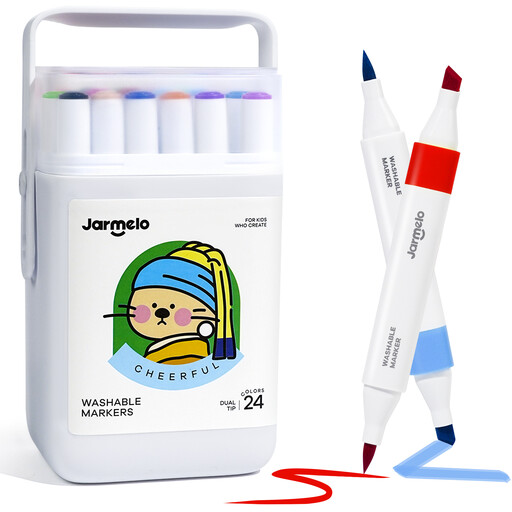
Why this fits the profile: A straightforward set for children and beginners who want to colour, sketch and create simple letters.
The two tip shapes make the set more versatile than one with a single universal tip. According to the product description, the ink is water-based and 90% washable from skin and most fabrics.
24 colours, brush and chisel tip, storage box with handle and ventilated caps.

Why this fits the profile: For adults and artists who want to sketch with alcohol markers and combine colour blocks with fine details.
The set clearly states both functions per marker: a brush tip from 1 to 5 mm and a fineliner tip of 0.6 mm. This means no single tip is responsible for every drawing task.
24 colours, alcohol ink, two tip shapes and a cardboard storage box. Be aware of possible bleed-through on thin paper.

Why this fits the profile: For creative projects on surfaces like wood, canvas, glass or ceramic, where ordinary felt-tip pens aren’t enough.
The product description explicitly mentions multiple surfaces and two tip sizes of 1 and 3 mm. This lets you check beforehand whether the marker suits your project.
6 metallic colours, water-based acrylic ink, ink level indicator and shake-and-pump mechanism.
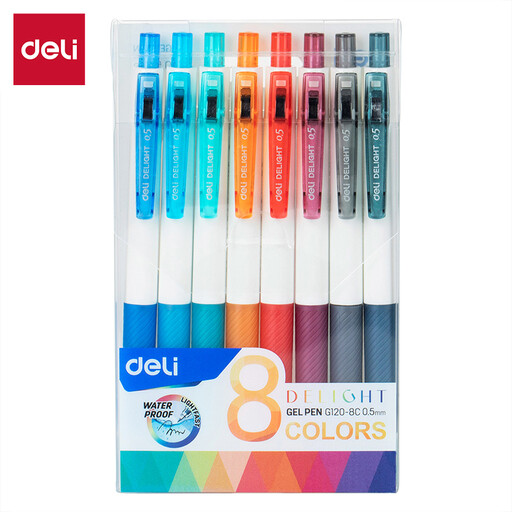
Why this fits the profile: A practical choice for colour-coding, bullet journals, notes and everyday writing on standard paper.
The fixed tip size of 0.5 mm makes the set predictable for small letters. According to the product description, the ink is quick-drying; test the result on your own paper.
8 colours, fine needle tip, rubber grip and suitable for journaling and colour-coding.
We’ve put together a full, up-to-date list of products that fully meet these strict selection criteria and comply with current European safety regulations.
For journaling, gel pens with a 0.5 or 0.7 mm tip are usually the most practical. They offer control for small letters and colour-coding. Choose erasable gel pens if you make changes often, but don’t use them for documents that need to withstand heat over time.
Put the cap back on immediately after use and press it on firmly. Store markers out of direct sunlight and close both caps on dual-tip markers. For acrylic markers, follow the activation instructions on the packaging. If a pen doesn’t write temporarily, test it on scrap paper first instead of pressing down harder.
Alcohol markers are generally intended for sketching and creative applications where bleed-through and odour can be a factor. Always check the recommended minimum age, use the markers in a well-ventilated room, and for younger children choose a product specifically marketed as markers for children.
