
Vandaag of morgen in huis

Kwaliteit gegarandeerd

Welkomstaanbiedingen ontgrendelen: GRATIS bezorging | Tot 80% korting | Gratis 30 dagen JoyPlus-proefperiode
Download de app
Coloured pens are handy for school notes, diaries, creative projects and colour-coding. Yet an attractive pen set can sometimes disappoint in practice. A pen that writes clearly on the packaging may bleed through thin paper, smudge quickly or dry out after a short time.
So don't just focus on the number of colours. The tip size, type of ink, grip and how you store the pens are what really determine whether they remain pleasant to use.
A set with dozens of colours may look like good value, but it often contains many similar shades. For school or the office, you're usually better off with a compact selection of clear colours such as black, blue, red and green. For journaling or drawing, pastel, vintage or metallic shades can be more valuable.
So think about how you'll actually use the colours:
A broad tip gives a clear line, but uses more ink and can bleed through thin paper. A fine tip is suitable for small notes, but may be less comfortable for large areas of colour.
A claim like "smooth writing" doesn't tell you much on its own. It's better to check the line width in millimetres and the type of pen. Coloured felt-tips, coloured ballpoints, gel pens and fineliners each produce a different writing result.
Quick-drying ink can be useful for both left-handed and right-handed users, but the result varies depending on the paper type. Also, a pen that the product description says can be left uncapped for a while will last longer if you do put the cap back on after use.
When buying, look out for:
The tip size determines how much control you have:
A medium tip of 0.7 mm is often a practical middle ground. For small diary boxes or compact school notes, 0.5 mm is more obvious.
Anyone who writes or draws for long periods will quickly notice whether a pen feels comfortable in the hand. A non-slip grip or a triangular barrel can provide extra control. For young children, a thicker, triangular shape can be easier to hold.
Also check whether the pen is retractable. That prevents loose caps on a desk and protects the tip when carrying it in a pencil case.
For children, warnings are important. Various sets state that they are not suitable for children under three years old due to small parts. Always check the recommended age and any CE information in the product description for coloured pens intended for children.
A CE marking is a conformity marking for applicable European requirements; it is not a general assessment of writing quality. Claims about washability or drying time come from the brand's product information. According to STABILO's own information, certain STABILO pens, for example, have washable ink or can be left uncapped for a certain period. Treat this as a product specification and follow the care advice.
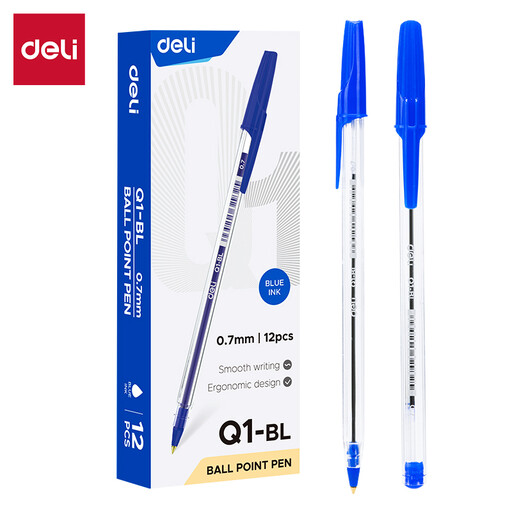
Why this fits the profile: A practical supply for home, school or the office, with twelve blue ballpoint pens for everyday writing.
The specifications are clear: 12 pieces, blue oil-based ink and a bullet tip of 0.7 mm. So you're not paying for unused colour overlap.
12 pens, 0.7 mm tip and retractable cap; suitable for forms, notes and documents.
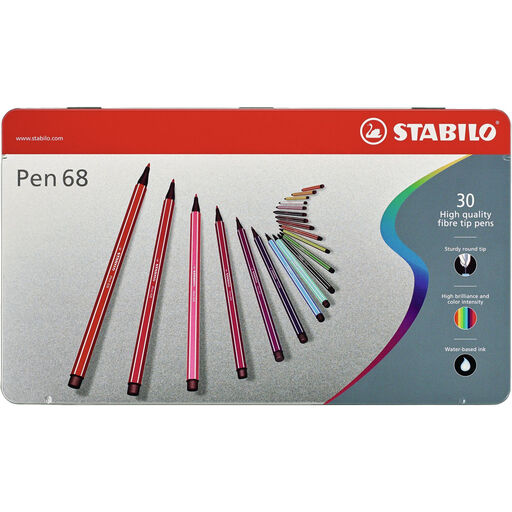
Why this fits the profile: For creatives and hobbyists who want to work with bright colours, a robust tip and watercolour techniques.
The product information mentions a line width of approximately 1 mm and a pressure-resistant tip. This means the set is less focused on broad colour areas alone.
30 colours, water-based and, according to STABILO, suitable for watercolour effects with a wet brush; use thicker paper for this.
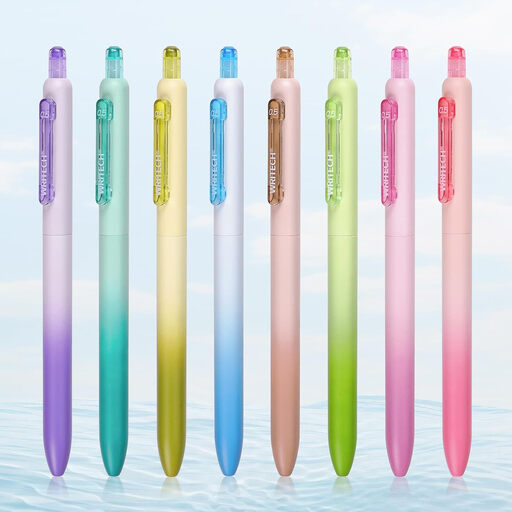
Why this fits the profile: For journaling, small diaries and precise colour-coding where a fine line and a quiet click mechanism are desired.
The 0.5 mm tip limits the line width for details. The retractable design avoids a loose cap; according to the product description, the ink is quick-drying.
8 coloured gel pens, fine 0.5 mm line and a silent click function according to the product description.
We've put together a full, up-to-date list of products that fully meet these strict selection criteria and current European safety regulations.
With a few simple habits, writing and drawing pens will last longer:
For children, sets such as STABILO Trio Scribbi, STABILO power or STABILO Cappi are practical thanks to their thicker shape, colour choice and product information about washable ink. According to STABILO's own information, these features are designed to make colouring and everyday use easier; always check the current packaging and age recommendation.
For journaling, gel pens of 0.5 to 0.7 mm, fineliners and fine rollerball pens are often suitable. Look for quick-drying ink to minimise smudging. Do test the pen on the paper in your notebook, because paper thickness and coating affect the result.
Coloured felt-tips usually give a more vivid colour and are suitable for drawing and larger areas. Coloured ballpoint pens typically use less ink and are more practical for forms, school notes and everyday office work. For very precise lines, you could consider a fineliner or gel pen.
Close the cap properly, retract click pens and follow the specific storage advice. Don't leave a set in a hot car or in direct sunlight for a long time. For children, cap rings, such as on certain STABILO Cappi sets, help prevent loose caps from getting lost so easily.
