
Vandaag of morgen in huis

Kwaliteit gegarandeerd

Welkomstaanbiedingen ontgrendelen: GRATIS bezorging | Tot 80% korting | Gratis 30 dagen JoyPlus-proefperiode
Download de app
Coloured pens and markers may seem simple to choose, but the difference between a useful set and a disappointing purchase often comes down to the details. A fine liner is ideal for notes, but falls short when you need to cover large areas with colour. A marker with striking colours may look appealing, but is not always suitable for textbooks, clothing or thin paper.
For school pupils, students, parents, office professionals and creative users, three potential pitfalls are particularly important:
The nib determines how much control you have. For different writing and drawing tasks, you can use these guidelines:
A metal-clad nib, as found on certain fine liners, can provide extra stability when used with a ruler or stencil. With brush pens, the flexibility of the nib is what matters most.
The type of ink determines drying time, coverage and suitability for each surface.
According to the product description of the Faber-Castell Goldfaber Sketch Marker Set, the alcohol ink is fast-drying, water-resistant and permanent once dry. These are the manufacturer's product specifications; they do not mean that the markers are suitable for every type of paper.
For children, ventilated caps, a suitable age recommendation and clear safety information are important. The STABILO power felt-tip pens are described in the product information as having washable ink and a pressure-resistant nib. According to the manufacturer, the ink can be removed from hands with soap and water, while pre-treatment is recommended for clothing. Treat this as usage guidance, not a guarantee for every fabric.
Also bear the following in mind:
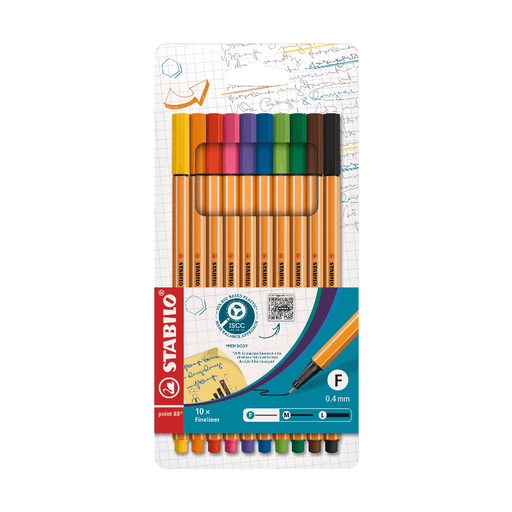
Why it suits this profile: The set of 10 colours is easy to manage for schoolwork, diaries, summaries and simple drawing projects. The 0.4 mm nib is ideal for precise writing.
The fine nib prevents small lettering from becoming cramped. The water-based ink suits many paper applications, but always check that it is suitable for your paper.
0.4 mm line width, metal-clad nib and 10 different colours in a resealable set.
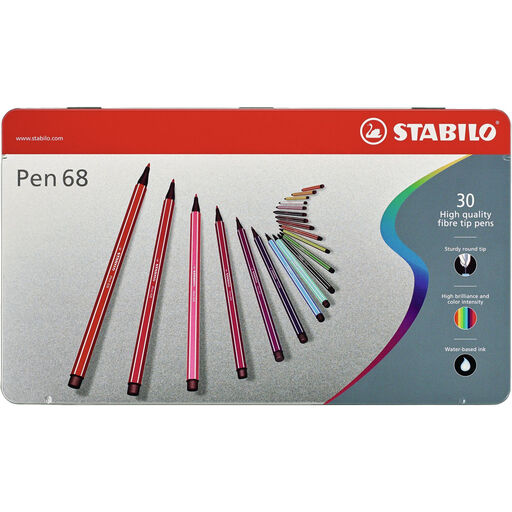
Why it suits this profile: This set is aimed at users who combine colouring, drawing and sketching. The 30 colours offer greater variety for illustrations, cards and creative projects.
The robust nib is designed to distribute ink evenly. For watercolour techniques, the product information recommends using thicker paper.
Water-based ink, an approximately 1 mm line width and a set of 30 colours. According to the manufacturer, the pen can be left uncapped for an extended period without drying out immediately.

Why it suits this profile: These acrylic markers are designed for creative projects on a range of materials, including wood, glass, ceramics, canvas and plastic. They are a good fit for makers who work on more than just paper.
The product description clearly states which surfaces are suitable. This reduces the risk of making the wrong purchase for decoration projects, provided you test the surface beforehand.
Six standard colours, opaque water-based acrylic ink and two nibs measuring 1 and 3 mm. Activate by shaking and pumping.
If you mainly write, gel pens, rollerball pens or coloured pens may be a better choice than broad markers. According to the product description, the WRITECH Liquid Ink Rollerball has a 0.5 mm nib and comes in eight vintage colours. This makes it well suited to journalling, notes and detailed drawing. For red corrections or colour-coding, sets of 0.7 mm gel pens are practical, such as the WRITECH set of 10 red pens.
For younger users, washable felt-tip pens are often the more sensible option. The Faber-Castell Felt-Tip Pens Set contains 12 colours and, according to the product information, has a sturdy nib and ink that can be washed from hands and most fabrics under the specified conditions. When buying for children, always check the recommended age and safety information on the product page.
We have put together a complete, up-to-date list of products that fully meet these strict selection criteria and the applicable European safety regulations.
For school, fine liners measuring 0.4 to 0.5 mm are useful for summaries, diagrams and colour-coding. For younger children, choose felt-tip pens with a sturdy nib and check whether the ink is washable. For everyday writing, gel pens or rollerball pens are usually more practical than acrylic or alcohol markers.
Replace the cap immediately and store the set according to the product instructions. Fine liners and many felt-tip pens remain usable for longer when properly sealed and kept out of direct sunlight. A claim that a pen can remain uncapped for an extended period, as with some STABILO products, comes from the manufacturer's product information and depends on usage and conditions.
They can. Alcohol ink is more fluid and may bleed through thin paper. Place a protective sheet beneath your drawing and use marker paper or another type of thicker paper. For notebooks, diaries and school exercise books, water-based fine liners or coloured pens are often a more suitable choice.
