
Vandaag of morgen in huis

Kwaliteit gegarandeerd

Welkomstaanbiedingen ontgrendelen: GRATIS bezorging | Tot 80% korting | Gratis 30 dagen JoyPlus-proefperiode
Download de app
Coloured pencils may seem straightforward, but the differences between sets often lie in details you only notice once you start drawing. A cheap set may contain lots of colours, yet still be difficult to blend. A metal tin may look practical, but it says nothing about the quality of the core. And a product described as “ergonomic” is not automatically suitable for every hand.
With this buying guide, you can compare coloured pencils based on measurable features, such as the number of colours, core thickness, pencil shape and how you plan to use the set.
A 48-colour pencil set may seem appealing, but more colours do not automatically mean a better drawing experience. For children or beginners, 12 to 24 colours are often easier to manage. If you create lots of shadows, skin tones or landscapes, you may benefit from 36 or 48 individual shades.
Don’t just consider the number of pencils. Also look at:
Coloured pencils with a soft core generally release colour easily and are useful for smooth areas of colour. However, a soft point wears down more quickly and may break under heavy pressure. Check whether the product description provides information about core thickness and core bonding.
For some products, the manufacturer may mention special SV bonding or a break-resistant core. This is a product specification from the brand, not a guarantee that the point will never break under any circumstances. Store pencils in a dry place and avoid dropping them or pressing too hard.
A round wooden barrel can roll away while you are drawing. A hexagonal shape is usually more stable on a desk. A triangular shape can make the pencil easier to hold, particularly for young children or during longer drawing sessions. The choice is personal, so focus on whether the dimensions suit the user.
A set of coloured pencils in a metal tin protects the pencils during transport and makes storage simple. Cardboard packaging is often lighter and may be perfectly adequate for use at a dedicated drawing desk.
Hardness determines how the pencil responds to paper. A softer core releases colour more quickly and is suitable for colouring, layering and soft transitions. A harder core is useful for fine lines and details. Coloured pencils may use designations such as B, HB or a brand-specific classification. Only compare these designations within the context of the product, as the scale may feel different from one brand to another.
Core thickness is also relevant:
You can use watercolour pencils dry, just like ordinary coloured pencils. With a wet brush or waterbrush, you can blend and spread the applied colour. Check that the product description explicitly states that the core is water-soluble. An ordinary coloured pencil core does not automatically become a watercolour pencil simply because the pencil has been coated with water-based lacquer.
For illustrations with visible lines, ordinary coloured pencils are often easier to use. For backgrounds, colour gradients and painterly effects, watercolour pencils are more versatile. Bear in mind that you will need suitable paper and a brush.
For young users, thicker, triangular pencils may be more comfortable to hold. According to the product description, the STABILO Trio thick has a 4.2 mm core and a triangular shape. The Faber-Castell Jumbo Grip range also uses a thicker triangular shape and a Soft-Grip zone. Children above the stated minimum age should still be supervised because of the sharp point and small parts.
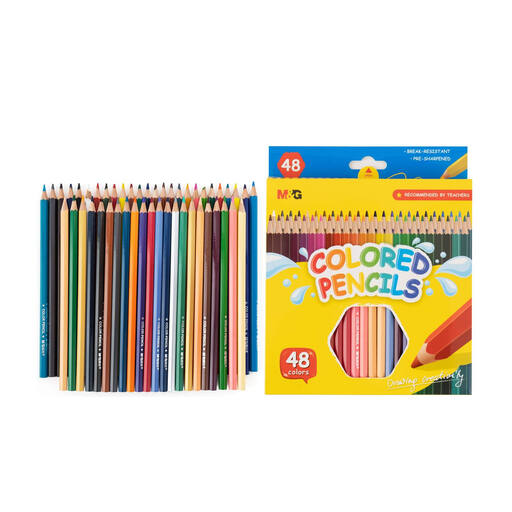
Why it suits this profile: The set offers 48 colours for schoolwork, simple illustrations and first drawing projects. The hexagonal wooden barrel is practical for use at a desk.
You are not limited to working with just a small selection of basic colours. The product description also mentions pre-sharpened, break-resistant cores; use normal pressure to help prevent the points from breaking.
48 individual colours, a hexagonal shape and a wooden barrel. According to the product information, the set is suitable for colouring, sketching and school use.
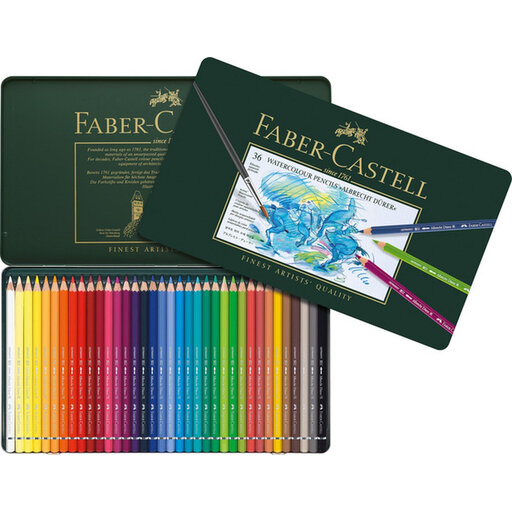
Why it suits this profile: This set combines dry drawing with water-soluble colour. That makes it suitable for adults, students and illustrators who want to explore different techniques.
The product description clearly states that the core is fully water-soluble, has a diameter of 3.8 mm and comes in a metal tin. This makes the features more specific than a general claim of quality.
36 watercolour pencils, a hexagonal shape, certified cedar wood according to the product information, and a metal tin. A waterbrush is not listed for this variant.
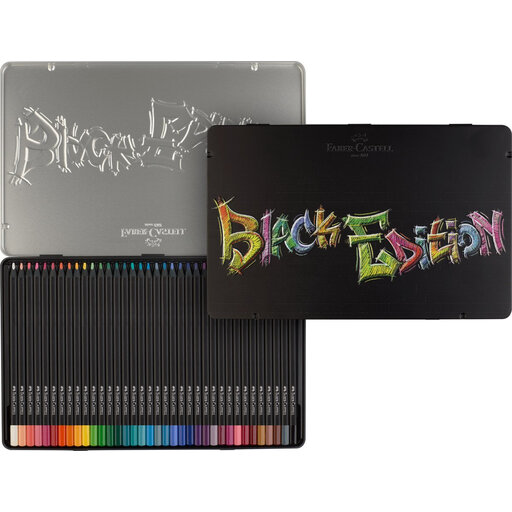
Why it suits this profile: This set is aimed at people who colour regularly and use different types of paper. According to the product description, the pencils are suitable for light, coloured and black paper.
The triangular shape provides a secure grip, while the metal tin prevents loose pencils from rolling around in a bag. The stated SV bonding is designed to help limit core breakage.
36 colours, a 5 mm core, soft colour laydown according to the product description, and a metal tin. No eraser is included.
We have put together a complete, up-to-date list of products that fully meet these strict selection criteria and the applicable European safety regulations.
The lifespan of coloured pencils depends greatly on how they are used. These habits can help prevent unnecessary wear:
For children, it is generally best to choose a thicker, triangular shape with a sturdy core. Also check the recommended minimum age and use a suitable sharpener. The STABILO Trio thick and Faber-Castell Jumbo Grip are examples of models aimed at children’s hands according to their product descriptions.
Ordinary coloured pencils are designed for dry use. Watercolour pencils contain a water-soluble core, allowing you to blend the colours with a wet brush. Always check the product specifications; not every pencil that creates soft lines is water-soluble.
For simple drawings, 12 to 24 colours are enough. A set of 36 or 48 colours offers more possibilities for mixing, shading and creating gradual transitions. Start with a smaller set if you are not yet sure which drawing technique you use most.
